The 1975 European Championships in Skien posed an unfamiliar problem for Soviet gymnastics.
For much of the previous decade, the hierarchy of women’s gymnastics had appeared relatively stable. The Soviet Union remained the dominant force in the sport. Rivals emerged and faded, but the broader order endured. Then, in May 1975, a thirteen-year-old Romanian named Nadia Comăneci arrived in Norway and defeated the Soviet stars.
Soviet coaches were already quite familiar with Comăneci, and Sovetsky Sport, the official sports newspaper of the USSR, had been following her progress before the European Championships. What makes the newspaper’s coverage worth reading is not its evaluation of her talent but the discussion her victory provoked. The European Championships did not settle a debate. They started one.
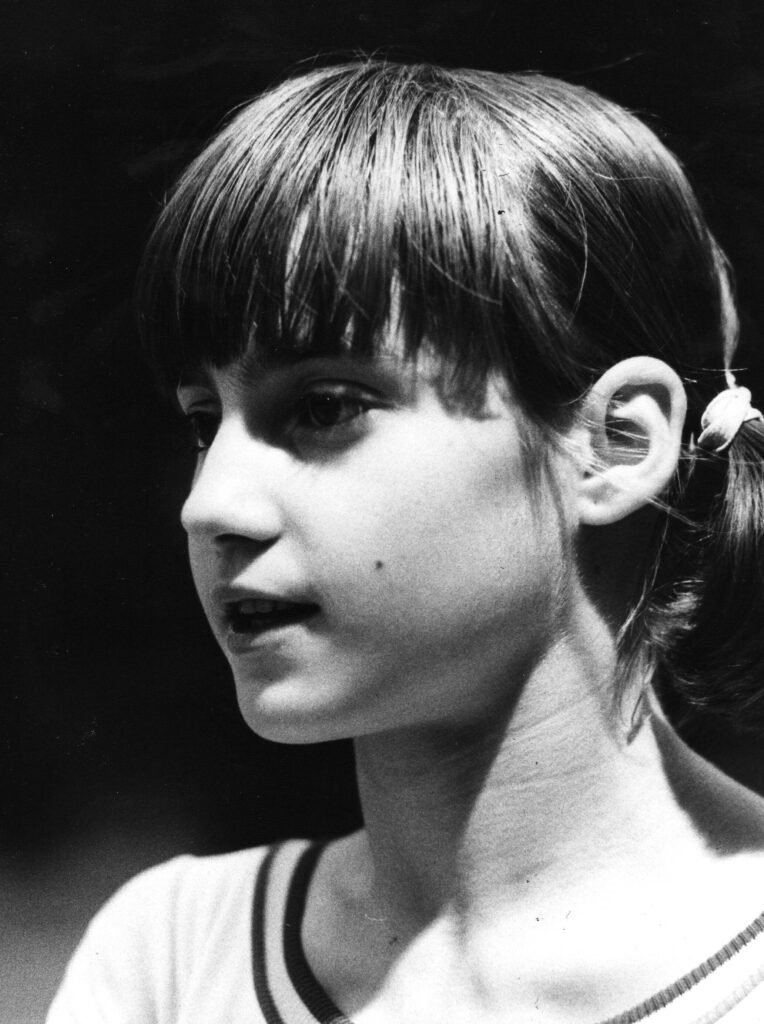
Note: This photo is not from the European Championships.
“Nadia or Ludmilla?”
When Sovetsky Sport correspondent Mikhail Suponev arrived in Skien, he found local newspapers framing the championship around a simple question:
“Nadia or Ludmilla?”
Sovetsky Sport, May 3, 1975
On one side stood Ludmilla Tourischeva, Olympic champion, world champion, and the most accomplished gymnast in Europe. On the other stood Nadia Comăneci, a Romanian teenager whose reputation had been growing steadily through junior competitions and international tournaments.
Suponev quoted junior national team coach, Ludmilla Ivanova:
“I’ve known Comăneci for more than a year now. And I’m certain that this very young gymnast will achieve great things in our sport. She has practically no weak spots. Her program is fully up to contemporary standards in terms of difficulty. Her uneven bars routine is virtuosic.”
Sovetsky Sport, May 3, 1975
Soviet specialists already regarded Comăneci as one of the sport’s most promising young athletes. Yet Ivanova’s praise contained an important qualification:
“I think she still lacks a certain emotionality and lyricism, which naturally shows most in her floor exercise.”
Sovetsky Sport, May 3, 1975
The assessment did not stand for long.
“This Is Already a Different Comăneci”
Questions about Comăneci’s artistry on floor were not limited to the Soviet press. A month before the European Championships, Britain’s Observer had described her as the sport’s newest sensation, predicting that “give her another year or two and there may be no confining the exquisite talent of this tiny Romanian girl.” Yet even that article framed her against a familiar contrast. The Soviets were still regarded as the more artistic gymnasts. Ludmilla Savina’s floor exercise was judged “technically and artistically more perfect, more graceful.”
Despite her shortcomings, Comăneci won the all-around anyway. David Hunn acknowledged that Savina possessed greater polish, but he still found something irresistible in the Romanian gymnast’s performance. “There is in this sport a special place reserved for magic,” he wrote, “and that is what little Nadia possesses.”
When Soviet coaches arrived in Skien a few weeks later, they encountered a gymnast who no longer fit the familiar distinction between Romanian difficulty and Soviet artistry. After watching Comăneci train, Vladislav Rastorotsky concluded that the criticism no longer held:
“In my view, people were wrong about Comăneci. Her floor exercise is remarkable, too. In short, the championship is going to be very hard for us.”
Sovetsky Sport, May 3, 1975
The significance of the remark lay in what it implied. Soviet coaches believed they had identified a weakness in Comăneci’s gymnastics. Now they were watching it disappear. Journalist Suponev credited that transformation to the work of her coach, Béla Károlyi:
“The Romanian coaches, and in particular Comăneci’s coach — the tall, athletically built Béla Károlyi — understood perfectly well that in order to win the all-around, Comăneci needed to eliminate the weak link in her preparation. And apparently the time before the championship was devoted primarily to choreographic training and to improving the content of her floor exercise specifically.”
Sovetsky Sport, May 3, 1975
After seeing her in Skien, even Ivanova revised her earlier assessment:
“This is already a different Comăneci.”
Sovetsky Sport, May 3, 1975
What impressed Soviet observers was not merely Comăneci’s talent but the speed of her development. She was improving rapidly, correcting weaknesses, and expanding her repertoire in ways that were difficult to ignore.
The question was no longer whether she was gifted. The question was how much better she might become.
The Day Nadia Was Better
When the all-around competition began, the drama initially centered on the Soviet team.
Nelli Kim performed well despite a few difficulties on balance beam. Sovetsky Sport praised her composure on an apparatus where deductions were almost unavoidable:
“N. Kim handled even this treacherous apparatus superbly, boldly performing the Korbut salto, landing motionless on the narrow beam, and confidently completing the routine.”
Sovetsky Sport, May 3, 1975
Her score of 9.55 was considered strong, and the newspaper ultimately concluded that “Kim can count her performance at the European Championships as the finest of her athletic career.”
Ludmilla Tourischeva’s competition unfolded differently. Errors on both uneven bars and balance beam left her well behind her usual standard. On bars, a slip of the foot nearly caused a fall and resulted in a score of just 9.35. On beam, she again lost her balance during a series of rolls and managed to stay on the apparatus only through what the newspaper described as sheer determination.
The Soviet camp attributed those mistakes to circumstances that had little to do with Skien itself. Tourischeva had spent much of the winter recovering from injury. Her coach, Vladislav Rastorotsky, explained:
“Over the winter, we lost three full months of training due to injury. We only really began preparing for the European Championships in March. It seemed like everything was going normally and that Lyuda would arrive at the championships in form. But now I feel that she was still two or three weeks short. And before this we absolutely should have competed somewhere. Because even with enormous experience you still need to restore your competitive edge.”
Sovetsky Sport, May 3, 1975
None of these explanations changed the result. Comăneci won, and she did it in stellar fashion.
The full extent of Tourischeva’s physical condition would not become public until 1986, when she revealed that she had spent the spring recovering from a fractured vertebra. In Skien, however, neither spectators nor journalists had access to that knowledge. What they saw instead was a Romanian gymnast performing at a level that forced a reassessment of the sport’s hierarchy.
Suponev’s account leaves little doubt about the quality of Comăneci’s performance. Her uneven bars routine was described as:
“a new word in gymnastics.”
Sovetsky Sport, May 3, 1975
She invented a whole new way of expressing gymnastics. The only visible error was a slightly imprecise landing on her dismount. The audience reaction, he wrote, could be compared only to the reception that greeted Olga Korbut’s famous loop at the Munich Olympics.
Comăneci’s superiority extended beyond bars. On vault, she outperformed Nelli Kim, who would go on to win the Olympic vault title the following year. Both gymnasts performed the same vault, but Suponev saw a clear difference:
“Nelli executed her piked Tsukahara cleanly enough and landed steadily. But of course the judges had before them the same vault as performed by Comăneci, and hers won on both height and distance of flight.”
Sovetsky Sport, May 3, 1975
Suponev’s conclusion was straightforward:
“One simply has to accept that on this particular day Nadia Comăneci — an unquestionably talented gymnast — was stronger than her rivals.”
Sovetsky Sport, May 3, 1975
It is, in some respects, a backhanded compliment. The formulation leaves open the possibility that, on another day, the outcome might have been different. But the more revealing qualification came in the sentence that followed:
“But hardly anyone would argue that a new undisputed leader has emerged in world women’s gymnastics.”
Sovetsky Sport, May 3, 1975
Olympic Anxiety
The most interesting Soviet reaction to Skien appeared not in the championship report itself but in the debate that followed.
Several weeks later, Olympic champion Olga Karaseva published a lengthy essay titled “Olympic Anxiety.” On the surface, the article discussed European Championship results. In reality, it was about the state of Soviet gymnastics.
Karaseva challenged what she saw as an overly simple explanation of Comăneci’s victory:
“People are saying that Nadia Comăneci won the European Championship on the strength of exceptional difficulty.”
Sovetsky Sport, May 24, 1975
She disagreed.
“Comăneci had exactly the same number of superior difficulty groups as Tourischeva.”
Sovetsky Sport, May 24, 1975
The difference, Karaseva argued, lay in Comăneci’s virtuosity:
“The key point is that Comăneci performed the most spectacular elements—and the Romanian had more of these spectacular elements—at the very highest level.”
Sovetsky Sport, May 24, 1975
Yet Karaseva’s essay quickly moved beyond Comăneci herself. She used the European Championships to reflect on broader questions of development: the temptation to rush young athletes into senior competition, the risks of prioritizing spectacular difficulty over lasting mastery, and the possibility that Soviet gymnastics might be overlooking emerging weaknesses beneath its apparent depth.
The resulting argument was not simply about one Romanian gymnast. It was about competing visions of how champions should be made. Comăneci and Károlyi represented one model: rapid progress, early specialization, and extraordinary competitive success. Karaseva countered with a case for patience, artistry, and long-term development.
But we also want to see gymnasts who are artistic, capable of creating an artistic image. And to create an image, to live by feeling on the floor and learn to convey those feelings to the audience — for that one must mature, must earn one’s “own gymnastics” through suffering…
Sovetsky Sport, May 24, 1975
Comăneci was not merely the subject of the debate. She was its catalyst.
A Debate Worth Having
The significance of Karaseva’s essay becomes clearer when one reads the editorial note that accompanied it.
FROM THE EDITORS. Some positions in O. Karaseva’s article are, in our view, debatable and open to discussion. The relative disappointment of Soviet gymnasts at the European Championship, the emergence of new talented names on the European and world stage — all of this will compel our coaches to undertake a “revaluation of values” in preparing future Olympians. We invite specialists and all interested parties to share their views on the problems of women’s gymnastics on the eve of the Olympics.
Sovetsky Sport, May 24, 1975
The newspaper was not presenting Karaseva’s perspective as settled truth. It openly acknowledged that Soviet gymnastics faced problems worth debating. The editors spoke of a “relative disappointment” at the European Championships and argued that the emergence of new talent would require a “revaluation of values” in Olympic preparation. Rather than prescribing a solution, Sovetsky Sport invited coaches, specialists, and readers to participate in the discussion.
The concern itself was hardly concealed. Soviet gymnastics had been beaten. New challengers were emerging. Existing assumptions were being questioned. With only a year remaining before the Montréal Olympics, the search for answers had acquired a new urgency.
That may have been the most important consequence of Skien. Comăneci did not simply win the European Championship. Her victory helped trigger a public conversation about the future direction of Soviet gymnastics.
Notes
1. Comăneci had faced the Soviets at several competitions before the 1975 European Championships, including dual meets in 1972 and 1973.
2. I rely heavily on reports published in Sovetsky Sport because it was the official newspaper of the State Committee for Physical Culture and Sports of the USSR, making it one of the most authoritative sources on Soviet sport.
3. In English, Olga Karaseva is also known by the surnames Kharlova, Karasyova, and Kovalenko. In 1973, she began sounding the alarm about Comăneci in the pages of Sovetsky Sport.
Appendix: Karaseva’s Essay
OLYMPIC ANXIETY
FIND ONE’S OWN STYLE
HOW TO PRESERVE THE TALENT OF THE YOUNG ● ON DIFFICULTY THAT DOES NOT ALWAYS DO GOOD ● DEEP CONTENT IN EXERCISES — THE ESSENCE OF GYMNASTICS ● ON THOSE PREPARING FOR BATTLE IN MONTREAL
We know that our reserves and depth in women’s gymnastics are solid and dependable. If, say, two Soviet women’s teams were sent to the World Championships, both would likely contend for first place. Right now all twelve gymnasts of the senior national team, and many from the junior squad, could perform successfully at the most demanding tournament. I am not exaggerating in the least — this assertion is based on an analysis of the skill levels of the World Championship participants.
By tradition, this season too we follow the debuts of newcomers to the senior floor with great interest. Some competed for the first time at the senior level at the national Cup in Leningrad, others are preparing for the Spartakiad starts. Gymnasts are now admitted to senior competition at 15, and coaches can barely contain their anticipation of that day. Specialists too await encounters with young talents impatiently.
Talents?.. Is every new gymnast a brilliant talent? Of course not. Not every one. But well-prepared, capable athletes are emerging in numbers — coaches have mastered the most advanced methods of developing gymnasts of high international class.
But do we have gymnasts whose performances fill you with such joy that they bring tears to your eyes? Among the young, the newer generation, I would single out for now only Lida Gorbik. She has not only outstanding gymnastics ability — she has a God-given gift for self-expression, a soul…
This is why I have raised the subject. The technical execution of all our debutantes is sufficiently high. One cannot complain — coaches have learned to instill correct technique. At the USSR Cup, 15-year-old girls were able to hold their own in individual events even against celebrated senior gymnasts.
I continue to “compete” at meets, but now in the capacity of a judge. And I see that the gymnasts who have come closest to the ideal we, judges, hold in our minds are Tourischeva, Korbut, Saadi, Dronova, Gorbik… And what these gymnasts possess — artistry, spiritual depth — we judges must and will reward.
Are we rushing, eager to see our pupils among the world’s famous athletes too soon? Are we forcing events? Yes, they are all technically accomplished for their age — the Muscovites Nadya Nikiforova and Sveta Pozigun, the Rostov girls Larisa Kalachinskaya and Lyuba Yudina. But they lack the inner maturity that will, of course, come to them later. Yes, special attention is paid to gymnasts with the most polished technique (personally I consider Lyuda Tourischeva’s technique to be the most rational: she is able to perform elements of any difficulty at maximum amplitude and precisely shows the key positions of each movement). But we also want to see gymnasts who are artistic, capable of creating an artistic image. And to create an image, to live by feeling on the floor and learn to convey those feelings to the audience — for that one must mature, must earn one’s “own gymnastics” through suffering…
At the national Cup, I was pleasantly surprised by the performances of Ludmilla Savina from Minsk, Elena Kolesnikova from Voroshilovgrad, and Elena Primak from Chelyabinsk (both Elenas also performed well at the international “Riga-75” competition).
Savina did not shine in last season, though three years ago she was named among the most gifted Olympic prospects. She went through a decline, caused, it seems to me, by the difficulties of adolescence. She is a lyrical, gentle girl — she reminds me somewhat of Tanya Shchelbukova, Rusiko Sikharulidze. Lyuda has grown up. And now, in a time of promise, she has found her own gymnastics through hard experience. Her hour has come. I am certain: Savina will now move forward creatively. And how important it was during that period of “disappointments” not to overdo the workloads, not to apply excessive “psychological pressure.” Her tactful coach Lyubov Miromanova understood everything and guided her pupil carefully through the dangerous reefs.
Kolesnnikova and Primak have blossomed; each is developing an individual style, their programs are being modernized, and what is visible now is not merely ‘difficulty alone,’ as was the case a year ago, but the most important thing in gymnastics, its very essence — the profound expressive content of the exercises.
Who could have joined the sport’s elite at an early age? Dronova? Yes. Gorbik? Yes. Ira Tsarik? Probably yes too. But Savina, perhaps, simply needed to wait for her time to come, and the Muscovite Marina Lev needs to wait another year (despite finishing sixth at the Cup). A pattern has been noticed: the very youngest love to dazzle audiences with ultra-difficult elements. Lyuba Yudina, for instance, showed a triple twist on floor exercise. A record-setting trick! Yet another proof that there is no limit to difficulty in gymnastics. And we certainly need such “experiments.” But Yudina is currently in 17th place in the all-around. Difficulty, after all, is far from being the measure of class. Behind it, I repeat, must stand deep content.
The patience of coaches — the ability to resist rushing to harvest the fruit — is therefore of paramount importance now. Talented girls appear like mushrooms after rain. But through coaching impatience we lose many, even very gifted, gymnasts. One must develop a fine sense for predicting the precise right “moment” for young girls to enter senior gymnastics. I would remind less experienced coaches: handle youth with care!
At the national Cup and at the Moscow News competition, my attention was drawn to members of the junior squad — Antonina Glebova from Leninsk-Kuznetsky, Tamara Kazanina from Voronezh, Leningrader Olga Koval. At the Riga tournament — Alla Zelenko from Minsk, Kolesnikova, Primak, Sveta Kudinova from Vitebsk. Kolesnikova and Kudinova will soon be 17, while Olya Koval is not yet 14.
Different schools are represented. Kazanina — the school of Yu. E. Shtukman; Glebova — the school of I. I. Mametyev; Zelenko — the school of V. S. Khomutov; Kudinova — the school of V. D. Dmitriev. The schools differ, but the general direction is unified, leading toward the development of those qualities I spoke of above. Even among advocates of ultra-difficulty — Shtukman and Mametyev — the difficulty itself is “softened” in Glebova’s exercises by a decent choreographic culture and thoughtfully constructed compositional architecture.
But on the other hand, without the search for ever-more-difficult elements in modern gymnastics, even possessing remarkable artistry, one risks losing the role of leader. Take Nina Dronova, who in the Riga final reverted on vault to the old, reliable Yamashita. But clarity of execution is no longer enough here — judges demand difficulty. Nina “saved the situation” with an elegant twisting vault — she does have reserves.
As it turned out, Alla Zelenko performed her floor exercise to new music that suited her combination perfectly. Top score, first place. And Larisa Latynina rightly observed: “The accompaniment is wonderful and the choreography is successful. But did you forget the double pirouette? That is an achievement, that is an adornment of the exercise… Yes, one must never forget about difficulty…”
Now people are saying that Nadia Comăneci won the European Championship on the strength of exceptional difficulty. But she had exactly the same number of superior difficulty groups as Tourischeva. The key point is that Comăneci performed the most spectacular elements — and the Romanian had more of these spectacular elements — at the very highest level. Yes, Comăneci is a unique phenomenon in gymnastics. And our coaches must pay special attention to the search for those connections and elements with which one can bring judges and spectators to rapture. However, I am convinced that it will be virtuosic, not trick-based, execution that will continue to constitute the essence of gymnastics.
Olga KARASEVA, Honored Master of Sport.
Editorial Note
FROM THE EDITORS. Some positions in O. Karaseva’s article are, in our view, debatable and open to discussion. The relative disappointment of Soviet gymnasts at the European Championship, the emergence of new talented names on the European and world stage — all of this will compel our coaches to undertake a “revaluation of values” in preparing future Olympians. We invite specialists and all interested parties to share their views on the problems of women’s gymnastics on the eve of the Olympics.
Sovetsky Sport, May 24, 1975
ОЛИМПИЙСКОЕ БЕСПОКОЙСТВО
ИСКАТЬ СВОЙ ПОЧЕРК
КАК СОХРАНИТЬ ТАЛАНТ ЮНЫХ ● О СЛОЖНОСТИ, КОТОРАЯ НЕ ВСЕГДА ИДЕТ НА ПОЛЬЗУ ● ГЛУБОКОЕ СОДЕРЖАНИЕ УПРАЖНЕНИЙ — СУТЬ ГИМНАСТИКИ ● О ТЕХ, КТО ГОТОВИТСЯ К СРАЖЕНИЯМ В МОНРЕАЛЕ
Мы знаем, что наши тылы и резервы в женской гимнастике прочны и надежны. Если бы, скажем, на чемпионат мира поехали две наши женские команды, то, вероятно, обе были бы на высоте положения. Сейчас все двенадцать спортсменок основной сборной и многие гимнастки из молодежной могли бы успешно выступить на самом ответственном турнире. Я нисколько не преувеличиваю, это утверждение основывается на анализе мастерства участниц мирового первенства.
По традиции и в этом сезоне мы с интересом следим за дебютантами большого помоста. Одни впервые выступили на взрослых соревнованиях на Кубке страны в Ленинграде, другие готовятся к спартакиадным стартам. С 15 лет допускаются теперь на взрослые состязания гимнастки, и, понятное дело, тренеры ждут не дождутся этого дня. И специалисты тоже с нетерпением ожидают встреч с юными талантами.
Талантами?.. Неужели каждая новая гимнастка — яркий талант? Конечно, нет. Не каждая. Но хорошо подготовленных, способных спортсменок появляется много — тренеры овладели самыми передовыми методами воспитания гимнасток высокого международного класса.
Ну, а есть ли у нас такие гимнастки, от выступления которых приходишь в неописуемый восторг и даже плакать хочется — так трогает? Из молодых, из юного поколения я бы выделила пока только Лиду Горбик. У нее не только выдающиеся способности к гимнастике, у нее есть природой данное умение самовыражаться, душа есть…
Вот к чему я завела этот разговор. Техника исполнения у всех наших дебютанток достаточно высока. Ничего не скажешь — научились наставники ставить правильную технику. На Кубке СССР 15-летние девочки могли поспорить в отдельных случаях и с именитыми мастерами.
Я продолжаю «выступать» на соревнованиях, но уже в качестве судьи. И вижу, что ближе всего к идеалу, существующему в нашем судейском воображении, приблизились по мастерству Турищева, Корбут, Саади, Дронова, Горбик… И то, чем обладают эти гимнастки — артистизм, одухотворенность, — мы, судьи, должны и будем поощрять.
Не спешим ли мы, стараясь поскорее увидеть своих учеников среди всемирно известных спортсменок? Не торопим ли события? Да, они все достаточно техничны для своего возраста — и москвички Надя Никифорова, Света Позигун, ростовчанки Лариса Калачинская, Люба Юдина. Но у них нет внутренней зрелости, которая, конечно же, придет к ним позже. Да, особое внимание обращается на гимнасток, обладающих наиболее совершенной техникой (лично я считаю, что самая рациональная техника у Люды Турищевой: она умеет выполнять любые по трудности элементы на максимальной амплитуде и очень четко фиксирует так называемые «мертвые точки» движений). Но мы еще и хотим видеть гимнасток артистичных, умеющих создавать художественный образ. А чтобы создавать образ, жить на помосте чувствами и научиться доносить их до зрителя, — для этого надо созреть, выстрадать «свою гимнастику»…
На Кубке страны меня приятно удивили выступления минчанки Людмилы Савиной, Елены Колесниковой из Ворошиловграда, Елены Примак из Челябинска (обе Лены удачно выступали и на международных соревнованиях «Рига-75»).
Савина в прошлом сезоне явно не блистала, хотя три года назад эту гимнастку называли в числе самых одаренных олимпийских надежд. У нее был спад, вызванный, как мне кажется, возрастными причинами. Девушка она лиричная, мягкая, чем-то напоминает Таню Щелкубову. Русико Сихарулидзе. Люда повзрослела. И вот в пору надежд она выстрадала «свою гимнастику». Пробил и ее час. Я уверена: Савина теперь пойдет вверх в творческом смысле. А как важно было в этот период «разочарований» не переборщить с нагрузками, с «психологическим нажимом». Тактичный тренер Любовь Миромановa все понимала и осторожно вела свою ученицу сквозь опасные рифы.
Колесникова и Примак похорошели, каждая обретает индивидуальный почерк, их программа модернизируется, где видна не только «одна сложность», как год назад, но и главное в гимнастике, ее суть — глубокое содержание упражнений.
Кому можно было появиться в солидной компании в раннем возрасте? Дроновой? Да. Горбик? Да. Ире Царик? Пожалуй, тоже да. А Савиной, может, надо было выждать время «в свое время», и москвичке Марине Лев годик подождать (несмотря на то, что заняла она на Кубке шестое место). Замечена закономерность: самые юные любят потрясать зрителей сверхсложными элементами. Скажем, Люба Юдина показала на вольных тройной пируэт. Рекордный трюк! Еще одно доказательство того, что предела сложности в гимнастике нет. И нам такие «эксперименты», безусловно, нужны. Но у Юдиной пока 17-е место в многоборье. Ведь сложность — это еще далеко не показатель класса. За этим, повторю, должно стоять глубокое содержание.
Поэтому выдержка тренеров, умение не торопиться срывать плоды приобретает сейчас главное значение. Способные девочки появляются, как грибы после дождя. Но из-за тренерской поспешности мы многих, даже очень способных, гимнасток теряем. Необходимо тонко предугадывать точную «дату» вступления юных девочек в большую гимнастику. Хотелось бы напомнить неопытным еще тренерам: осторожно — молодость!
На Кубке страны и на состязаниях на приз газеты «Москоу ньюс» мое внимание привлекли члены молодежной сборной — Антонина Глебова из Ленинска-Кузнецкого, Тамара Казанина из Воронежа, ленинградка Ольга Коваль. На турнире в Риге — минчанка Алла Зеленко, Колесникова, Примак, Света Кудинова из Витебска. Колесниковой и Кудиновой скоро будет 17, а Оле Коваль и 14 еще нет.
Разные школы представлены. Казанина — школа Ю. Э. Штукмана, Глебова — школа И. И. Маметьева, Зеленко — школа В. С. Хомутова, Кудинова — школа В. Д. Дмитриева. Школы разные, а общее направление единое, ведущее к развитию тех качеств, о которых я говорила выше. Даже у сторонников сверхсложности — Штукмана и Маметьева — эта самая сложность «скрадена» в упражнениях Глебовой неплохой хореографической культурой, продуманными композиционными построениями.
Но, с другой стороны, без поиска элементов «ультраси» в современной гимнастике, даже обладая удивительным артистизмом, можно потерять роль лидера. Вот, скажем, Нина Дронова в финале в Риге вернулась в опорных прыжках к старой, доброй «ямасите». Однако и четкость здесь уже не помогает — судьи требуют сложности. Нина «спасла положение» изящным «винтом» — запас у нее все-таки есть.
Так получилось, что вольные упражнения Алла Зеленко исполняла под новую музыку, которая очень подошла к ее комбинации. Высшая оценка, первое место. А Лариса Латынина справедливо заметила: «И аккомпанемент замечательный, и постановка удачная. А про двойной пируэт забыли? Это ведь достижение, это украшение упражнений… Да, про сложность забывать никак нельзя…».
Вот сейчас говорят, что Надя Команечи победила на чемпионате Европы за счет исключительной сложности. Но у нее было столько же групп высшей трудности, как и у Турищевой. Главное здесь то, что Команечи исполняла самые эффектные элементы (а этих эффектных элементов у румынки было больше) на высочайшем уровне. Да, Команечи — явление в гимнастике уникальное. И наши тренеры должны особое внимание обратить на поиск таких связок и элементов, с помощью которых можно привести в восторг судей и зрителей. Однако я убеждена, что не трюковое, а виртуозное исполнение будет по-прежнему составлять суть гимнастики.
Ольга КАРАСЕВА, заслуженный мастер спорта.
ОТ РЕДАКЦИИ. Некоторые положения статьи О. Карасевой, на наш взгляд, спорны, дискуссионны. Относительная неудача советских гимнасток на чемпионате Европы, появление новых талантливых имен на европейской и мировой аренах — все это заставит наших тренеров произвести «переоценку ценностей» в подготовке будущих олимпийцев. Мы приглашаем специалистов, всех заинтересованных лиц высказаться по проблемам женской гимнастики в преддверии Олимпиады.
More on the European Championships
One reply on ““This Is Already a Different Comăneci”: How the USSR Reacted to Nadia Comăneci in Skien”
Savina was very unlucky not to beat Nadia at Champions All in London in 1975. A botched vault at the start of the competition cost Ludmila Savina of the USSR the gold although she came back to outscore Nadia on bars and beam. Frank Taylor, Daily Mirror, April 14, 1975, “ When the final round – the floor exercises started – Savina had 27.65 points, the Romanian 27.6. The crowd gasped as Nadia put a foot outside the square. How much would she be penalised for that fault ? The judges – kindly I thought – gave her an incredible mark of 9.7. Out came Savina with a superb exhibition. She was marked down at 9.45. Nick Stuart our National coach thought the Russian girl was a little unlucky. He said I thought Savina got fewer marks than she deserved on the beam and asymmetric bars”
Another reporter noted “Nadia’s mark of 9.7 and the subsequent marking down of her Russian rival can be attributed to sheer emotional involvement and audience intimidation”.
As the Observer newspaper stated Savina’s floor exercise was judged “technically and artistically more perfect, more graceful”.
A defeat at Champions All would have been a rare hiccup for Nadia as she appears to have won every AA competition she entered from 1974-77. While most were minor meets she won each of the big 4 she competed in (Olympics, Pre-Olympics, 2 European Championships).
After her victory at the 1973 Dual meet (Juniors) USSR v Romania the Soviet coach said “This girl is better than Olga Korbut was at her age”. After her success in Skien the Soviet press called her “The most brilliant” gymnast of the new generation. Sovietsky Sport published a piece which was reprinted in full in Romania. Part of it said ” we know that Nadia Comaneci’s exercise on the uneven bars ushered in something new in gymnastics. We will not list the elements of her routine since they will be named after their inventor. One thing may be said however : Nadia is amazing”. Galina Shamrai (1954 AA World Champion) wrote “Now, many are saying that the Romanian Nadia Comaneci won the European Championships and the Pre-Olympics with super-difficult elements. This is a misconception. Yes, Comaneci’s combinations are very impressive but they are performed with the highest level of virtuosity. Her main thing is not the trick, but purity.”. After the Olympics Ellen Berger, East Germany, Head of the F.I.G women’s technical committee noted “Nadia’s performance was unique and unbeatable”. The USSR magazine Sovietski Sport wrote “Comaneci is today indeed the greatest gymnast in the world because she embodied in her program everything modern gymnastics required – complexity, risk, masterly style, emotional elan”. TASS – the Soviet news agency – declared her sportsperson of the year in 1976.