Categories
1975 East Germany European Championships Romania WAG

“She Knows She Is Good”: An East German View of Nadia Comăneci in 1975

Even before Nadia Comăneci’s legendary performances at the 1976 Montreal Olympics, East German gymnastics officials had taken careful note of the Romanian teenager. Ellen Berger, the East German national team coach and a member of the FIG’s Women’s Technical Committee, was characteristically measured when asked whether Comăneci’s near sweep of the 1975 European Championships had surprised her. “No,” she said flatly. “We knew Nadia and were aware of her capabilities.” The sensation, Berger explained, was partly an artifact of the FIG’s age regulations, which had kept Comăneci off the international stage until the year she turned 14 — meaning the wider gymnastics world had simply not yet had the chance to see her.

What Berger did not withhold was her admiration for the quality of the performance itself. Comăneci ‘s routines, she observed, were extraordinarily difficult and executed with total confidence. More striking still was her psychological makeup: “She knows she is good, and nothing bothers her — not the audience, not her competitors, nothing at all.” Her one caveat was equally revealing: a single competition, she insisted, could not support sweeping conclusions. Ludmilla Tourischeva, she noted pointedly, remained one of the best gymnasts in the world. The subtext was clear — East Germany was not yet ready to concede the future to Romania.
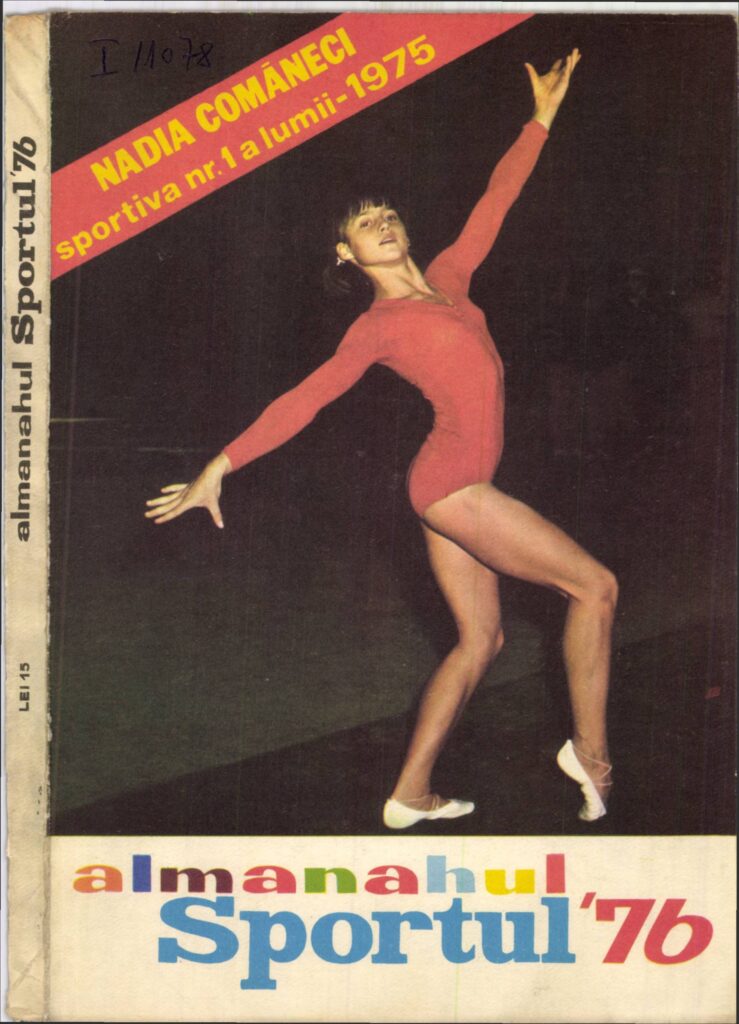

Nadia Comăneci on the cover of Sportul‘s 1976 Almanac. Sportul was Romania’s main sports newspaper. The 1976 almanac covered the events of 1975.
Categories
1975 European Championships Romania USSR WAG

“This Is Already a Different Comăneci”: How the USSR Reacted to Nadia Comăneci in Skien

The 1975 European Championships in Skien posed an unfamiliar problem for Soviet gymnastics.

For much of the previous decade, the hierarchy of women’s gymnastics had appeared relatively stable. The Soviet Union remained the dominant force in the sport. Rivals emerged and faded, but the broader order endured. Then, in May 1975, a thirteen-year-old Romanian named Nadia Comăneci arrived in Norway and defeated the Soviet stars.

Soviet coaches were already quite familiar with Comăneci, and Sovetsky Sport, the official sports newspaper of the USSR, had been following her progress before the European Championships. What makes the newspaper’s coverage worth reading is not its evaluation of her talent but the discussion her victory provoked. The European Championships did not settle a debate. They started one.

Nadia Comăneci, July 1975. Copyright: imago/Pressefoto Baumann

Note: This photo is not from the European Championships.
Categories
1975 Code of Points WAG

1975: The Women’s Code of Points

In 1975, the Women’s Technical Committee published a new version of the Code of Points. Below, you’ll find some of the updates, as well as the complete English text.

Happy gym nerding!


In Some Ways, Execution Started to Matter More in 1975.

Compared to the 1970 Code of Points, the 1975 Code of Points put slightly more emphasis on execution, making it worth 5.0 points (rather than the previous 4.0 points).

19701975
Composition of
Exercise
6.00 Total5.00 Total
-Value
of Difficulty*
4.003.00
– Originality and
Value of Connections
1.501.50
– Value of General
Composition
0.500.50
Execution4.00 Total5.00 Total
Execution and
Amplitude
1.50 for execution
1.50 for amplitude
4.00
– General
Impression
1.001.00

But More Elements of Superior Difficulty Were Required in 1975.

19701975
4 elements of
medium difficulty
(0.50 each element)
4 elements of
medium difficulty
(0.30 each element)
2 elements of
superior difficulty
(1.0 each element)
3 elements of
superior difficulty
(0.60 each element)

Related: According to the 1975 Code of Points, the “final phase should contain an element or acrobatic series of superior difficulty” on floor exercise.


Changes to Vault

  • During optionals, two different vaults had to be performed.
  • During vault finals, two different vaults with turns had to be performed, one of which must have at least a ½ turn. Both vaults must be valued at 10.0 points.
    • In other words, gymnasts could not perform a handspring + front tuck in finals because the vault did not have a turn.
    • They could, however, perform a tucked Tsukahara and a piked Tsukahara because both vaults had turns and were out of a 10.0.
    • Note: This rule was edited in 1978, and the turn requirements were removed. As indicated in the appendix of the PDF below, the updated language stated: “During the Finals the gymnast must perform two different vaults. The counting mark will be the average mark of both vaults.”
  • Reminder: The rules for vault finals had begun to change in 1974.

Notable Changes to Beam

  • Length of the Routine
    • In 1975, the routine had to be between 1:15 and 1:35
    • In the 1970 Code, beam routines were longer — between 1:20 and 1:45
  • Do you hate full turns on beam? You have the 1975 Code of Points to blame! In 1975, a full turn became a requirement.
  • Large leaps or hops also became a requirement in 1975.

As You’ll See…

  • The Code of Points included some aspirational skills. For example, it included a vault entry with a front 1½ salto onto the table.
  • But difficulty in the 1975 Code of Points was largely uneven. For example, the floor section does not include a double full — a skill that was becoming increasingly common.

One More Thing

  • Falls
    • The 1975 Code was more lenient, making a fall a 0.50 deduction.
    • Note: Previously, in the 1970 Code of Points, falls off the apparatus received a 1.0 point deduction.
      • In this sense, the MAG and WAG Codes of Points were in harmony. Both disciplines gave 0.5 deductions for falls.
      • They weren’t in harmony when it came to risk, originality, and virtuosity (ROV). The women’s Code of Points wouldn’t include ROV until 1979. Meanwhile, the men’s Code of Points introduced the concept in 1968.

With No Further Ado…

Here’s the 1975 Code of Points for Women’s Artistic Gymnastics.


More on the Code of Points

Categories
1975 Code of Points MAG

1975: The Men’s Code of Points

In 1975, the Men’s Technical Committee published a new version of the Code of Points. Below, you’ll find some of the updates, as well as the complete English text.

Happy gym nerding!