When Sun Xiaojiao won bronze on balance beam at the 2001 World Championships, she turned 17 that year, according to the FIG’s records. A year later, when she took gold at the 2002 World Cup Final, she turned 18.
But here’s the thing: Sun Xiaojiao was not born in 1984.
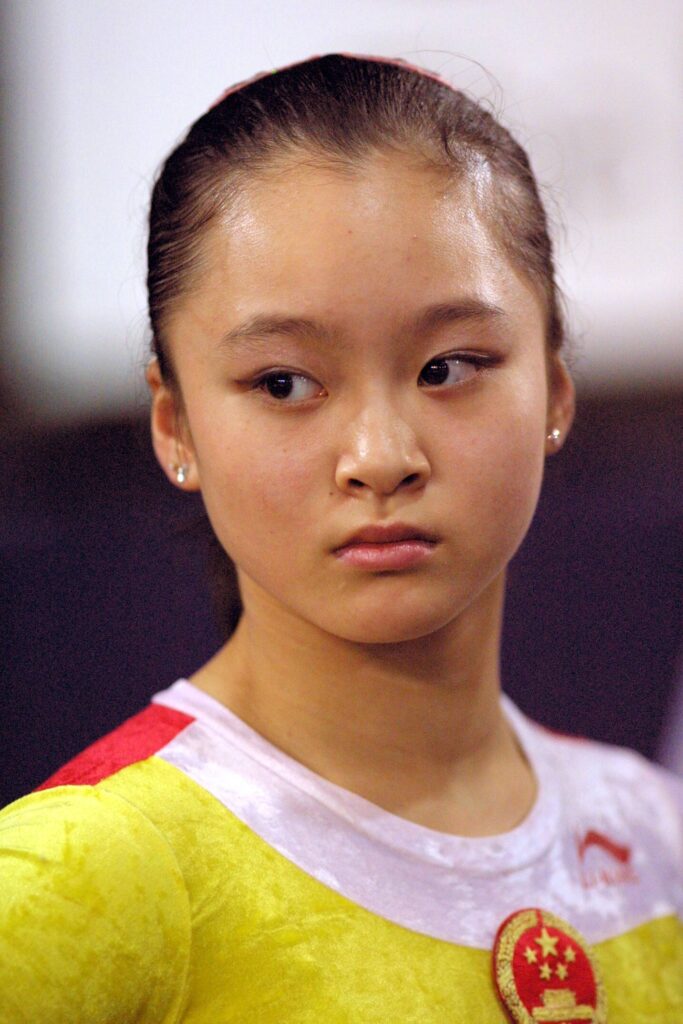
The Gymnast Who Was Born in 1985 and then in 1984
Sun Xiaojiao’s competitive birthday had not always been 1984.
In May 2000, Sina Sports ran a piece titled, “Introducing the Most Competitive Balance Beam Contenders at the China Gymnastics Championships” (中国体操争霸赛最有竞争力平衡木选手介绍). Among the contenders was Sun Xiaojiao, who was born on December 18, 1985:
The 2000 Li Ning Cup China Gymnastics Individual Event Championships, opening at 18:00 on the evening of May 15th, will be held in Wuhan, Hubei, and marks the first national gymnastics individual event competition ever staged in China. This competition represents an important initiative by the General Administration of Sport, the Gymnastics Sport Management Center, and the Chinese Gymnastics Association in boldly pursuing reform of the competition system and exploring market development. The Wuhan meet is the first stop in the series; on the men’s side the Pommel Horse King title will be decided, while on the women’s side competitors will vie to become the first Balance Beam Queen in Chinese gymnastics history. The following are profiles of the athletes who finished in the top eight on balance beam at the 1999 National Gymnastics Championships and National Individual All-Around Championships:
[…]
(Archived here)
Sun Xiaojiao: Zhejiang, born December 18, 1985. National Individual All-Around Championships: 6th
5月15日晚18:00开幕的2000年李宁杯中国体操单项争霸赛将于湖北武汉举行,是在我国首次举行的全国体操单项比赛。本次比赛是国家体育总局、体操运动管理中心和中国体操协会勇于进行比赛体制改革和市场探索的一次重要尝试。在武汉举行的这次比赛是系列争霸赛的第一站,男子项目将决出鞍马王、女子项目将争夺中国体操史上第一位平衡木皇后,以下是获得1999年全国体操锦标赛和全国个人冠军赛平衡木前八名的运动员简介:
[…]
孙晓姣:浙江,1985年12月18日出生。
全国个人冠军赛第六名
But 1985 was not the birth year Sun Xiaojiao ultimately used in international competition. When she competed at Cottbus in 2000, she had to meet the minimum age requirement of sixteen, which meant she needed a 1984 birth year. Accordingly, her official competition biography lists her date of birth as December 18, 1984.

The Professor Who Was Born in 1986
But the story does not end there.
After retiring from gymnastics, Sun Xiaojiao completed her undergraduate studies at Beijing Normal University and later earned a master’s degree in sport education and training science at Beijing Sport University. She is now an associate professor at the Shanghai University of Sport. Her CV, available online, shows that she was not born in 1984 or 1985. In fact, she was not even born in December.
Sun Xiaojiao was born in May 1986, which means she was only 15 when she won her bronze medal at the 2001 World Championships and 16 when she won gold during the 2002 World Cup finals.
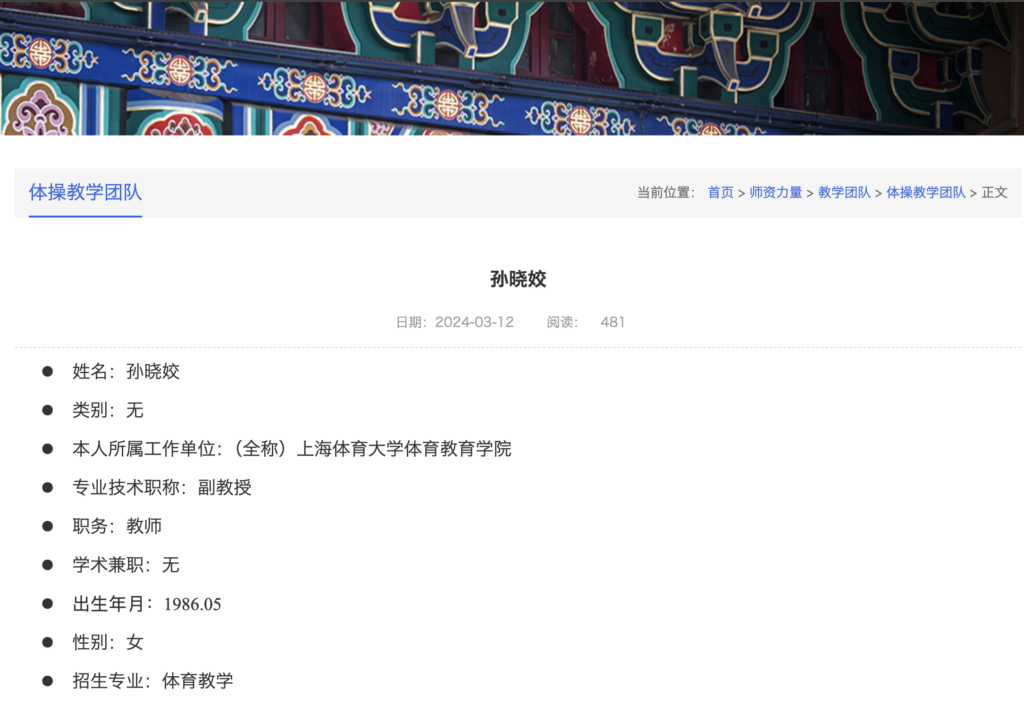
Archived here
Translated here
The Education Levels of Chinese Gymnasts
Sun Xiaojiao’s story invites us to take a brief look at the education of elite gymnasts in the early aughts. Her path is somewhat atypical, as Chinese gymnasts have historically tended to have relatively low levels of formal education.
In 2006, Chinese researchers published a study on the education levels of elite athletes. The authors concluded:
It is clear that while China’s elite gymnasts achieve very high competitive standards, their level of formal education is quite low. A portion of the athletes exhibited a conspicuous mismatch between age and educational attainment, presenting the inverted pattern of being “older in age but lower in education.”
可见我国优秀体操运动员虽然竞技水平很高但是受教育程度很低。还有部分运动员明显地出现年龄和学历不相符呈 “年龄大、学历低” 的倒置现象。
Yuan Shuli, Wang Kangle, Yang Yong, “A Study of Academic Learning and Cultural Literacy Among China’s Elite Gymnasts” (我国优秀体操运动员文化学习与文化素质研究), Journal of the Hebei Institute of Physical Education, 20.1, 2006
The researchers attributed the low levels of educational achievement to the quality of education at designated sports schools and the increased training demands as the athletes grew older.
At present, the cultural education of athletes in China continues to operate under a system in which the sports sector runs its own schools. Because athletes study and train within the same environment, the academic atmosphere differs markedly from that of ordinary schools, and the quality of athletes’ learning suffers accordingly. Educational resources within the sports system are also extremely limited — including the number and quality of teachers, as well as curriculum design. This is one of the significant factors bearing on gymnasts’ academic awareness and cultural literacy.
A survey of how many academic class sessions athletes attended per week found that 30 individuals — one fifth of the total — attended fewer than two sessions per week, while 75.5% averaged three to five sessions per week. Those attending more than five sessions per week were almost exclusively athletes still enrolled at the primary-school level. It is evident that Chinese gymnasts have far less study time than ordinary students, and that class attendance decreases progressively as athletes grow older. This is one of the root causes of the relatively low cultural literacy among China’s gymnasts.
我国优秀竞技体操运动员文化教育现状我国目前运动员的文化教育仍然采用体育系统自己办教育的体制运动员学习、训练都是在同一个环境中进行导致文化学习氛围和普通学校有很大差别运动员学习效果较差另外体育系统自身的教育资源也十分有限如教师的数量与质量、课程设置等。这也是影响我国体操运动员文化学习意识和文化素质的重要因素之一。
通过对运动员每周上课次数的调查笔者发现每周文化课学习少于2次的有30人占五分之一有75∙5%的运动员平均每周上课3~5次5次以上的几乎都是在小学就读的运动员。可见我国体操运动员的学习时间比普通学生要少很多而且随着运动员年龄的增长学习次数呈逐渐递减趋势。这是造成我国体操运动员文化素质较差的根本原因之一。
Despite these odds, Sun Xiaojiao went on to earn a graduate degree, become an associate professor, and author scholarly work—a trajectory that sits in stark contrast to her coach’s teasing that she was suited to be a housewife (see the next article).
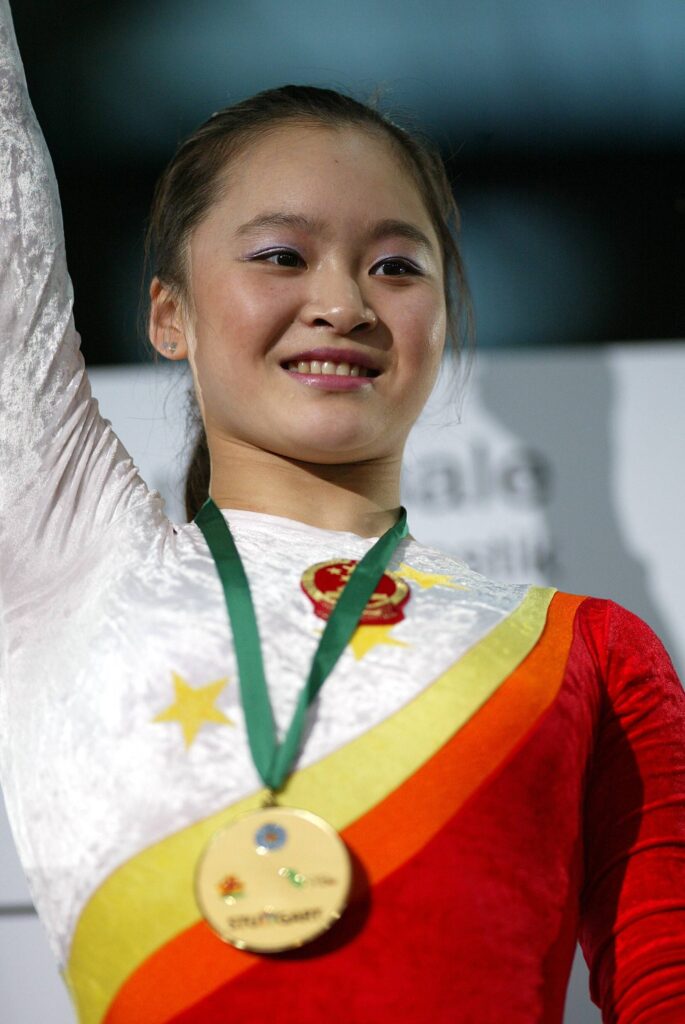
Appendix: A 2003 Profile of Sun Xiaojiao
Note: Her age is curiously absent from this long profile.
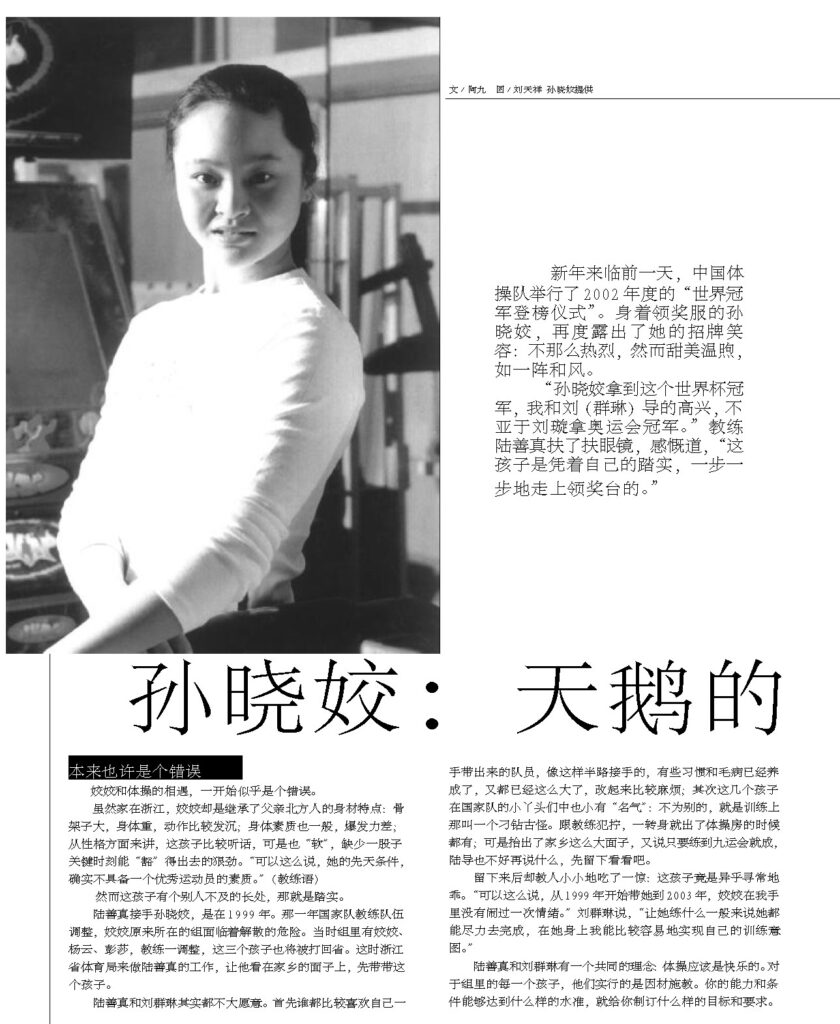
Sun Xiaojiao: The Birth of a Swan
On the day before the New Year, the Chinese gymnastics team held its 2002 “World Champion Honors Ceremony.” Sun Xiaojiao, dressed in her award ceremony uniform, wore once again her signature smile — not effusive, but sweet and warm, like a gentle breeze.
“When Xiaojiao won this World Cup title, Coach Liu [Qunlin] and I were no less happy than when Liu Xuan won the Olympic gold,” said coach Lu Shanzhen, adjusting his glasses with a sigh. “This child climbed onto the podium one step at a time, through sheer steady effort.”
What May Have Been a Mistake from the Start
Jiaojiao’s encounter with gymnastics seemed, at the outset, to be a mistake. Although her family was from Zhejiang, she had inherited her father’s northern physique: a large frame, heavy build, and movements that landed with a certain weight; her physical conditioning was unremarkable, her explosive power poor. In terms of temperament, she was obedient, but also “soft” — she lacked the ferocity that could be unleashed in a critical moment. “One could say,” in the words of her coach, “that her natural gifts did not, in any real sense, equip her to be an elite athlete.”
And yet this child had one quality others could not match: steadiness.
Lu Shanzhen took over Sun Xiaojiao in 1999. That year brought a reshuffling of the national team coaching staff, and the group Jiaojiao had been in faced disbandment. The group included Jiaojiao, Yang Yun, and Peng Sha; with the coaching changes, all three were at risk of being sent back to their provincial teams. The Zhejiang Provincial Sports Bureau stepped in to appeal to Lu Shanzhen, asking him, as a matter of hometown loyalty, to take the girl on for a while.
Neither Lu Shanzhen nor Liu Qunlin was particularly enthusiastic. For one thing, coaches generally prefer working with athletes they have developed from the beginning; inheriting someone mid-career meant dealing with habits and flaws already set, and at this stage of their development, those were difficult to correct. For another, these girls had already earned a certain reputation among the younger members of the national team — not for any distinguished reason, but because they were notorious in training for being difficult and unpredictable. There had been instances of quarreling with coaches and walking out of the gymnasium. But with the weight of hometown loyalty invoked, and assurances that they only needed to train through to the Ninth National Games, Lu Shanzhen felt he could hardly refuse. He would keep them on and see.
What followed was a small surprise: the girl was remarkably well-behaved. “I can say this without reservation,” Liu Qunlin recalled. “From when we started working with her in 1999 to 2003, Jiaojiao never once threw a tantrum under my watch. Whatever I asked her to work on, she would generally give it her full effort. With her, it was relatively easy for me to carry out my training intentions.”
Lu Shanzhen and Liu Qunlin shared a fundamental belief: gymnastics should be joyful. With each athlete in their group, they practiced individualized instruction — whatever level your ability and circumstances could realistically support, that was the target and standard they set for you.
“Honestly, when Jiaojiao first joined us, we didn’t pay her much attention. We had Liu Xuan and Kui Yuanyuan in the group at the time, and with the 2000 Olympics on the horizon, and her own attributes not being particularly outstanding, there was basically no way to put her into competition.”
In those days, Ling Jie, Huang Mandan, and others who had joined the team around the same time as Jiaojiao were already beginning to shine. At the 1999 World Championships in Tianjin, Ling Jie took silver on the uneven bars and gold on the balance beam; Huang Mandan won bronze on bars. Jiaojiao, meanwhile, was simply a member of the cheering section in the stands, rooting for the women’s team. At that year’s National City Games — which the first-string team did not attend — Jiaojiao and Yang Yun competed; Yang Yun took five gold medals, while Jiaojiao finished second to Yang Yun in every single event, returning home with five silvers.
In those days, the dream of a world title seemed impossibly distant to Jiaojiao. It was like the sun behind a layer of cloud — she could feel a trace of its warmth, but never imagined that a day of bright sunshine might belong to her as well. Among a flock of proud swans on the gymnastics team, Jiaojiao quietly played the role of the ugly duckling.
“I didn’t have that many thoughts, no real goals — just train.” The disappointment was real, but because her expectations had never been too high, the days were ordinary, and she was at peace with them. Without too much pressure, her state of mind was relatively healthy. Her calm, generous temperament served her well during those ugly-duckling years.
Lin Daiyu and the Devoted Housewife
Jiaojiao had a nickname — “Lin Daiyu” — given to her by Liu Qunlin. The implication was self-evident: she cried easily.
In this reporter’s impression, her tears were fairly frequent. Eight times out of ten, when I visited the training hall, she was crying — never the howling tantrum kind, but a quiet, red-eyed distress. Generally, her tears appeared when the training plan the coaches had laid out seemed to her impossible to complete. Once, after a poor session on the uneven bars, Coach Lu lost his temper and punished her with one hundred qianzi xiaofan — back handsprings. It was something said in the heat of anger, of course, but the conscientious Jiaojiao took it to heart and was horrified: “One hundred — my God, how would I ever get through them all?” After ten or so, she could do no more. She stood there, mouth pouting, tears dripping steadily down her face. Coach Lu asked, “Are you going to keep going?” She said nothing, just stared at the floor and picked at the skin on her hands. “Then go and do handstand holds.” In her mind: Once I finish the handstands, my arms will be aching — I won’t be able to train properly tomorrow, and then I’ll get scolded again… It was nearly six o’clock. Jiaojiao stood beside the uneven bars and stood there until the lights went out in the gymnasium. Fortunately, Coach Lu did not push her to train further. The experienced Lu Shanzhen knew that training at such a moment was pointless. He had seen Kui Yuanyuan throw herself on the floor, refusing to train; a little mood like this from Jiaojiao was well within his understanding.
For Jiaojiao, crying was not a way of throwing a temper tantrum at her coaches — it was simply a release. Before the Asian Games, she ran a fever over 38 degrees Celsius, yet did not dare stop training. That afternoon, they were rehearsing the dance elements of the floor exercise. Jiaojiao gasped and sobbed at the same time, tears caught on the thick curve of her eyelashes, mixed with sweat, her round little face flushed deep red. Liu Qunlin stood nearby, her heart aching, yet unable to let her stop — the moment she stopped, the weight would shoot up.
“We joke,” Lu Shanzhen said, “that Jiaojiao’s temperament is actually ideally suited to being a devoted housewife.” She was introverted, kind-natured, even-tempered, and obedient. But she had one genuine strength: consistency in performance. At the Busan Asian Games, Yang Yun suddenly sustained an injury a month before the competition. Thrust into leadership at a moment of crisis, Jiaojiao led a group of inexperienced “little soldiers” who had never competed in a major tournament, and was called upon to go first in every event. Going first is a thankless task: the responsibility is enormous — whether the opening shot lands sets the tone for the whole team’s morale — and the judges invariably award lower scores to the first competitor, which affects individual results. As the team’s eldest sister, Jiaojiao was unsettled on the inside, too, but she carried out her role reasonably well. “Taking a personal hit doesn’t matter.”
After observing her over a period of time, the coaches determined that Jiaojiao’s balance beam was genuinely strong, with its own distinctive character. She had a good feel for the beam — she seemed to “grip” it — her movement vocabulary was comprehensive, and her consistency was solid. The balance beam became her breakthrough event.
The 2000–2001 winter training period held particular significance for Jiaojiao. It was the turning point of her gymnastics career. The new rules had just been released following the Olympics, and while others were still savoring the aftertaste of the Games, Jiaojiao had already begun adapting to the new code ahead of anyone else. She had returned to her province for a training stint; without the high-pressure atmosphere of the national team bearing down on her, she relaxed and played around with new skills. When winter training resumed, Jiaojiao learned six new and difficult elements in one stretch: the “tucked jump 360,” the “one-arm back handspring to layout,” the “piked front aerial,” the “straddle jump to ring leap,” the “Sossunova,” and the “360-degree reverse planche” — and her progress was rapid, her acquisition remarkably smooth. By the end of winter training, she was the first athlete to reach a 10.0 start value on the balance beam; in fact, when her difficulty connections and bonuses were tallied, her routine exceeded 10.0, reaching a 10.2 start value.
When spring arrived, Jiaojiao traveled to Sydney for an international competition. When her balance beam routine was unveiled, it drew gasps of admiration. The new code had just come into effect; others had not yet assembled routines worth a 10.0 start value, let alone Jiaojiao’s 10.2. And yet the score that came back was unexpected — 9.75. She had won the circuit event.
That 9.75 carried extraordinary meaning for Jiaojiao. It was roughly from this moment that she and her coaches began to have genuine confidence in her abilities. Even now, a 10.0 start value on beam is not universally achieved, but she had already mastered it with ease.
Snacks, Weight, and Self-Control
Just as everything seemed to be brightening, a new problem emerged.
Female gymnasts generally have to pass through a weight-management ordeal at some point. Liu Xuan, it is said, had given her coaches no shortage of headaches over exactly this issue in her day. Lu Shanzhen and Liu Qunlin, experienced in such matters, took this approach: no force — the hope was that athletes could manage it themselves. At its core, this was not simply a matter of weight; it contained within it a question of psychological maturity.
At the Ninth National Games, Jiaojiao won the balance beam title, fulfilling the task that the Zhejiang Provincial Sports Commission had set when it entrusted her to Coach Lu. Meanwhile, her contemporaries — Ling Jie, Dong Fangxiao, Bai Chunyue, Peng Sha — had one by one retired, and rising stars like Kang Xin and Zhang Nan were making their presence felt. Jiaojiao herself began to wonder whether to keep going. After all, given her natural gifts, reaching this point had already been an achievement. Once she let her guard down, the weight moved in to cause trouble. Her frame was naturally large, and she was still in the developmental years; back home, she ate at this relative’s house and drank at that one’s, and with training unsystematic after the major competition, the weight jumped up by over ten jin in no time. When she returned to the national team, it was a shock — from that point on, weight became a serious and persistent problem.
Coaches rarely banned the athletes from eating meals altogether. With training loads as heavy as theirs, no food simply was not sustainable. The main problem was snacks. The small shop at the bottom of the training center dormitory building did a roaring trade, and the gymnastics team’s athletes were its most loyal customers. In principle, given how grueling the training was, a few snacks were entirely understandable, and as long as things didn’t get out of hand, the coaches would look the other way. But these were still children, and in the face of snack temptation, there were moments when self-control slipped. At the final team meeting before the Asian Games, head coach Huang Yubin stood before everyone and said plainly: “Jiaojiao, if you haven’t dropped ten jin before we leave, you’re not going to the Asian Games.” Over those ten days, she went from 96 to 90 jin.
The incident that most exasperated the head coach occurred before the 2002 World Cup Final, at one of the qualifying circuit events — the last two stops of the preliminary series. Jiaojiao’s balance beam had been going consistently well throughout; she sat in first place in the standings, the title drawing nearer with each competition. But before leaving Beijing, she had stuffed an excess of wafer biscuits, dried beef, and chocolate into her luggage. She had been performing beautifully in training at home, then arrived in Glasgow, England, having gained so much weight that she was barely clearing the layout somersault.
Liu Qunlin was furious. She let Jiaojiao have it thoroughly: “Jiaojiao, losing control at other times is one thing — what I genuinely cannot understand is this: this is a competition. The critical juncture! And you are facing a world title! What an incredibly rare opportunity, sitting right there in the palm of your hand — it all comes down to your weight. If it were me, I would cut off an arm willingly! It’s just a few mouthfuls of food — how can you not give that up?”
“Someone like this — I have no respect for them.” After that, Liu Qunlin did not speak to Jiaojiao for three days. During warm-ups, where she had always been the one to assist with stretching on the boards, she sent Zhang Nan to take over instead. When something like this happened, the blunt-spoken Liu Qunlin was beside herself with frustration — yet with no other coach on the trip, she had no one to confide in but Zhang Nan, talking to her as one might talk to an adult.
Jiaojiao, accustomed to her coaches’ relentless verbal guidance, was now genuinely flustered. The silence was something she did not know how to navigate. There was nothing left to say — just compete, and compete well. The results at that stop were not bad: Raducan took gold, Jiaojiao and Zhang Nan finished second and third respectively.
“And this time, before the Final — did she bring snacks?” the reporter asked.
“She didn’t. I didn’t check her bags. Same principle as always: the revolution depends on self-motivation. I was also afraid that if I found something, we’d both be embarrassed.” A quiet word with Jiaojiao later: she shook her head, a shy smile crossing her pretty face. “No.”
The Feeling of Being World Champion
At the World Championships in Ghent two years earlier, Jiaojiao had won bronze on the balance beam — Raducan had taken gold. The result was perfectly reasonable, but Jiaojiao felt the sting of it. She had performed exceptionally well that day, with barely a wobble, sticking her dismount cleanly. But without sufficient reputation, she had received only third place. Still, she had banked enough of an impression. And this competition had made the previously unimaginable dream of a world title feel tangibly close. Jiaojiao held that feeling inside, determined to prove herself the following year.
Addressing Jiaojiao’s tendency not to project enough expression in competition — not quite commanding the judges’ attention — Lu Shanzhen and Liu Qunlin spoke with her on multiple occasions. They helped her understand that every circuit event was crucial to her campaign and had to be contested with full effort, pursuing the best possible result. If a single competition could not make the judges feel she was luminous, then the accumulation of impressions across many competitions would serve the same purpose. Following this strategy, Jiaojiao competed steadily and methodically through every stop, eventually qualifying for the 2002 World Cup Final with the top cumulative ranking.
Her condition heading into the Final was exceptional. It was the same period as that year’s World Championships, and before the departure, the coaches quietly sized up the three young athletes representing the women’s team — Kang Xin, Zhang Nan, and Sun Xiaojiao — and murmured to each other: “Jiaojiao is the one with the best shot.”
Lu Shanzhen took Zhang Nan and Kang Xin to the World Championships; Liu Qunlin stayed behind to work with Jiaojiao alone. In the week before departure, Jiaojiao’s form surged in a way that even her coaches found startling. Her spins came up; her 1080 in the acrobatic line was beautiful — and it wasn’t just the balance beam. Her vault and uneven bars were looking extraordinary too, enough to make observers do a double-take: was this really the same languid, soft-edged Sun Xiaojiao they knew from every other day? Liu Qunlin asked her: “Do you really want to compete right now?” Jiaojiao nodded. Her competitive hunger had never been this intense — she was like a warhorse rearing and neighing on the eve of battle.
Honestly, with the girl in form like this, Liu Qunlin would have gladly put her out there the very next day — they had already trained more than enough, what was the point of continuing? But the timing wasn’t right, and no amount of impatience would change that. She told Jiaojiao to ease back, that peaking too early could cause problems — no athlete could reach two competitive peaks within the same month. She kept the training load in a steady range: not too high, for fear of over-excitation and fatigue; not too low, for fear of the weight climbing back up.
After an anxious wait, departure day finally arrived and everything was in order. The weight question had been settled before leaving. Once at the venue in Stuttgart, Germany, her form was excellent — every tumbling pass clean — and they simply waited for the final to come.
Then, at the last moment, something went wrong.
On the first day, Zhang Nan placed second on floor. The balance beam was scheduled as the final event on the second day. In pre-competition warm-ups, Jiaojiao was buzzing with excitement, constantly active on the apparatus. “Honestly, in over three years of coaching her, that was the first time I had ever seen her with that kind of fire.” When told to rest, she would pause briefly and then drift back to the beam to keep working.
Then, just before her turn, Jiaojiao suddenly said to Liu Qunlin: “Coach Liu, my head really hurts. Why can’t I see the beam?”
Liu Qunlin felt cold sweat break out all over her body. Good God — at this most critical moment, after training this a thousand times for exactly this one chance, and now she can’t see it?
“It’s fine, come down for a moment.” Liu Qunlin kept her composure by force: “Drink some coffee, take a short rest.” In the minutes of that break, she encouraged, she soothed. “It’s just one routine — you know this so well, there won’t be any problem.” She kneaded Jiaojiao’s legs to help her relax and steadied her own nerves.
The two competitors before Jiaojiao both fell from the beam.
When Sun Xiaojiao’s turn came, Liu Qunlin was so tense she didn’t know what to do with herself, yet she kept her face composed.
Jiaojiao mounted the beam. The “tucked 360 to ring leap” — and then something went wrong, a tilt in the air! Liu Qunlin’s heart shot into her throat. The beam surface is only ten centimeters wide — if that tilt became a fall… But Jiaojiao’s face took on a look of resolve no one had seen from her before. She adjusted, she fought, and she held on — sheer will. This cost her 0.1 in difficulty connections, dropping the start value to 9.9, but it was still the highest start value of any athlete in the competition.
After that, every connection, every slight tremor — Liu Qunlin lived through them all with a clenched heart. It was more exhausting than the Olympics. When Jiaojiao finally stepped off the beam and stuck her landing, Liu Qunlin exhaled a long breath. The weight lifted, just slightly. But there was still a Brazilian competitor left — Jiaojiao’s most formidable rival, with equally high difficulty and a 10.0 start value.
The Brazilian girl, unlucky, fell from the beam. Liu Qunlin’s heart dropped to solid ground in an instant. She turned — and coach and athlete wrapped their arms around each other, holding on for a long, long time.
In that moment, Jiaojiao — who cried so easily — shed no tears. She only smiled: in the instant that belonged to her, she showed the world her most radiant face.
At last, in this moment, the swan was born.
* * *
Text: A Jiu
Photos: Liu Tianxiang and provided by Sun Xiaojiao
Editor: Cai Peiying
New Sports, February 1, 2003
Appendix B: A Translation of Sun Xiaojiao’s CV
Sun Xiaojiao
Date: March 12, 2024
- Name: Sun Xiaojiao (孙晓姣)
- Category: None
- Affiliation (full name): School of Physical Education, Shanghai University of Sport
- Professional Title: Associate Professor
- Position: Lecturer / Faculty Member
- Academic Affiliations: None
- Date of Birth: May 1986
- Gender: Female
- Recruitment Major: Physical Education Teaching
- Contact: [Redacted]
Main Research Areas
- Physical education pedagogy
- Gymnastics teaching and training
Education and Work Experience
- 2004–2008: Studied at Beijing Normal University
- 2009–2012: Studied at Beijing Sport University
- 2012–present: Faculty member, School of Physical Education, Shanghai University of Sport
She places strong emphasis on teaching and is responsible for multiple gymnastics-related courses, including:
- Undergraduate courses (Physical Education and Sports Training majors):
- Gymnastics
- Theory and Practice of Specialized Gymnastics Teaching and Training
- Practice of Competitive Sports Teaching and Training
- Graduate course:
- Gymnastics
Major Academic and Research Achievements (past 5 years, in reverse chronological order)
Journal Articles
- “Physical Exercise, Sedentary Behaviour, Sleep and Depression Symptoms in Chinese Young Adults During the COVID-19 Pandemic: A Compositional Isotemporal Analysis.” June 2022.
- Jiang Weiwei; Ji Mingxia; Chi Xinli; Sun Xiaojiao (corresponding author), “Relationship between Adverse Childhood Experiences and Mental Health in Chinese Adolescents: Differences among Girls and Boys.” May 2022.
Books
- Guidelines for Teaching and Training Young Gymnasts in China (Women’s Volume), General Administration of Sport of China & Chinese Gymnastics Association, 2021 (contributing author).
Research Projects
- Principal investigator of one Shanghai municipal-level project
- Participant in two National Social Science Fund projects
- Participant in three Shanghai Science and Technology Commission projects
- Participant in four Shanghai municipal/department-level projects
- Participant in one service-oriented project
- Participant in one consulting project
Awards
Teaching Awards
- Third Prize, 3rd Yangtze River Delta Normal Universities Smart Teaching Competition (2021)
- First Prize, Shanghai Normal Universities Smart Teaching Competition (2021)
- Second Prize, Shanghai University Young Physical Education Teachers Teaching Competition (2016)
Student Mentorship Awards
- National College Physical Education Skills Competition (2021):
- Team First Prize
- Gymnastics Event First Prize
- 2nd Yangtze River Delta Teaching Skills Competition (2020):
- Second Prize, Third Prize
- 1st Yangtze River Delta Teaching Skills Competition (2019):
- Third Prize
Graduate Student Requirements
- None
More on Age