When Ecaterina Szabó later acknowledged that her birthdate had been falsified, Nemzeti Sport wrote in 1990 that this revelation merely confirmed what had long been understood inside the sport: it was “an open secret in gymnastics circles that the ages of gymnasts were often manipulated, and that coaches sought to neutralize near-adult competitors by fielding girls who were still small, not yet close to true puberty. But no one dared to speak up.”
According to Romanian newspapers, Laura Cutina officially competed under the birthdate July 13, 1968. Yet the documentary record of her early career points consistently to a different reality.
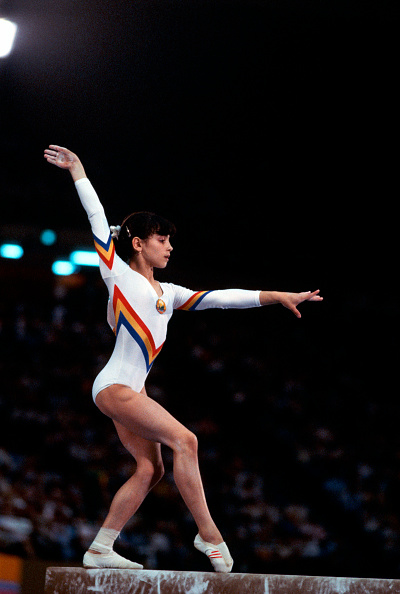
In December 1980, Cutina placed third in the all-around at the Romania Cup while competing in Category IV. At the time, Romanian gymnastics divided junior athletes into strictly age-defined categories; Category IV was reserved for gymnasts aged eight to ten. Had Cutina truly been born in July 1968, she would have been twelve—clearly ineligible for that division. To compete, let alone place, in Category IV, she must have been born no earlier than 1970.
Her results in 1981 align with that conclusion. At the national championships in Ploiești, Cutina won the all-around title in Category III with a score of 37.800. This category was designated for gymnasts aged ten turning eleven and eleven turning twelve. With a 1970 birth year, Cutina would have fit squarely within that range.
By 1983, at an age consistent with twelve turning thirteen, Cutina was added to the national team. She was introduced in the press as one of three recent arrivals—alongside Lenuța Rus and Mirela Iordac—“included to test their capabilities and prospects, in whom great hopes are placed even for the season that is knocking so insistently at the door.”
Cutina quickly justified those expectations. Yet journalists continued to signal, often obliquely, that her official age did not withstand scrutiny. At a September dual meet against the Netherlands in Deva, she took sixth in the all-around and tied for second on vault with Mihaela Stănuleț. The Dutch newspaper De Volkskrant described her as “the strongest representative of an upcoming, very young generation.” Not merely young—very young.
Falvak Dolgozó Népe, a newspaper from the Hungarian People’s Union of Romania, was even more pointed. Reporting on the same dual meet, it placed the word “senior” in quotation marks—“felnőtt”—a subtle but unmistakable cue to readers that some athletes were seniors in name only.
The girls are in good form, as confirmed by the match against the Dutch and by the national championships held in recent days. Lavinia Agache won her third national title, but public attention turned toward the virtually unknown, likewise teenage Laura Cutina, who surprised even the experts. On floor, for example, she received a perfect ten—and incidentally, she was one of the youngest competitors in the “senior” championships.
Ifjúmunkás, the Hungarian-language paper published by the Romanian Communist Youth Union, dispensed with euphemism altogether. In its coverage, it noted that the competition’s success was enhanced by the confident performances not only of the national team members, but also of the younger gymnasts—“that is, 12–13-year-olds!” Based on the results, readers could easily piece together who was among those 12- and 13-year-olds, and Cutina was likely one of them. Within weeks, she would nevertheless be deemed fifteen and age-eligible for the 1983 World Championships.
It is interesting to emphasize that our national team was one of the youngest in the [World Championships]. Lavinia Agache, the veteran of the squad, was 17 years old; Ecaterina Szabó, Mihaela Stănuleț, Mirela Barbălată, and Camelia Benciu were 16; while Laura Cutina, the revelation of the domestic autumn competition season, was 15 years old — therefore at the minimum age limit permitted by the regulations.
Sportul, November 5, 1983
Cutina went on to win silver with the Romanian team and place ninth in the all-around at the 1983 World Championships in Budapest, earning particular praise for her vault and floor exercise. The following year, she finished second at the American Cup and became an Olympic team gold medalist in Los Angeles.
During that “unforgettable night” in Los Angeles in 1984, as the Romanian press called it, she announced herself on the sport’s biggest stage. Sportul captured the moment with a pointed rhetorical contrast: “Who is Ecaterina Szabó? Here, the ‘queen’ is Mary Lou Retton. Who are Lavinia Agache, Simona Păucă, or Laura Cutina? Since Wednesday evening, their names have begun to be remembered.”
By 1985, Cutina was officially age-eligible to compete in senior competitions. She won another team silver that year, despite injuring a tendon during warm-ups. Persistent injuries sidelined her throughout the 1986 season, and she retired in 1987. Her final major appearance came at the World University Games in Zagreb.
Like so many gymnasts from her time, Laura Cutina achieved her greatest successes under a birthdate that was not her own. And yet, looking back, her regrets are personal rather than procedural. “I regret that I never won an individual medal,” she later reflected in Romanian Gymnasts in Conversation. “I want to turn back time and do it better—but that isn’t possible.”
Notes
1. Based on early press accounts, there is a slight possibility that Cutina was born in 1969, which would have made her underage in 1983 but not in 1984. The December 10, 1980, edition of Sportul describes her as an eleven-year-old. Yet she was competing in Category IV, which, at that time, was reserved for gymnasts aged eight to ten. Had she in fact been eleven—born in 1969—in December 1980, she should have been competing in Category III.
According to one of her public Facebook pages, she graduated from the Liceul Industriale Nr. 37 in 1989. A typical graduating class in 1989 would consist largely of students born between late 1970 and 1971.

Several months ago, I emailed Cutina to confirm her birthdate, but did not receive a response. Should she ever respond, this account will be updated accordingly. info@gymnastics-history.com.
2. The athlete database on the World Gymnastics website indicates that Cutina was born in 1970, but the database is often wrong for gymnasts of pre-Internet time periods.
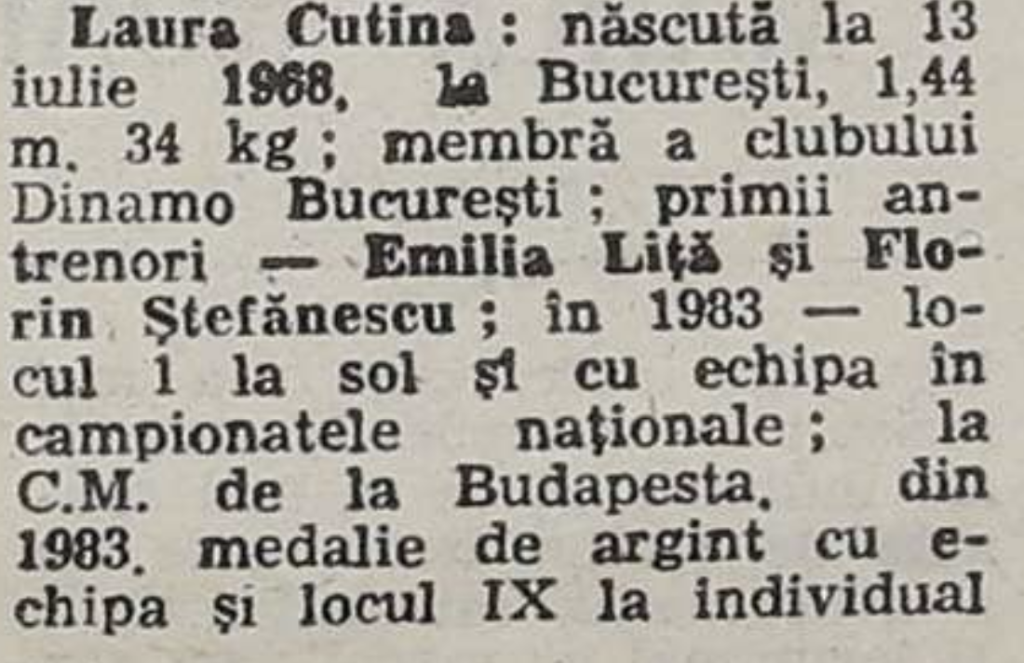
3. Online, Cutina’s birthdate is regularly listed as September 12 or 13. However, in the November 5, 1983, edition of Sportul, her birthdate is listed as July 13.
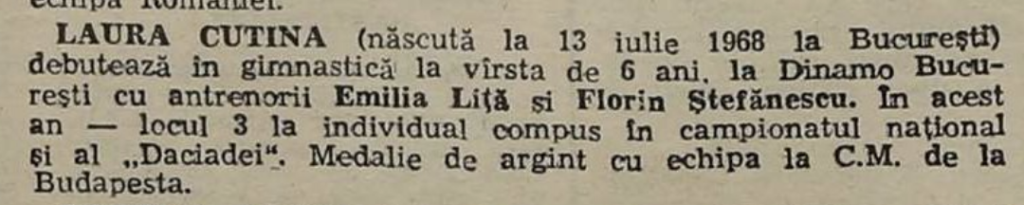
The same is true of the August 4, 1984, edition of Sportul.
4. Another irregularity involves the spelling of Simona Păucă’s surname in the Romanian press. Some reports render it as “Păucă,” while others spell it “Păuca.” I have not been able to determine which version is correct.
References
Dutch Press
De Volkskrant
“Gymnasts Far Behind Romania.” 6 September 1983.
Romanian Press in Hungarian
Falvak Dolgozó Népe
“Sports Mosaic.” By Lajos Kotila, 24 September 1983.
Ifjúmunkás
“Bucharest, Duisburg, Deva…” 11 September 1983.
Romanian Press — Sportul
Sportul
“Two Bucharest Clubs Victorious in the Romania Cup: Triumf (Women) and Dinamo (Men).” 10 December 1980.
Sportul
“Dinamo Bucharest: Tradition and Promise.” 22 April 1981.
Sportul
“National Gymnastics Champions.” 23 June 1981.
Sportul
“Only Continuous, Demanding, High-Level Preparation Can Ensure Gold, Silver, and Bronze Medals!” 19 December 1981.
Sportul
“Successes by the Gymnasts.” 20 April 1982.
Sportul
“Junior Gymnasts’ Championships.” 8 November 1982.
Sportul
“Are Talents No Longer Being Produced in Onești?” 10 November 1982.
Sportul
“Beautiful and Applauded Performances on the Opening Day.” 4 December 1982.
Sportul
“Cristina Grigoraș Returns Successfully to Competition.” 6 December 1982.
Sportul
“The Expected Championship Successes Are Forged… on the Hard Trails of the Bucegi Mountains.” 21 January 1983.
Sportul
“Romania’s Women’s Gymnastics Team — In Spain.” 16 March 1983.
Sportul
“A Success by Ecaterina Szabó — and by Our Entire Team.” 22 August 1983.
Romanian Press — Scînteia
Scînteia
“Olympic Training Center for Bucharest Juniors.” 3 February 1983.
Scînteia
“Women’s National Gymnastics Championships — Lavinia Agache, First Place in the All-Around.” 18 September 1983.
Scînteia
“Women’s Gymnastics — After the National Championships and Before the World Championships.” 25 September 1983.
Romanian Press — România Liberă
România Liberă
“Women’s Gymnastics Between Two Generations.” Interview by Ion Bocioacă. 19 January 1983.
Romanian Press — Scînteia Tineretului
Scînteia Tineretului
“The Impossible Is Being Sought — and It Has Become… Fashionable.” Interview by Horia Alexandrescu. 21 March 1983.
Books
Romanian Gymnasts in Conversation. By Karen Louise Hollis.
More on Age