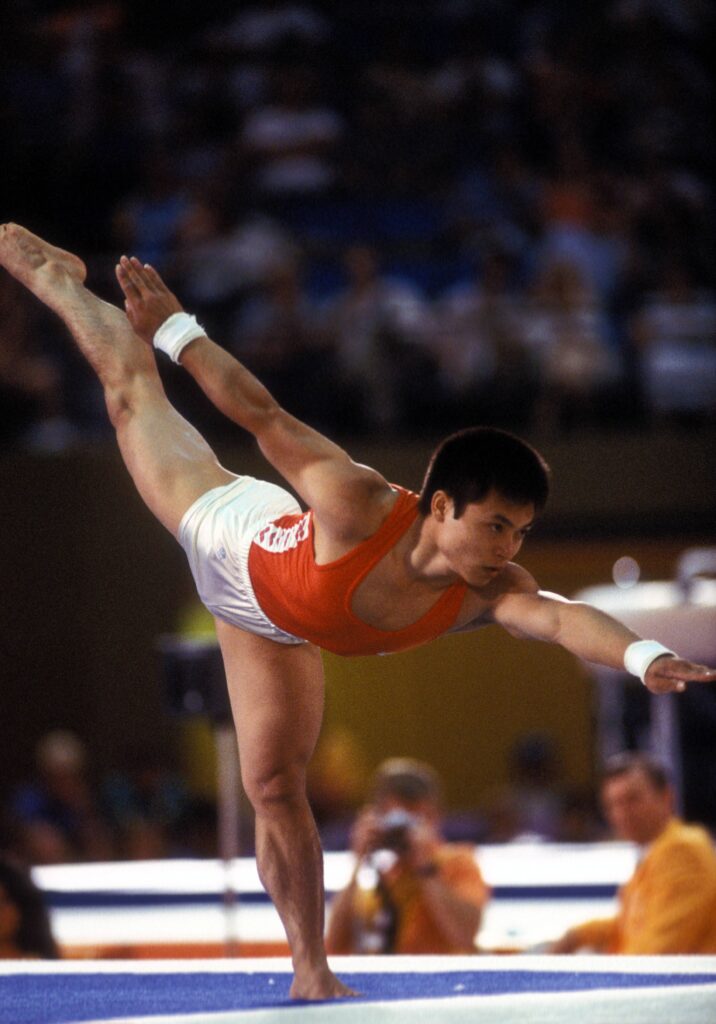
Within the gymnastics community, Lou Yun is best known for winning back-to-back Olympic vault titles in 1984 and 1988. Two of his innovations—a handspring rudi on vault and a double side salto with a ¾ twist on floor exercise—appear in the FIG Code of Points under his name. Outside the competitive arena, however, he has repeatedly reinvented himself. Spanning nearly twenty-five years, the articles translated here trace his evolution from Olympic champion to entrepreneur and eventually to one of the public faces of China’s Olympic movement. Although they do not constitute a complete biography, they offer a far fuller portrait of Lou Yun’s life compared to his remarkably sparse Wikipedia page.
1984
Famed Gymnast Lou Yun and New Recruit Tang Yong
By Yang LongmingRecently, among the officers and soldiers of a certain border-defense unit of the Yunnan frontier troops holding positions at Laoshan, a heartwarming story has been spreading: an exchange of mutual encouragement between new recruit Tang Yong and Lou Yun, China’s celebrated gymnast.
One is a world-renowned gymnast; the other a new soldier who enlisted only in 1984 and now guards the border. How did the two come to be connected? It turns out that Tang Yong’s former classmate, Pan Yongchao, had been selected for the Chinese national gymnastics team and had spent the past four years training alongside Lou Yun day and night. After the successful conclusion of the Laoshan battle, Tang Yong, filled with emotion, wrote a letter to his old classmate Pan Yongchao, describing in detail the heroic deeds performed during the fighting. The border soldiers’ heroic conduct inspired the athletes of the Chinese gymnastics team, who eagerly passed Tang Yong’s letter around to read. Deeply moved after reading it, Lou Yun, on the eve of his departure for the Los Angeles Olympics, took up his pen and wrote back to Tang Yong: “With a heart full of reverence, I extend my warm regards to the brave soldiers holding the Laoshan positions, who fear neither hardship nor bloodshed and sacrifice. I will draw on the heroic conduct of our border-defense soldiers to inspire myself to study and train even harder.” At the same time, he proposed that he and Tang Yong carry out a friendly competition to bring glory to the motherland and honor to the army. Lou Yun vowed to achieve new results at the Olympics, to strive to win gold medals, and to let the five-starred red flag fly high over an American gymnasium. He also expressed his hope that Tang Yong, in the fight to defend the motherland’s sacred territory, would strike down more enemies and earn more honors. On July 6, upon receiving Lou Yun’s letter, Tang Yong immediately wrote back, pledging to fulfill his sacred duty as a soldier, to strictly guard the motherland’s frontier, to punish without mercy any enemy who dared to invade, and to report back to the people of the motherland with outstanding achievements.
Note #1: The Laoshan campaign refers to a series of border engagements between China and Vietnam that began in April 1984, part of the broader Sino-Vietnamese border conflict that simmered for a decade following the brief 1979 war between the two countries. Chinese forces captured a strategically significant hill known as Laoshan (in Vietnamese, Núi Đất or the “Hà Tuyên” sector) from Vietnamese troops, and the two sides subsequently traded control of surrounding high ground through sustained shelling and infantry assaults into the late 1980s. The fighting, though far smaller in scale and less internationally reported than the 1979 war, produced significant casualties on both sides and was heavily publicized within China at the time as a patriotic cause, generating a wave of propaganda around soldiers’ heroism — the context in which Tang Yong’s letters and Lou Yun’s reply should be understood. A ceasefire and disengagement were eventually reached in 1989, and the border area was formally demarcated following the 1999 Sino-Vietnamese Land Border Treaty.
Note #2: PLA Daily’s core audience is servicemen, and its core mission is to sustain morale and a sense of purpose among troops in relatively obscure, unglamorous postings — a border garrison in Yunnan being about as far from a Los Angeles arena as one could imagine. By putting a border private in direct epistolary contact with a globally famous athlete, the story tells soldiers: what you’re doing is on the same plane as what an Olympic champion is doing; the nation is watching you both, and you inspire each other as equals.
PLA Daily, July 20, 1984
体操名将楼云与新战士汤勇
Author: 杨龙明
最近,坚守在老山阵地的云南边防部队某部指战员中,传颂着新战士汤勇与我国体操名将楼云互相开展竞赛活动的佳话。
一个是世界上著名的体操运动员,一个是1984年才入伍、守卫在边防的新战士,他们是怎么联系起来的呢?原来,汤勇昔日的同学潘勇超被选入中国体操队,和楼云朝夕相处已经四年。老山战斗胜利结束后,汤勇满怀激情地给老同学潘勇超去信,详细介绍了战斗中的英雄模范事迹。边防战士们的英雄事迹,激励了中国体操队的健儿们,他们争相传阅汤勇所写的信。楼云阅信后感奋不已,在赴洛杉矶参加奥运会的前夕,挥笔给汤勇写信说:我怀着崇敬的心情,对不怕艰难困苦,不怕流血牺牲,坚守在老山阵地上的勇士们表示亲切的慰问。我要以边防战士的英雄行为激励自己,更加刻苦的学习和训练。同时,提出与汤勇开展为祖国争辉,为军队添彩的竞赛活动。楼云决心在奥运会上创造新的成绩,努力夺金牌,让五星红旗在美国体育馆里高高飘扬。同时他希望汤勇在保卫祖国神圣领土的战斗中,多杀敌多立功。7月6日汤勇收到楼云的信后,立即回信表示:一定要尽战士的神圣职责,严守祖国的边防,随时严惩敢于来犯之敌,以优异成绩向祖国人民汇报。
1984
Young “King of the Vault” Lou Yun
Lou Yun, hailed by spectators at the Olympics as the “King of the Vault,” is twenty years old this year and one of the youngest members of our national gymnastics team. At fourteen, he was selected from the Hangzhou amateur sports school into the national training squad, where he began his gymnastics career under coach Yang Mingming.
In April 1981, Lou Yun injured his leg. Twenty days after his cast was removed, he was already back in training, his leg hurting so badly that sweat would break out on his forehead; even while sleeping, he had to prop his leg on a pillow. But he persevered with tenacious willpower. His skills improved rapidly, and that same November, at the Tokyo International Gymnastics Championships, he won four gold medals and one bronze with his high-difficulty routines.
Lou Yun’s routines are known for their stability and quality, executed with high difficulty. He particularly excels in vault and floor exercise. In the vault final at the 22nd World Gymnastics Championships, it looked all but certain that the Soviet competitor would take first place, but Lou Yun, brimming with confidence, dared to go head-to-head with the strongest rival. Remaining calm and composed, he completed his full routine flawlessly, earning a perfect score, and ended up tying the Soviet gymnast for first place.
PLA Daily, August 6, 1984
年轻的“跳马王”楼云
在奥运会上被观众誉为“跳马王”的楼云,今年二十岁,是我国体操队中最年轻的队员之一。他十四岁时从杭州业余体校选进国家集训队,从师于杨明明,开始了体操生涯。
一九八一年四月,楼云摔伤了腿,二十天后拆了石膏他便参加训练,腿痛得脑门子直冒汗,睡觉时腿下也要垫个枕头。但他以顽强的毅力坚持了下来。他的技术提高很快,终于在同年十一月的东京国际体操赛上,以高难动作获得四枚金牌和一枚铜牌。
楼云的动作稳定性高,有质量,有难度,尤以跳马和自由体操见长。在第二十二届世界体操锦标赛跳马项目决赛时,眼看苏联选手获冠军即成定局,但楼云充满信心,敢与强手对抗。他沉着镇定,圆满地完成了整套动作,赢得满分,结果与苏联选手并列冠军。
1988
“The King of the Vault” Lou Yun
China Sport Science and Technology, 1988-03-21
Male gymnast Lou Yun was born on June 23, 1964, in Hangzhou, Zhejiang Province. He has a stocky, compact build — not the ideal physique for a gymnast. But he is intelligent and loves to think through problems. In 1973, his father enrolled him in gymnastics at the Hangzhou Amateur Sports School, and under the guidance of his first coach Wu Weirong, within less than a year, he had won the Hangzhou elementary school gymnastics competition and was sent on to the Zhejiang Provincial Amateur Sports School for further training. At the 1977 national amateur sports school gymnastics competition, he took one first place, one fourth place, and three fifth places. His movements were nimble and his jumping power strong, and he was selected for the national gymnastics training squad, where he came under the careful cultivation of Coach Yang Mingming and embarked on a new chapter in his gymnastics life.
His specialties were vault and floor exercise, earning him the nickname “King of the Vault.” In 1981, he traveled abroad for the first time to compete at the Chunichi Japan Cup in Nagoya and the Tokyo Metropolitan International Gymnastics Invitational. The young calf unafraid of the tiger, he defeated the established gymnastics stars Brückner of East Germany and Japan’s Kajitani Nobuyuki and Gushiken Koji, sweeping the floor exercise and vault titles at both invitationals. In 1982 and 1983, his results rose steadily: he won the vault at the 9th Asian Games and the 12th World University Games, and at the 22nd World Artistic Gymnastics Championships, where China won the men’s team title for the first time, Lou Yun made an outstanding contribution: he won parallel bars and placed third in the all-around. Across other international competitions in those two years, he collected ten titles in the all-around, vault, floor exercise, and parallel bars.
In 1984, the 23rd Olympic Games were held in Los Angeles. In the team competition, Lou Yun’s vaulting was light, graceful, and sure-footed, earning two scores of ten. In the event final, he performed two new and highly difficult skills he had spent only six months mastering: a front handspring into a layout front salto with 180-degree twist, and one with a 540-degree twist. The former received a perfect score; the latter received 9.9. He won the gold medal, and also took silver on floor exercise and fourth place on horizontal bar.
In 1985, the Chinese team won silver in the men’s team competition at the 23rd World Artistic Gymnastics Championships, with Lou Yun as a key team member; he also took the vault silver medal. In 1986, the 10th Asian Games were held in Seoul. As a mainstay of the Chinese team, he won the men’s team title, and in the individual events claimed gold on vault and bronze in the all-around, rings, and parallel bars. At the 24th World Artistic Gymnastics Championships in 1987, he swept both the vault and floor exercise gold medals, and was again a key contributor to China’s men’s team silver.
Over fourteen years, he has pursued constant innovation in the development of his gymnastics, incessantly refining his technique and achieving one new milestone after another. In 1985, he was awarded the title of International Master of Sport. He was named one of the ten best athletes in China for 1987. This year, he has been training with single-minded focus in preparation for the Olympics. His main rivals will be the Soviet gymnasts; the road to gold will be hard-fought, and he is determined to give everything he has at the Games.
“跳马王”楼云
免费
China Sport Science and Technology
1988-03-21
男子体操选手楼云,1964年6月23日生于浙江省杭州市。他身体结实粗矮,从体型看,当体操运动员是不够理想的。但他聪明,爱动脑子想问题。1973年他父亲把他送到杭州市业余体育学校练体操,在启蒙教练吴维荣的指导下,不到一年功夫,就获得杭州市小学生体操比赛的冠军,又被送到浙江省业余体校深造。1977年全国业余体校体操比赛中,取得一项冠军、一个第四名和三个第五名。他动作灵巧,弹跳力好,被选入国家体操集训队,受到杨明明教练的精心培育,过上了新的体操生涯。
他的特长是跳马和自由体操,人称”跳马王”。1981年他首次出国参加名古屋中部日本杯和东京都国际体操邀请赛,初生牛犊不怕虎,竟战胜了体操名将、民主德国的布鲁克内尔和日本的梶谷信之、具志坚孝司,包揽了这两场邀请赛的自由体操和跳马冠军。1982年和1983年,他的成绩节节上升,获得第九届亚洲运动会和第十二届世界大学生运动会跳马冠军,在第二十二届世界体操锦标赛中,中国队第一次夺得男子团体世界冠军,楼云立下了汗马功劳,在个人项目的比赛中,获得双杠冠军和全能第三名。他还在这两年的其他国际比赛中,共获得全能、跳马、自由体操和双杠项目的十个冠军。
1984年,第二十三届奥运会在美国洛杉矶举行,楼云在团体赛中跳马动作轻飘优美,落地稳,得了两个十分,在单项比赛中,他做出了仅用半年时间攻下的两个高难新动作:前手翻直体前空翻转体180度和转体540度,前者得满分,后者得9.9分,夺得了金牌,并取得自由体操亚军和单杠第四名。
1985年,中国队获得第二十三届世界体操锦标赛男子团体亚军,他是主力队员,并夺得跳马银牌。1986年,第十届亚洲运动会在汉城举行,他作为中国队的主力,夺得男子团体冠军,在单项赛中,拿到跳马金牌和全能、吊环、双杠铜牌。1987年,在第二十四届世界体操锦标赛中连夺跳马和自由体操金牌,也是中国队获得男子团体亚军的主力队员。
十四年来,他在发展体操运动的道路上勇于创新,对技术精益求精,不断取得新成就。1985年获得国际级运动健将称号。被选为1987年全国十名最佳运动员之一。今年以来,他正在为迎接奥运会而埋头训练,他的对手主要是苏联运动员,夺取金牌的道路是艰苦的,他决心到奥运会上去拼一拼。
1994
Lou Yun’s “Commercial Full-Twist”
Chun Hong
Nanfeng Chuang, 1994-03-15
Not long ago, I ran into Lou Yun again at the National Sports Feilong Conference. This solidly built young man from Hangzhou, once celebrated internationally as the “King of the Vault,” has left the world of sport behind and stepped into the marketplace, strategizing and competing with merchants from across the country. Yet the marketplace is not the competition floor — can he recapture his “kingly form” amid the tides of commerce?
● Going It Alone to Build the “Lou Yun Brand”
On August 18, 1993, “Lou Yun Industrial Group” was established in Hangzhou. According to Lou Yun, the company was formed through a joint-stock arrangement combining several enterprises, with registered capital of 38 million yuan and a current workforce of nearly 2,000. Its main activities at present are producing and selling sportswear and athletic footwear, representing several name-brand sporting goods, and working toward the launch of a “Lou Yun Brand” line of sporting goods in the second half of the year. Lou Yun laughingly said he intends to compete with Li Ning in the marketplace, and hopes that the “Lou Yun Brand” can become the next great Chinese sports brand after “Li Ning.”
Lou Yun’s transformation from celebrated gymnast to company boss has stirred considerable debate. Some feel that, while Lou Yun excels at gymnastics, business is another matter. Others are supportive: “Success has always come through trying — everyone has the right to play different roles in society, and you won’t know if you’re up to it until you try.” Opinions are divided, and assessments vary. Lou Yun’s own view: “In gymnastics terms, I’m a veteran, but in society, I’m still a young man. I can’t spend the rest of my life coasting on what I did in my athletic career; I should try other fields. Even if I fail in the end, I’ll have no regrets, because I’ve already done right by myself in the first half of my life.”
Lou Yun’s decision to open a company was not an impulse, nor a reckless move. Before striking out on his own, he had already had a period of experience “jumping into the sea” of commerce.
After the 1988 Seoul Olympics, Lou Yun announced his retirement, with no thought at the time of going into business. Then one day a newspaper item caught his eye: the Dongguan Shilong Tongda Garment Co., Ltd. had secured the Chinese distribution rights for the global brand Adidas. He found this an impressive achievement and wrote a letter of congratulations.
That letter unexpectedly changed the course of Lou Yun’s life. As the saying goes, “the willow planted without thought grows into shade.” Upon receiving the letter, Tongda’s general manager, Huang Tuo, immediately invited Lou Yun to visit the company. Everything he saw there felt new and exciting, as though he had stepped into a different world. General Manager Huang subsequently asked him to stay on as assistant general manager, and Lou Yun gladly accepted.
From 1989 to 1991, Lou Yun worked at Tongda, responsible for market development and advertising. This was his entry point into the business world. Over that period, he went from knowing nothing to gradually mastering the work, accumulating a degree of business experience. He recalled: “I went in with a mindset of learning. I wasn’t trying to accomplish anything remarkable. I learned a great deal there: the principles and tricks of doing business, and a basic understanding of the process by which raw materials become finished sportswear. That experience was decisive in enabling me to go out on my own.”
When Tongda Footwear Co., Ltd. was established in 1991, the plan was for Lou Yun to concurrently serve as sales manager. But by then he wanted to strike out, to build something of his own, and he decided to leave Tongda for the time being. Rumors circulated outside that Lou Yun and the company had parted on bad terms; in fact, his relationship with Tongda remained excellent, and he continues to promote Tongda products under his own company’s name.
The celebrated dancer Zhou Jie, speaking about her own business experience, once said: “Commerce is not simple. It’s not about luck or fame; it requires giving everything you have.” Lou Yun recognizes this too. He believes that fame is a double-edged sword in business. On one hand, athletes are perceived as physically capable but mentally limited — not suited for business. On the other hand, there’s a fear that when the moment demands a hard-nosed approach, you’ll go soft. After all, the common saying is that there’s no honest merchant, and how can a “sharp dealer” be squared with a “sports star”? His only recourse, therefore, was to prove through action: “I, Lou Yun, can not only do gymnastics — I can do business too.”
● From “King of the Vault” to Riding the Waves
As Lou Yun has advanced into the commercial world, he has yet to fix on a grand long-term objective — this is naturally different from his gymnastics days, when the goal was simple: world champion, Olympic champion. Yet these two vastly different careers share the same underlying purpose: to prove his own ability. In his gymnastics career, he won titles at the world, Olympic, and Asian levels — the satisfaction those brought is something his business life cannot yet match.
Lou Yun’s gymnastics career was not smooth sailing from the start, just as his business career today is accompanied by skeptical looks from those around him. He began playing on gymnastics apparatus at age 5, then entered the junior sports school. Lean, tall physiques tend to suit gymnastics, while Lou Yun was not tall and was slightly stocky — many coaches considered him unsuitable material. That environment forced him to work several times harder than those around him in order to succeed. Throughout it all, he remained resolute and self-assured. At age 12, when his junior sports school coach asked him to write down his goals, he wrote: “I want to win a world championship. I want to represent the Chinese national team in international competition.” Looking back now, it seems somewhat naive — but it was precisely that determination, that measure of self-belief, which produced the results that followed. Today, when he encounters setbacks in business, Lou Yun often returns in his mind to the grueling years of childhood gymnastics training, and from that draws the confidence to face adversity. He said candidly that the greatest gift of his gymnastics career was: “I came to know myself; I came to believe in myself.” Perhaps that is the secret behind his long string of remarkable achievements.
Lou Yun continues to follow the development of Chinese gymnastics with interest. He said: “New rules have come in, young foreign competitors keep emerging, and the competition has intensified. Under the current rules, once you reach the final, it’s a single-chance affair — no matter how skilled you are, one mistake and everything is lost. That’s not so different from competition in the marketplace.” The mental qualities gymnastics demands are exceptional. You must keep yourself steady through movements that are ever-changing, just as in a commercial world that shifts by the moment, holding your ground and remaining standing is no easy thing. Lou Yun accomplished the former; the verdict on the latter is still out. The best is yet to come.
● Studying Hard the Way of Business
Whether in the years when gymnastics claimed his whole heart, or now as he rides the waves of commerce, Lou Yun has always been good at stealing moments of leisure amid the busy rush, enjoying himself — playing a satisfying game of tennis, belting out songs at a karaoke bar, or running freely across a football pitch, showing what he’s made of. He is a die-hard Chinese football fan and never misses a national team match. In his view, football is not merely a sport — it embodies an inspiring spirit. He said earnestly, “Chinese football still has hope. What’s needed now is patience and tolerance. Looking at the national team’s disappointing performances, their mental resilience isn’t there yet, their fundamentals aren’t solid enough, and they only dig deep when the situation is critical — that has to change.”
Lou Yun says he was born to wander — he has never stayed long in one place, and has been out making his way in the world since childhood, with experiences not unlike those of characters in martial arts novels. He is an admirer of the heroes in Jin Yong’s and Gu Long’s fiction — figures who “carry righteousness on their shoulders and bring compassion to all under heaven” — and holds a particular admiration for the character “Little Li Flying Dagger.”
He prizes friendship deeply, placing it above romantic love. When he first went into business with friends, they told him: “Lou Yun, even if you put in not a single cent, we’re still willing to work with you.” Moved as he was, Lou Yun held to his principles: “My friends meant well and offered to help me — I appreciate that from the bottom of my heart. But I would never let them bear the costs while I took the gains. Friends should benefit each other equally.”
Venturing into business for the first time, one naturally cannot rely purely on chivalrous heroics to navigate the world. In between the hard work, Lou Yun has been studying the ways of commerce diligently — drawing lessons and accumulating experience from Sidney Sheldon’s business-world novels and the management strategies of successful overseas business figures such as Konosuke Matsushita. That said, learning from others is one thing; blindly copying is another. He believes that “many foreign management and market management approaches don’t translate well to the mainland — China has its own characteristics and customs, and people who didn’t grow up in China may not truly understand it.”
Lou Yun is an easy-going, cheerful, and optimistic person. In managing his company, he always consults and deliberates with his colleagues and delegates authority as broadly as possible. He said: “Individual ability is always limited — you have to rely on skilled professionals and capable people to support you. I don’t want to micromanage everything; I want to give talented people room to use their abilities. If they don’t perform, that only reflects my own failure — it means I misjudged the person.” Working under such an open-minded boss, people can give their best and go out and achieve with confidence.
Lou Yun believes that love and career need not come at each other’s expense. He now has a girlfriend — a rather exceptional young woman from Hangzhou. He said, “Family matters, too. At a certain point in life, you need to settle down and build a home. The career doesn’t weigh on me the way gymnastics once did. Doing business is more like a hobby now. Really, a person only needs a measure of success to feel content.”
Though he says he harbors no ambition for towering commercial achievement, with a personality that never easily admits defeat, Lou Yun will surely strive to be his best. We look forward to seeing him navigate the marketplace with the same poise and flair as a beautifully executed Thomas flair on the gymnastics floor — performing his own graceful “commercial full-twist” in the sea of business. □
(Editor: Zheng Xiaohong)
楼云的“商海全旋”
春鸿
南风窗1994-03-15
不久前在全国体育飞龙大会上又见到了楼云。这位健壮墩实,昔日在国际上享有”跳马王”美誉的杭州小伙子,告别体坛之后步入商场,运筹帷幄,与众商家逐鹿中原。然而,商场毕竟不同于赛场,在商海大潮中,他能否再现”王者风范”?
●自立门户力创”楼云牌”
1993年8月18日,”楼云实业集团公司”在杭州成立。据楼云介绍,公司是以股份制形式由几家企业合成的,注册资金为3800万,现有员工近2000人。目前主要是生产和销售运动服装、运动鞋,代理一些名牌体育用品,并争取今年下半年推出”楼云牌”系列体育用品。楼云笑言要在商场上与李宁竞争,他希望”楼云牌”能成为继”李宁牌”之后的又一中国名牌。
楼云由著名体操运动员摇身一变成为公司老板,引起了许多人的争议。有人认为:”楼云搞体操行,做生意不一定行。”也有人赞成:”自古成功在尝试,每个人都有权利扮演其不同的社会角色,胜任与否要试过才知道。”可谓众说纷纭,褒贬不一。楼云认为:”对体操运动来说,我算老运动员了,但在社会上,我还是年轻人嘛,不能在运动生涯结束后就一辈子吃老本,应该在其他行业试一试,哪怕最后失败了也心甘情愿,毕竟我前半辈子对得起自己了。”
楼云开公司并非出于一时兴起,也不是盲目的举动,在他自立门户之前还有一段”下海”的经历。
1988年24届奥运会后楼云宣布退役,当时他并没有经商的念头。有一天,报纸上刊登了一条消息:东莞石龙通达制衣有限公司拿到了世界名牌”阿迪达斯”(adidas)的中国代理权。他觉得这是个了不起的成绩,于是写了封信去祝贺。
没想到这封信却改变了楼云的命运。”无心插柳柳成荫”,通达公司总经理黄托收到贺信后,立即邀请楼云去公司参观。在那里见到的一切都使楼云感到新奇,好像步入了新的世界。后来,黄总希望他留下来担任助理总经理,他欣然应允。
从1989年到1991年,楼云在通达公司工作,负责开发市场和广告宣传。这是他踏入商界的起点,在那段时间里,他由一窍不通到逐渐熟悉了业务,积累了一定的经商经验。他回忆道:”我当时是抱着学习的态度去的,没想过要创出什么功绩。在那里学到了很多东西,知道了经商的一些原则、窍门,对运动服装从原材料进来又如何成衣的过程有了一定了解。这对现在自立门户起了决定性作用。”
1991年通达鞋业有限公司成立,本来让楼云兼任销售部经理。但这时候,他想闯一闯,做点自己的事业,决定暂时离开通达公司。外界有谣传说,楼云与原公司不欢而散,其实他和通达公司关系很好,现在还常以自己公司名义推销通达公司的产品。
著名舞蹈家周洁谈及她经商时说:”经商并不简单,不是靠运气,靠名气,而是要付出生命的全部。”楼云也意识到这一点,他认为知名度对经商有利有弊。一方面运动员给人的感觉是四肢发达,头脑简单,做生意不行,另一方面怕该拉下脸时又心软,都说无奸不奸,”奸商”如何能与”体育明星”划上等号呢?因而,他只有通过实际行动向人们证明:”我楼云,不但能搞体操,也能做生意。”
●从”跳马王”到弄潮儿
楼云在向商场进军途中,尚未定出远大目标,这毕竟不像以前做体操运动员时,只有单纯的目标——世界冠军、奥运冠军,但这两种大相径庭的事业却出于同样的目标——证明自己的能力。体操运动生涯中,世界、奥运、亚洲的冠军,他都拿过,其中获得的满足感是如今从商所无法比拟的。
楼云的体操运动生涯开始时并非一帆风顺,正如现在从商一样,周围充满怀疑的目光。他5岁开始玩体操,之后进入少体校。瘦长型的人较适合体操运动,而楼云个头不高又稍胖了一点,不少教练都认为他不是练体操的料。这样的环境迫使他只有比别人付出多几倍的功夫,才能获得成功。自始至终,他都很坚定很自信,12岁时少体校教练要他写打算,他写道:”我要得到世界冠军,要代表中国队出去参加国际比赛。”现在回想起来,当年是有点幼稚,但确实是靠这样一股劲儿,这么一分自信,才有后来的成绩。”如今在商场上遇到挫折时,楼云常会重新回味小时候练体操的艰苦岁月,从而也就有信心去面对困境。他坦言:体操运动生涯的最大收获是”自己了解了自己,自己相信了自己。”也许这就是他取得一系列骄人成绩的秘密。
楼云现在仍然关注中国体操运动的发展。他说:”新规则出台,国外年轻选手不断冒出,体操运动竞争加强了。如今新规则规定进入决赛后是一槌买卖,再有水平一旦有失误也前功尽弃。这跟商场的竞争异曲同工。”体操这个项目所要求的心理素质不同一般,要在千变万化的动作当中稳定自己,正如商业社会瞬息万变,要有立足之地,屹立不倒并不容易。前者楼云做到了,后者还未有定论,好戏在后头。
●努力钻研为商之道
无论是对体操情有独钟的岁月,还是如今在商海踏浪弄潮,楼云都善于忙里偷闲,自得其乐,打上一场痛快淋漓的网球,去卡拉OK潇洒唱一回,或在足球场上纵横奔跑,大展雄威。他可是中国足球的铁杆球迷,中国队的比赛必看。在他看来,足球不光是一种运动,还体现出一种鼓舞人心的精神。他恳切地说:”中国足球还是有希望的,现在需要的是宽容和等待。从中国队不尽人意的表现来看,他们的心理素质还不行,功底不够扎实,而且靠关键场合才去拼几下,这种状况一定要改变。”
楼云自言天生是漂泊的命,从未在一个地方长留过,从小在外面闯荡江湖,其境遇颇似武侠小说的人物。他也着迷于金庸、古龙笔下”铁肩扛道义,仁慈济天下”的英雄,尤为钦佩小李飞刀的为人。
他非常珍惜友情,认为友情高于爱情。当初和朋友一起办公司,朋友们对他说:”楼云,哪怕你一分钱也不出,我们也愿意跟你合作。”楼云感动之余也坚守原则:”朋友出于好意,帮我忙,我心领了。但让他付出,我得利,这种事我决不会做。朋友之间更应该互利。”
初涉商海,自然不能光靠侠义仁道的英雄谋略处世,楼云在拼搏之余,正努力钻研为商之道,从西德尼·谢尔顿的商战小说,松下幸之助等国外成功商界人士的经营策略中吸取和积累商战的经验。当然,借鉴归借鉴,他不会盲目地照搬,他认为:”国外许多经营管理、市场管理在大陆不太适合,中国有自己的特色、习俗,不在中国长大的人可能不太了解中国。”
楼云为人随和,开朗乐观。他在公司管理上,总是与同伴协商共议,尽量放权于人。他说:”个人能力毕竟有限,一定要靠专业人才、有用之才协助我。我不希望管太多事情,尽量让’英雄’有用武之地,他们做不好,也只能说明自己的失败——没看准人。”能在这样开通的”头儿”底下工作,人可尽其才,可以放心地去闯。
楼云认为爱情和事业应能兼顾,他现在已有了一位女朋友,是个相当不错的杭州姑娘。他说:”家庭也很重要,到了一定年龄也要成家立业。如今事业已经没有像练体操时看得那么重,经商只是作为一种兴趣来做,其实一个人能有一点成功就可以心满意足了。”
虽然口头上说不祈求在商业上有巨大成就,但以他永不轻易言败的个性,楼云一定会力争做到最好。我们期待着他在商场上潇洒进退,如体操场上漂亮的”托马斯全旋”一般,也在市场上做出优美的”商海全旋”……□
(编辑:郑小红)
2006
“A Life in Two Acts”: The King of the Vault
Pei Yu, Cao Kezhen — Staff Reporters
Discovering Value, 2006-12-05
“I will lead my team with an athlete’s confidence and bearing, encourage them with my own story, and tell them how a young athlete whom nobody believed in went on to become an outstanding champion.”
He was once known as the “King of the Vault.” Over a gymnastics career spanning 16 years, he won more than ten world championship titles, became the first Chinese athlete to win back-to-back Olympic gold medals, and had two of the most difficult elements in gymnastics named after him by the International Gymnastics Federation — the “Lou Yun” salto and the “Lou Yun” rings skill.
Lou Yun often says he has lived “two lives.” The first life was his life as an athlete — a life in which he gave everything and received everything in return. The second life, which came after his athletic career, has not been as dazzling as the first, but effort has ultimately brought its rewards.
How many ventures Lou Yun has been involved in since retiring is something he himself probably couldn’t say with certainty. He is a free-spirited man. Just as during his gymnastics days, he didn’t only love the vault but was equally drawn to floor exercise and rings, Lou Yun has found himself fascinated by many different industries. Perhaps it’s all that leaping about that earned him the name “King of the Vault.”
The Uncertainty of Transition
After retiring in 1990, he was forced to face a new set of choices.
“Entering society, I suddenly realized there were so many things I didn’t understand.” Over the following decade, he held a succession of positions: assistant general manager at the Dongguan Tongda Garment Group in Guangdong, chairman of the Lou Yun Sports Goods Store, deputy general manager and Hangzhou branch manager of the Zhejiang Juying Group, and assistant general manager of Adidas China’s representative agency. But none of these business ventures was truly successful. “My positioning wasn’t very accurate at the start. What passed for doing business was really just trading on my own fame — a very simple commercial model,” Lou Yun reflected on those early years.
Business was genuinely difficult for Lou Yun. The world of athletes and the world of commerce are very different. As an athlete, you only need to manage yourself, and your opponents are just pieces of apparatus — the horizontal bar, parallel bars, pommel horse, rings. The business world is far more complex. You not only have to manage yourself; you must, above all, understand how to deal with people. In that respect, Lou Yun was severely lacking at the time. Having come from an athletic background, he was simply too guileless.
Money and fame, of course, were never things Lou Yun lacked. His confusion and uncertainty lay in a different question: where was the path he truly loved and that truly suited him?
Lou Yun’s real education in business came when he entered real estate. In 2000, a property developer preparing to launch an “Olympic-themed” residential project in the Beijing market invited Lou Yun to serve as its brand ambassador. The concept appealed to him. But this time, drawing on the lessons of the previous decade, he went beyond the role of spokesperson and began actively involving himself in the company’s operations. He participated in virtually every aspect of the business — sales, landscape design, unit layout, marketing and promotion. The engineering department found it puzzling that a company ambassador would take such a keen interest in construction details; in reality, he was seizing every opportunity to learn.
He dealt with an enormous range of people — local township heads, village party secretaries, customers, government departments overseeing water and electricity supply, gas conglomerates, construction groups, suppliers. He seized every opportunity to learn, visiting construction sites to observe, swallowing his pride and queuing at government offices to process paperwork and get documents stamped. The Olympic-themed apartment project — Rongfeng 2008 — became the top seller at the 2001 China World Trade Real Estate Exhibition the moment it launched, was later named one of Beijing’s ten “star developments” of the year and one of the top thirty residential projects nationwide, and received high praise from officials at the General Administration of Sport.
After two years of effort, Lou Yun finally began to grasp the workings of business and rose from brand ambassador all the way to company CEO.
Emboldened by this first taste of success, he decided to go it alone in real estate. In 2002, Beijing Lou Yun Real Estate Co., Ltd. was established. Twelve years after leaving the competition floor, Lou Yun, now 38, finally began running a company of his own.
Kuviia Manor was the flagship project of Lou Yun Real Estate. His idea was to use the development to transform traditional property management into genuine property services, thereby improving market competitiveness. But real estate is a complex field, and a degree of experience and capital, combined with entrepreneurial passion and dogged perseverance, does not by itself guarantee great success. Although there were gains, Lou Yun seems to have come away chiefly with a clearer sense of his own shortcomings in this arena.
The Athlete’s Spirit Applies in the Marketplace Too
Knowing when to change course is the mark of a wise person; withdrawing from turbulent waters takes courage as well. Lou Yun decided to step back from real estate.
At the end of 2005, after careful deliberation, he moved into the communications sector, joining Yuanjie Technology Co., Ltd. as its vice president and general manager of the northern division.
“You must be wondering why Lou Yun would switch careers to do IT,” Lou Yun said with a laugh. “I only got involved once I’d thought it through clearly.” Yuanjie Technology is a high-tech company founded in 2003, whose main current product is an internet communications directory developed in partnership with China Telecom. Lou Yun saw strong potential in the venture, saying that the internet directory would create a platform for Chinese small and medium-sized enterprises to enter the global market.
“China has 20 million businesses, yet fewer than 20% have their own websites — far behind the rest of the world. The capacity to promote and develop through e-commerce remains very weak. Competition in the industry will be even more intense next year. The final year of WTO protection is nearly up, and the government will be rolling out many new policies. We need to keep developing new products and aim to partner with the world’s leading companies,” Lou Yun said with full confidence.
At Yuanjie Technology, Lou Yun is primarily responsible for market development, marketing, and product positioning. He said that this time he is not fighting alone — he has an outstanding team. “I will lead my team with an athlete’s confidence and bearing, encourage them with my own story, and tell them how a young athlete whom nobody believed in went on to become an outstanding champion. The spirit of hard striving that defines an athlete applies just as much in the marketplace.”
On the subject of business success, Lou Yun said: “Being able to do what you find interesting, being able to work happily every day — that is what it means to be a successful entrepreneur.”
Perhaps because his “first life” as an athlete was so triumphant, Lou Yun has always felt that his “second life” is an unexpected gift from heaven, and that any return he receives from it is pure profit. It is with this never-say-die attitude that he runs his business affairs.
Lou Yun’s new office is spacious and bright, with a view through the windows of the busy traffic flowing along Fuwai Avenue. Perhaps due to the demands of his work, Lou Yun looks somewhat tired. He is leaner than he was in his athletic days, but otherwise the years have left few marks on his face — though a trace of hard-won experience comes through in the way he speaks. Lou Yun is modest and easy-going, and it is now difficult to imagine that this is the man who once dominated the gymnastics world as the “King of the Vault.”
“我会用运动员的自信与气质去带团队,用自己的故事鼓励他们,把从大家都不看好的小运动员到成为一个优秀的冠军这样一个过程讲给他们听”
“两生”跳马王
裴瑜 曹可臻@本刊记者
Discovering Value2006-12-05
他曾被人们称为”跳马王”。在长达16年的体操生涯中,夺得过10余次世界冠军,他是第一位蝉联奥运金牌的中国人,国际体联还以他的名字命名了两个高难的体操动作——”楼云空翻”与”楼云吊环”。
楼云经常说自己有”两生”。第一生是运动员的一生,在这一生里他什么都付出了,也什么都得到了。而运动员之后的第二生虽然没有前一生那样辉煌耀眼,但付出终有回报。
现在的公司是楼云退役以来参与的第几个项目,可能他自己也说不很清楚。他是个天马行空的人。就像当初练体操时,他不仅热爱跳马,同样喜爱自由体操和吊环一样,楼云对很多行业都充满着兴趣。也许是不停地跳来跳去,所以叫”跳马王”吧。
转型的彷徨
1990年退役后,他必须重新面临选择。
”走入社会才突然发现,自己不懂的东西太多太多。”十年里,他先后担任了广东东莞通达制衣集团公司总经理助理、楼云运动精品商行董事长、浙江巨鹰集团公司副总经理兼杭州分公司总经理、阿迪达斯中国代理公司助理总经理等职。但这些从商经历并不成功。”一开始定位不是很准,所谓的从商也只是利用自己的知名度买进卖出,是一种很简单的商业模式。”楼云这样总结当初的经历。
经商对于楼云的确不容易。运动员圈子和商人的圈子很不一样。做运动员只要管住自己就行,面对的也只是单杠、双杠、鞍马、吊环这些器械。而商界要复杂许多。一个人不仅要管住自己,更主要的是要懂得与人交往。在这方面,当时的楼云欠缺很多。运动员出身的他太单纯。
当然,钱和知名度,楼云一样都不缺。他的迷茫和彷徨在于,到底哪里才是自己真正喜欢也适合自己发展之路?
楼云真正了解商业是在进入房地产之后。2000年,一家准备在北京市场推出”运动主题”民用住宅的房地产公司邀请楼云作形象代言,楼云也被这个主题所吸引。不过这次他接受了前十年的经验教训,除了作公司的形象代言人,他开始努力参与更多的公司经营。那时候公司的每个环节他基本都参与,销售、园林设计、户型设计、推广等。当时工程部的人觉得特别奇怪他作为公司形象代言人为什么会那么关心工程上的细节,其实,他是在抓住一切机会学习。
他和各种各样的人打交道,从地方的镇长、村支部书记,客户,到政府部门的供水、供电系统,燃气集团、建工集团、供料商;他抓住一切机会学习,到工地上观察,”拉下脸、放下面子”到政府部门跑手续、盖章。奥林匹克主题公寓——荣丰2008项目在2001年的国贸房展会上一经开盘即成为展会的销售冠军,后被评为当年北京十大”明星楼盘”、全国三十强名盘,受到国家体育总局领导高度评价。
两年的努力,楼云终于领悟了一些商业门道,也从形象代言一路晋升至公司CEO。
初试锋芒的他决定自己做地产。2002年,北京楼云置业有限公司应运而生。阔别赛场12年后,38岁的楼云终于开始独立经营属于自己的公司。
魁维亚庄园是楼云置业的招牌项目。他的想法是通过这个项目将房地产物业管理转化为物业服务,以这种方式提升市场竞争力。但房地产毕竟是一个比较复杂的领域,不是有了一点基础和资本,再加上创业的激情和吃苦耐劳的毅力和恒心就可以获得很大成功的。虽然也有一些收获,但楼云似乎更多地是看清了自己在这方面的不足。
运动员精神在商场中也同样适用
识时务者为俊杰,激流勇退也当得一个”勇”字。楼云决定淡出房地产。
2005年底,经过慎重考虑,他进入通迅领域,加盟远界科技股份有限公司,担任公司副总裁和北方分公司的总经理。
”你一定很奇怪楼云怎么会又转行做IT呢?”楼云笑笑说,”我是考虑清楚才介入的。”远界科技是个成立于2003年的高科技公司,现阶段的主要产品是与中国电信合作的互联网通讯黄页。楼云很看好这个项目。他说互联网黄页将为中国的中小企业跨入全球市场建立一个平台。
”中国有2000万家企业,然而真正有自己网站的不到20%,与国外的差距很大。通过电子商务来推广、发展自己的能力还很弱。明年业内的竞争会更激烈。WTO最后一年的保护期快到了,政府也将会出台很多政策。我们要不断研发新的产品,争取和世界顶级的公司合作。”楼云信心十足地说。
在远界科技,楼云主要负责市场开发、营销和产品定位。他说这一次他不是孤军奋战,他有一支很出色的团队。”我会用运动员的自信与气质去带团队,用自己的故事鼓励他们,把从大家都不看好的小运动员到成为一个优秀的冠军这样一个过程讲给他们听。努力奋斗的运动员精神在商场中也同样适用。”
说到商业上的成功,楼云认为:”能做自己感兴趣的事,每天能很快乐地工作,这样就是一个成功的企业家了。”
也许是自己作为运动员的”一生”太成功了,楼云一直认为自己的”第二生”是老天爷额外送给他的,任何回报都是赚的。他就是以这种怎么也不会输的心态经营着自己的商业。
楼云的新办公室宽敞明亮,窗外是阜外大街熙熙攘攘的车流。可能因为忙碌的工作,楼云显得有些疲倦。他比做运动员时清瘦了一些,除此之外岁月并没有在他的脸上留下太多痕迹,只是谈吐中时时带出一些沧桑。楼云很谦和,已难想象这就是当年那个叱咤体坛的”跳马王”。
2008
Lou Yun and His Olympic Spirit
Zhang Yunxin
Beijing Observation, 2008-09-10
Among the members of the Chinese Peasants’ and Workers’ Democratic Party, there is a figure known to every man, woman, and child. He currently serves as deputy director of the Party’s Central Committee on Cultural Affairs, and twice brought glory to the nation in Olympic gymnastics competition, winning the men’s vault gold medal at both the 1984 and 1988 Olympics. He is known as the “King of the Vault” — Lou Yun. To date, Lou Yun has competed in nearly 500 gymnastics meets, winning more than 40 gold medals on vault alone (including 3 world championship titles), with 86 gold medals of various levels in total. At the 23rd Olympic Games in 1984, he became the first to perform two extremely difficult vault skills: a “front handspring with 180-degree body twist into a layout back salto” and a “front handspring into a piked front salto with 540-degree twist” — the latter of which was named the “Lou Yun” vault by the International Gymnastics Federation. Both skills were included in the FIG Men’s Code of Points for the 1989–1992 scoring cycle. His skill of “a double side salto with a ¾ twist, performed in tuck, pike, or layout position” was named the “Lou Yun salto.” Both skills bearing his name remain among the most difficult elements in gymnastics today. Lou Yun began his gymnastics career at age 9 at the Hangzhou Amateur Sports School and enrolled in the Zhejiang Provincial Sports School the same year. In 1977, he was selected for the national gymnastics training squad. By the time he retired in 1989, after a career spanning 16 years, Lou Yun felt that gymnastics had given him not only gold medals and glory, but most importantly, “confidence.”
After retiring, Lou Yun went into business, working successively in the clothing industry, real estate, and IT. In the end, however, he could not bear to leave his original calling and chose “sports” as his path, centering his work on the theme of the Olympics and continuously developing Olympic-related industries.
As deputy secretary-general of the “China National Working Committee for the Care of the Next Generation Education Development Center,” Lou Yun has taken a keen interest in youth sports development. In the lead-up to the Olympics, he was commissioned by the Beijing Organizing Committee to audition cheerleading squad members from 20,000 young people across the country, selecting 366 who, after professional training, were prepared to perform at 12 venues during the 2008 Olympics. Lou Yun hoped “to cultivate in young people a sense of responsibility and honor through the promotion and popularization of cheerleading, to strengthen the spirit of teamwork and mutual assistance, to enrich young people’s extracurricular activities, and to allow China’s youth to experience, through athletic training, the joy and confidence that the Olympic spirit brings.” To that end, the slogan for the Beijing Olympics cheerleading selection competition was “You don’t have to be an athlete to participate in the Olympics” — making the Olympic arena not just a space for athletes and coaches, but a stage for young people too, showcasing the finest qualities of China’s youth to the entire world.
Everyone knows that cheerleading falls into two main categories: acrobatic cheerleading, which includes stunts like human pyramids and tumbling, and dance cheerleading — the kind performed by squads at NBA games in the United States. Lou Yun believes that cheerleading is not simply about shouting “jiayou”; its music, acrobatics, and dance can energize the crowd, complement the athletes’ performances, and shape the atmosphere in the arena — something fundamentally different from the old-style cheerleading sections, which merely chanted simple slogans from the stands.
To address issues such as non-standardized movement among cheerleading squad members, Lou Yun organized unified training, choreographed standardized routines, established China’s cheerleading competition regulations, and launched training courses for judges, coaches, and athletes.
With great enthusiasm for Lou Yun and his cheerleading program, I called him — and, as expected, he was in the middle of training with his squad. Lou Yun said: at present, the cheerleading teams have gathered for intensive training at major venues, with squads performing at the Bird’s Nest, Capital Gymnasium, Workers’ Gymnasium, and the Olympic Sports Center. The performances are not simply about choreographing and drilling the squad’s movements — more importantly, they are about cultivating the members’ love and support for specific Olympic disciplines. Our cheerleaders don’t just carry the responsibility of rallying athletes with cheers and chants; they also interact with the audience, guiding spectators to watch the competition in a civilized and proper way — knowing when to applaud, when to cheer, all of which the cheerleaders in the arena must lead. Our live performances must reflect the high standards and high level of the Beijing Olympics; this is an important component of hosting the Games, and so we want every spectator to personally feel the atmosphere of the competition venue and to experience the excitement and joy that the Olympics brings to everyone.
At the 1984 and 1988 Olympics, Lou Yun achieved an athlete’s greatest goal — winning gold medals. Now, he regards the 2008 Olympics as his own third Olympic Games, using the cheerleading squads he organized and selected to display the vigorous, uplifting spirit of China’s youth before the world, competing for a gold medal of the spirit.
So as not to take up too much of his training time, we kept the conversation brief, yet his Olympic passion shone through in every word he spoke, and his anticipation of showcasing youthful energy at the Games was plain to see. May Lou Yun and his cheerleading squad achieve new heights of glory at the Beijing Olympics.
楼云与他的奥运情怀
张云新
Beijing Observation
2008-09-10
农工党员中有一位妇孺皆知的名人,他现任农工党中央文化工作委员会副主任,曾在两届奥运会体操比赛中为国争光,夺得1984年、1988年两届奥运体操男子跳马金牌,被人称为”跳马王”——楼云。至今楼云已经参加过近500次体操比赛,仅”跳马”一项金牌就得了40多块(其中3次是世界冠军),其他金牌大大小小一共有86枚。在1984年第23届奥运会上,他首次在跳马上跳出”前手翻转体180度加直体后空翻”和”前手翻屈体前空翻转体540度”两个高难动作,后者被国际体联命名为”楼云跳”,在1989~1992年国际体联评分规则中,这两个动作被列入《国际体操男子评分规则》;他的”团体或曲体或直体侧空翻两周加转体270度”的动作,被命名为”楼云空翻”,以他的名字命名的这两个动作至今仍是体操运动中的高难度动作。楼云从9岁进入杭州市业余体校开始体操生涯,同年入浙江省体校,1977年入选了国家体操集训队,到他1989年退役,在长达16年的体操生涯中,楼云觉得体操带给自己的,不仅是金牌和荣誉,最重要的是”自信”。
退役以后,楼云开始经商,先后做过服装行业、房地产业、IT业,最后还是对他的老本行依依不舍,选择了”体育”这个行当,围绕着”奥运”这个主题,他不断地对奥运产业进行开发。
作为”中国关心下一代工作委员会教育发展中心”的副秘书长,楼云非常关心青少年的体育发展。奥运会前,他受奥组委的委托,从全国2万名青少年中海选出366名啦啦操队员,经过专业培训,准备参加2008年奥运会12个场馆的表演。楼云希望”通过啦啦操运动的普及和推广来培养青少年的责任感和荣誉感,加强团队协作互相帮助的精神,丰富青少年的业余活动,使中国的青少年在体育锻炼中体会到奥林匹克精神带来的快乐与自信。”因此,啦啦操北京奥运会选拔比赛,提出的口号就是”你不是运动员也能参加奥运会”,让奥林匹克赛场不仅是运动员、教练员的场地,也成为青少年的天地。在奥林匹克的大舞台上把中国青少年的良好风采展示给全世界。
大家都知道,啦啦操主要分两大类,一个是叫技巧啦啦操,有叠罗汉,翻跟头等技巧动作;还有一种就是舞蹈啦啦操,美国NBA篮球赛中间的那个啦啦队就属于舞蹈啦啦操。楼云认为,啦啦操不是简单地喊”加油”,其中的音乐、技巧和舞蹈可以激发观众的情绪,配合运动员的比赛,引导现场气氛,这与我们过去的啦啦队,只在观众席上喊一些简单的口号所发挥的作用是截然不同的。
针对啦啦操队员动作不规范等问题,楼云进行统一培训、编排规范动作,制定了中国”啦啦操”竞赛规程,并开展了裁判员、教练员及运动员的培训课程。
怀着对楼云和他的啦啦操项目的极大兴趣,我拨通了楼云的电话,不出所料他正在和他的啦啦操队进行训练。楼云讲:目前,啦啦操队已经在各大赛场集中集训,在鸟巢、首都体育馆、工人体育馆、奥体中心都有啦啦操队做表演,做表演不仅仅是对啦啦操队的动作进行编排和培训,更多的是要培养她们对一些专项奥林匹克项目的热爱和支持,因为我们的啦啦操不光承担在赛场上为运动员加油呐喊的体育展示表演,还要跟观众有互动,引导观众文明、正确的观看比赛,比如什么地方该鼓掌,什么地方喊加油口号,这都要靠在场上啦啦操的队员来引导。我们现场的表演展示要表现出北京奥运会的高规格、高水平,这是我们承办奥运会一个重要的组成部分,因此要让每一个观众都能亲身感受到赛场的氛围,享受到奥林匹克带给每一个人的激动和快乐。
在1984年、1988年两届奥运会上,楼云实现了一个运动员最大的目标——拿金牌;现在,他把2008年奥运会当作自己参加的第三次奥运会,通过组织、选拔出的啦啦操队员,在奥运赛场上把中国青少年蓬勃向上的风采展示在世人面前,去争取精神风貌的金牌。
为了不影响他的训练,我们没有多占用他的时间,但是他的奥运情怀却处处流露在言谈话语之间,在奥运会上一展青春活力的期待溢于言表。愿楼云和他的啦啦操队员在北京奥运会上再创辉煌。
More on Chinese gymnastics: