Categories
1981 Age European Championships USSR WAG

Alla Misnik: The 13-Year-Old Doing the Gymnastics of the Future

In April 1981, a gymnast from Kharkov stepped onto the podium at Leningrad’s Yubileiny Sports Palace and won the USSR Cup in artistic gymnastics. Alla Misnik, training under coach Valentin Shumovsky, announced herself as one of Soviet gymnastics’ brightest new talents. Her uneven bars routine featured what Sovetsky Sport called “a magnificent cascade” of elements—a Tkachev, a Jaeger, clear-hip circles with pirouettes, a double-back dismount—forming what one judge described as “a routine of the future.”

A month later, Misnik traveled to Madrid for the 1981 European Championships. There, the Soviet Union’s leading gymnast did not win. She finished third in the all-around behind East Germany’s Maxi Gnauck and Romania’s Cristina Grigoraș, and earned silver medals on uneven bars and floor exercise. For a debut at a major international championship, the results were impressive.

Yet they were results that required explanation in the Soviet press. Why had the Soviet team failed to win a single gold medal? Internationally, the outcome ignited debates about the direction of women’s gymnastics. Was it really a women’s sport anymore?

What went largely unremarked at the time, however, was a more basic fact: Misnik was too young to be competing in Madrid at all.
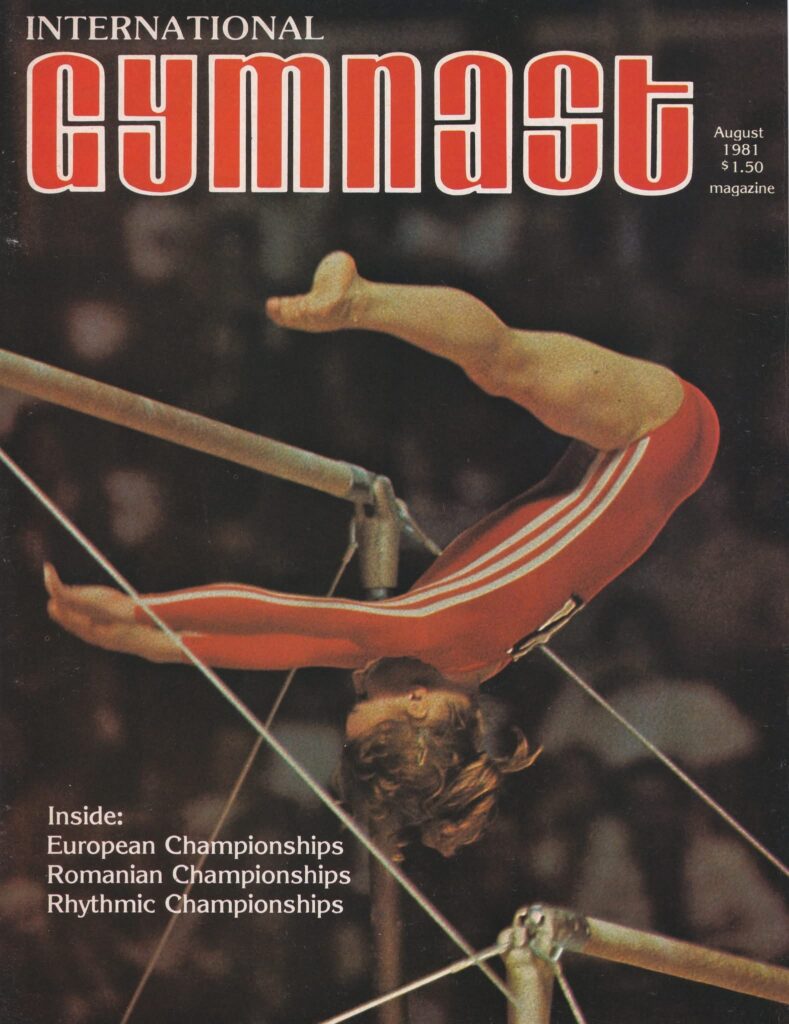
Misnik on the cover of International Gymnast
Categories
East Germany European Championships MAG Politics West Germany

1975: Wolfgang Thüne Defects from East Germany with the Help of Eberhard Gienger

At the 1975 European Championships in Bern, Switzerland, Nikolai Andrianov defeated Eberhard Gienger by a mere 0.050. But the real drama didn’t happen on the competition floor; it unfolded behind the scenes. East German gymnast Wolfgang Thüne, the 1974 silver medalist on high bar, vanished during the post-competition banquet, defecting to the West in an act that stunned his teammates and confused officials. For decades, whispers swirled. Had he hitchhiked across the border?

It wasn’t until 1999 that the truth came out. Eberhard Gienger, the legendary gymnast behind the eponymous high bar release move, had been keeping a secret for 24 years. It was he who had secretly driven Thüne across the border, and their story began in the most unlikely of places: in a bathroom.

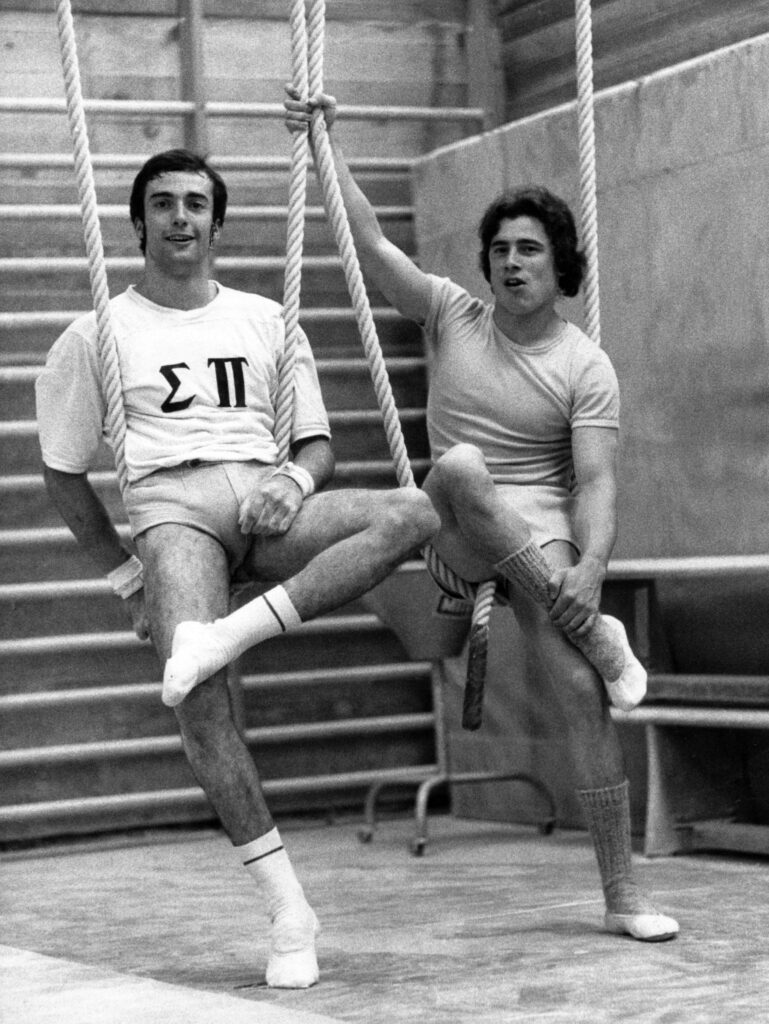
Datum: 17.09.1975, Eberhard Gienger (Left), Wolfgang Thüne (Right)
Categories
1977 European Championships Evolution FIG Bulletin FIG Congress

1977: Introducing Eight Gymnasts in Event Finals

At the 1977 European Championships, something new happened. Instead of there being six gymnasts in event finals, which had been the norm for nearly two decades, there were eight gymnasts in each apparatus final.

I know, it doesn’t sound like a major change, but the FIG lagged behind other sports like track and field, which started allowing eight finalists instead of six in the 1960s. 

But catching up to other sports wasn’t the only reason for including more gymnasts in finals. It was also to offer more opportunity to other athletes or, as it was phrased, to offer “greater equality of chance.” Arthur Gander and the executive committee, however, weren’t in favor of this proposal.

Let’s dive into what the FIG bulletins said…

Categories
1973 European Championships WAG

1973: Tourischeva Sweeps the Women’s European Championships

Only four gymnasts have swept the medals at the European Championships: Latynina in 1957, Čáslavská in 1965 and 1967, Tourischeva in 1973, and Boginskaya in 1990. All legends in their own right. And, as we’ll see below, Tourischeva won the floor title even with a fall during finals.

Looking back on this competition, vault was one of the more interesting events because much innovation was happening. Korbut introduced a full twist onto the horse. (Unfortunately, she was too injured to compete in finals and scratched after trying to sprint down the runway.)

Additionally, Tsukaharas, the vault that Tsukahara Mitsuo popularized in 1970, were becoming popular in women’s gymnastics. While others had competed the skill previously, Tourischeva, the reigning World and Olympic all-around champion, was now doing it, helping the vault seem less “masculine,” as one newspaper described it during the 1973 University Games.

Fun Trivia Fact: While the media coverage focused on Tourischeva and Korbut, neither gymnast received the highest score during the competition. Angelika Hellmann of East Germany did — with a 9.7 during the uneven bars finals.

So, with no further ado, here’s what happened at the 1973 European Championships in London.

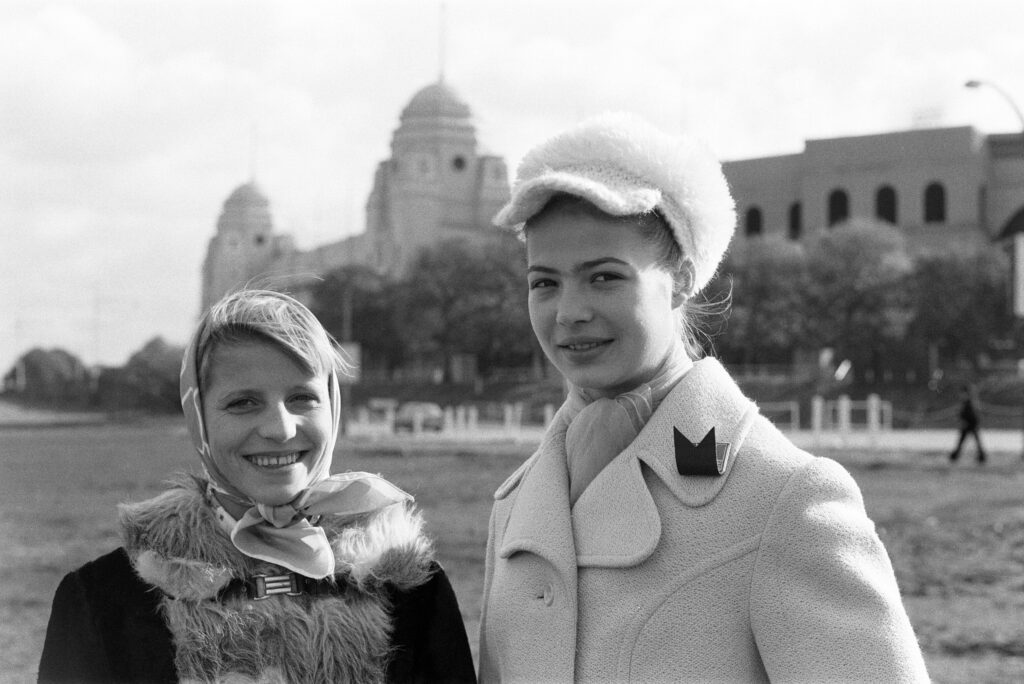
Olga Korbut and Ludmila Tourischeva take a walk around Wembley Stadium, London, 21st October 1973.
Categories
1973 European Championships MAG

1973: Klimenko Wins the All-Around at the European Championships

At the 1971 European Championships, Viktor Klimenko won the all-around. Then, while warming up for the event finals on floor, he tore his Achilles tendon. He managed to recover in time to win gold on pommel horse, silver on vault, and a silver with the Soviet team in Munich. One year later, in 1973, Klimenko once again found himself on top of the all-around podium at the European Championships in Grenoble, France.

But it was his teammate Nikolai Andrianov who pushed the sport’s difficulty level forward by debuting new elements: a double pike on floor as well as a full-twisting double back off rings. (Reminder: Tsukahara had competed a full-twisting double back off high bar in 1972, and one year later, Andrianov was doing the same dismount off rings.)

Also of note: Bernd Effing performed an Arabian 1 ¾ on floor in Grenoble, helping to usher in decades of roll-out skills (and concussions). And Eberhard Gienger added his own spin to Tsukahara’s full-twisting double back off high bar by performing the twist on the first flip.

While the gymnastics was exciting at the men’s European Championships, the organization of the competition left much to be desired. For example, they played the wrong national anthem for Eberhard Gienger. It happened during a historic medal ceremony where Gienger from West Germany and Klaus Köste from East Germany stood side by side on the podium.

Here’s a bit more about the 1973 European Championships in Grenoble.

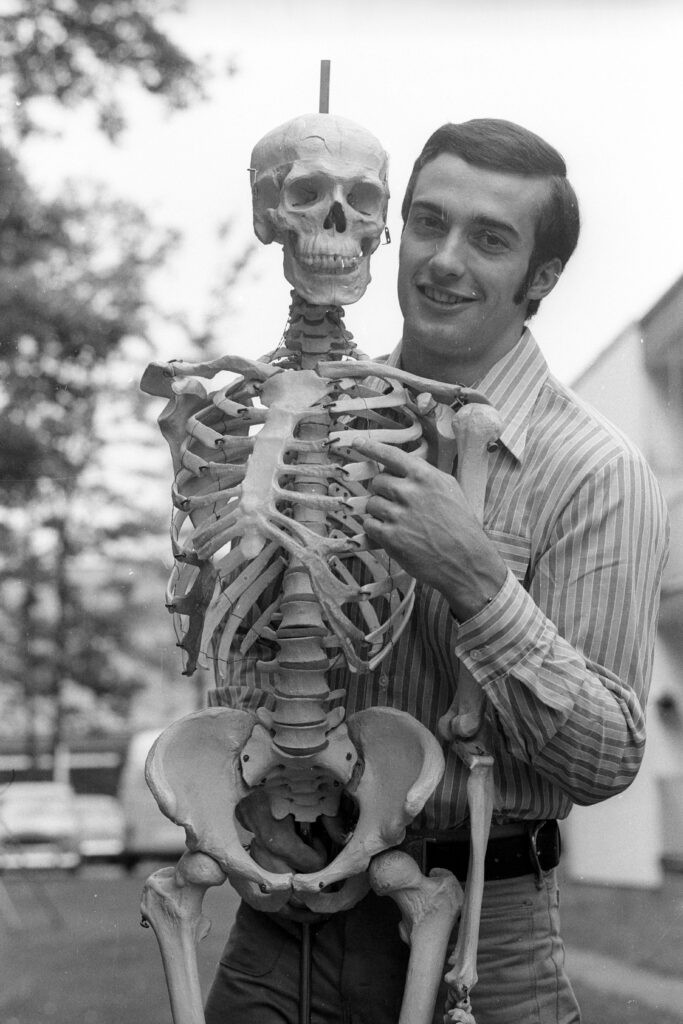
Eberhard Gienger (BR Deutschland) mit einem Skelett Eberhard Gienger BR Germany with a Skeleton

Note: I was looking for photos of the historic medal ceremony, but I couldn’t locate any. This is what I found instead.
Categories
1965 1967 Books Czechoslovakia European Championships

Čáslavská Remembers the 1967 Euros in “The Road to Olympus”

After Čáslavská’s disappointment in her performance in Dortmund, she debated if she should take a break from competing. Perhaps she had become too familiar to the judges, one coach suggested. (At one point in this section, Čáslavská recalls how the overly familiar Latynina was ignored during a press conference with Larisa Petrik in 1965.)

To make gymnastics exciting again, she and her coach Matlochová reworked all her routines, adding new elements to every routine. They made practice fun, with Matlochová riding a broom and trying to distract Čáslavská during her beam routines. They set her routines and training cues to music.

Čáslavská went on to compete at the 1967 European Championships. But Čáslavská had her doubts at the beginning of the competition. After a rough bar routine during the first rotation and an exceptional performance by Kuchinskaya on beam, Čáslavská was unsure if she would be able to defend her title. But right before beam, one of her superstitions happened. Someone broke a glass, and she had her lucky shards of glass. 

In the end, she became the only gymnast in the history of the European Championships to sweep all five events twice. She even scored two perfect 10.0s during the event finals.

Another interesting tidbit: For someone who ended up on top of the podium many times, Čáslavská disliked being on top of the podium. It made her feel awkward. 

So, with no further ado, here’s how Čáslavská recalls the 1967 European Championships in her autobiography from 1972.

Note: You can read more about the 1967 European Championships here and here.

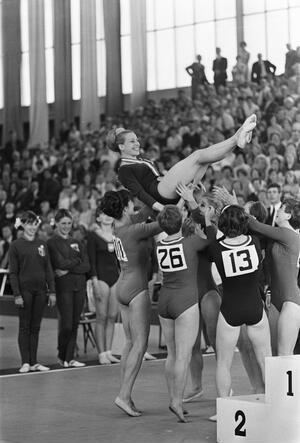
European gymnastics championships, Vera Caslavska being jockeyed, May 28, 1967, championships, gymnastics, The Netherlands
Categories
1965 European Championships Interviews & Profiles USSR WAG

1965: An Interview with Latynina before the European Championships

The gymnastics world had many questions for Latynina in the lead-up to the 1965 European Championships.

What did Latynina think about taking second place to Věra Čáslavská at the 1964 Tokyo Olympics? What did she think about taking second place to Larisa Petrik at the 1964 USSR Championships? Did she think she still had a chance to win the European Championships in 1965? What did she think of the current state of gymnastics with its ever-increasing difficulty, as epitomized by Čáslavská?

These are some of the questions that Latynina addressed in an interview printed in the Estonian sports magazine Spordileht on May 14, 1965, right before the European Championships in Sofia, where Latynina finished second behind Čáslavská.

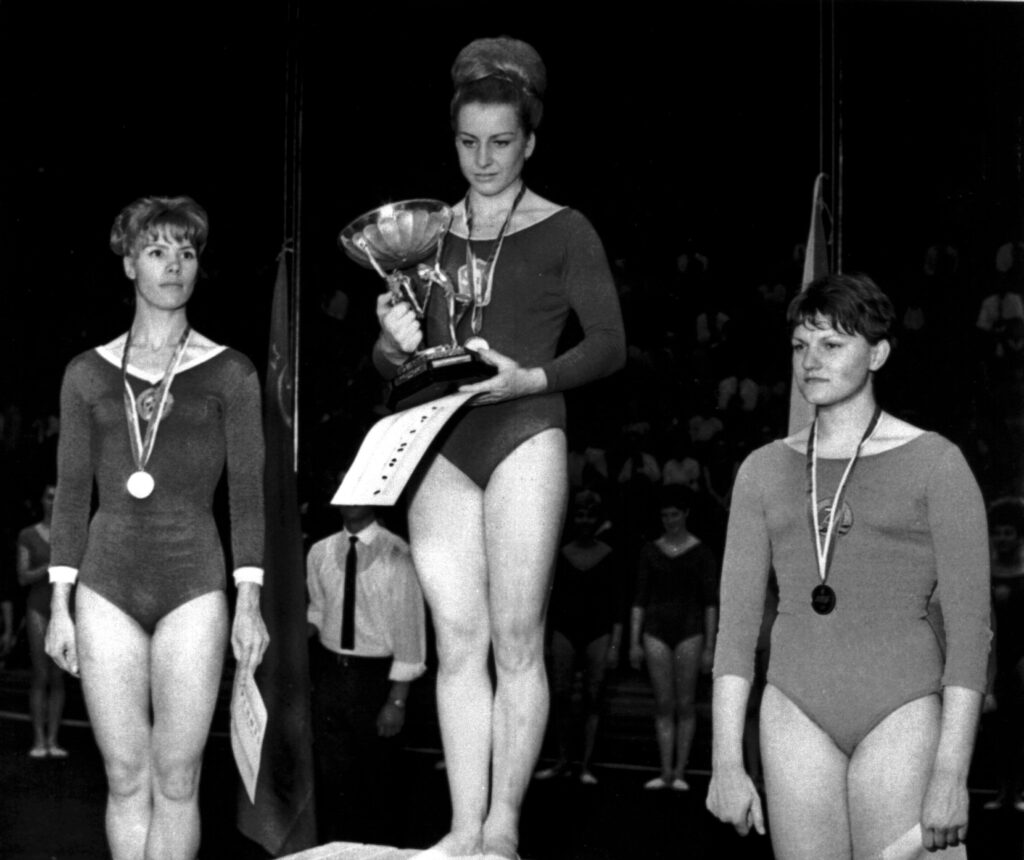
Copyright: imago/United Archives; European Gymnastics Championships, 1965, Sofia, Bulgaria. Pictured on the podium are gold medalist Věra Čáslavská of Czechoslovakia, silver medalist Larisa Latynina of the Soviet Union (left), and bronze medalist Radochla of the German Democratic Republic. 22nd May 1965.
Categories
1971 European Championships WAG

1971: Co-Champions at the Women’s European Championships

A peculiar situation arose at the 1971 European Championships in Minsk. Two gymnasts tied for the all-around title, but there was only one cup. Though the organizers did not break the tie for first place, they had to decide who should take home the European cup.

Let’s take a look at what happened in Minsk on Saturday, October 16, and Sunday, October 17.

Reminder: The men’s European Championships were much earlier in the year, in May.

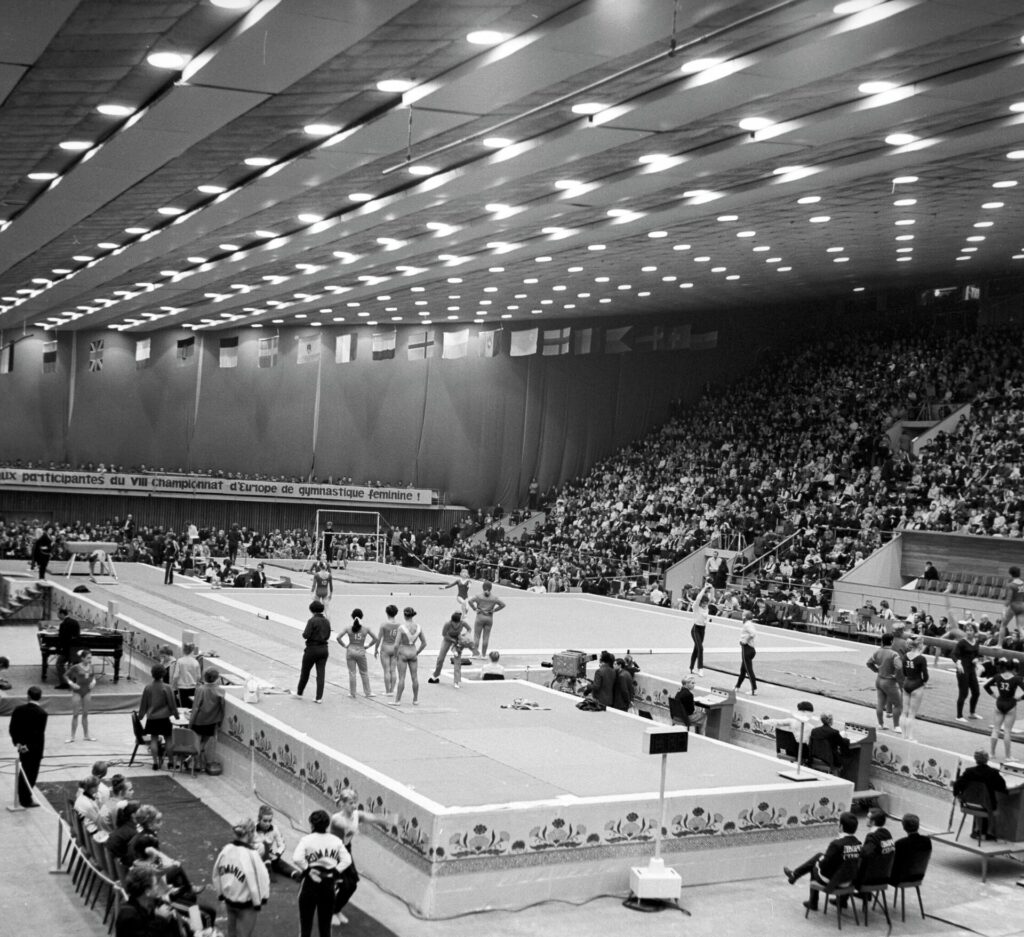
The arena in Minsk
Categories
1971 European Championships Interviews & Profiles USSR WAG

1971: An Interview with Lazakovich and Tourischeva before the European Championships

Just days before the 1971 European Championships, Nedelia, a weekly illustrated newspaper, ran an interview with Tamara Lazakovich and Ludmilla Tourischeva. (By the way, Lazakovich quit gymnastics, and the coach had to convince her to come back.)

In the same issue, another article looked at the state of Soviet gymnastics, comparing Lazakovich’s and Tourischeva’s distinct styles: “Wave and stone, poetry and prose, ice and fire — Tourischeva and Lazakovich.”

In addition, the article lamented that 13-year-old Nina Dronova could not participate in the European Championships due to her age, and it worried that she might tire of gymnastics before she had her chance to shine on the international stage.

Reminder: At the 1970 FIG Congress, the women’s artistic gymnastics delegates voted to lower the competitive age to 14.

What follows is a translation of the article on the state of Soviet gymnastics, as well as the interview with Lazakovich and Tourischeva (Nedelia, October 11, 1971).

Ludmilla Tourischeva, 1970 World Championships
Categories
1971 European Championships Judging Controversy MAG

1971: Klimenko Ends Voronin’s Streak at the Men’s European Championships

The 1971 Men’s European Championships were held in Madrid from Friday, May 14 (opening ceremony) to Sunday, May 16, 1971 (event finals). Here are a few key takeaways:

  • As expected, the competition was a fight between Voronin and his younger teammate Klimenko. 
  • The Soviet gymnasts swept the all-around podium.
  • Unfortunately, Klimenko tore his Achilles on floor during the warm-ups for the event finals.
  • Oh, and there was some questionable judging.

Want more info? Let’s dive in.

Source: Modern Gymnast, Nov. 1971