Trying to escape from one’s training environment is an almost universal experience in elite gymnastics. When Liu Xuan came down with mumps, her teammates envied her because the illness offered a rare break from training. In Romania, Rodica Dunca later described the Károlyi system as a “concentration camp” and recalled a failed escape attempt with Melitta Rühn and Teodora Ungureanu before the Securitate brought them back. Mihaela Stănuleț remembered a similar episode, claiming that she and Rühn tried to run away only for Béla Károlyi to send dogs after them.
Czechoslovakia was no exception. During the summer of 1985, a group of national team gymnasts slipped away from the centralized training center in Nymburk and spent the night in the surrounding woods. Below are two accounts of the incident: Jana Lábaková’s recollection from 1992 and the contemporary version offered by the national team coach. Read side by side, the two narratives seem to describe the same event from different perspectives. Together, they leave the impression that the full story of what happened in Nymburk has never been completely told—that what survives on the page may be only the tip of the iceberg.
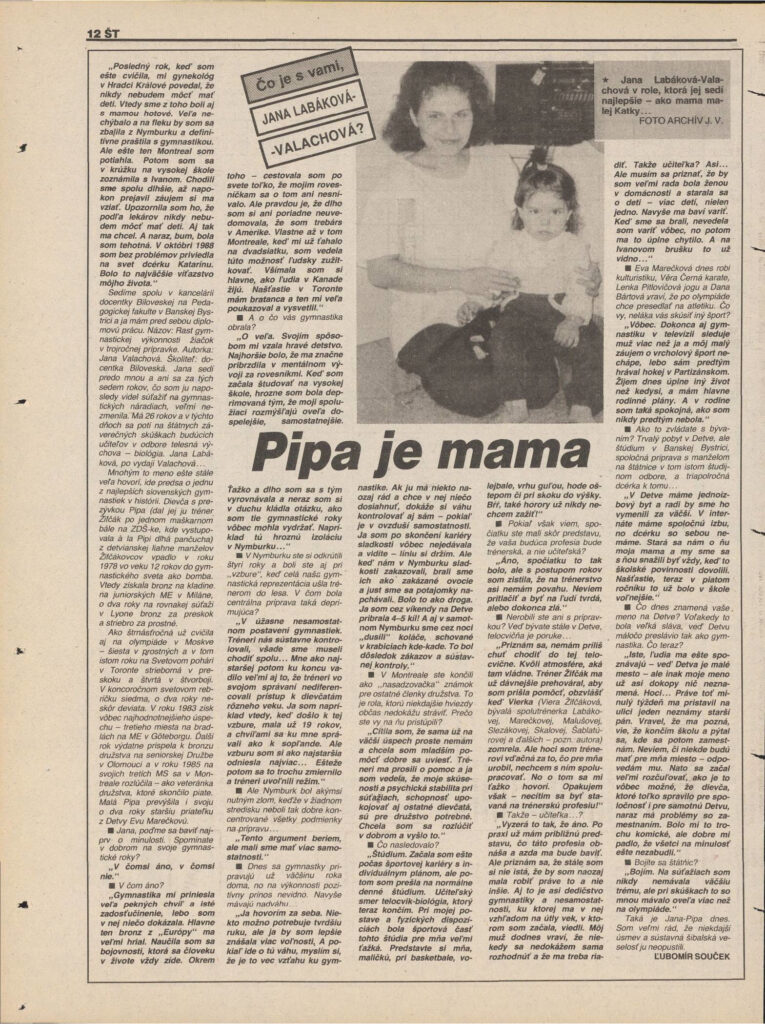
1992: Jana Lábaková’s Account
Pipa Is a Mother
What’s Become of You, Jana Labáková-Valachová?
“In my final year of competing, my gynecologist in Hradec Králové told me I would never be able to have children. My mother and I were devastated. I came very close to just walking out of Nymburk on the spot and quitting gymnastics for good. But I stuck it out through Montréal. Then, at a university club, I met Ivan. We dated for a while and eventually he expressed an interest in marrying me. I warned him that, according to the doctors, I would never be able to have children. And he wanted me anyway. Then suddenly — boom — I was pregnant. In October 1988, I gave birth without any complications to my daughter, Katarína. It was the greatest victory of my life.”
We are sitting together in the office of Associate Professor Bilovská at the Faculty of Education in Banská Bystrica, and before me lies a diploma thesis. Its title: The Growth of Gymnastic Performance in Female Pupils During a Three-Year Training Programme. Author: Jana Valachová. Supervisor: Associate Professor Bilovská. Jana sits across from me, and in the seven years since I last watched her compete on the apparatus, she has barely changed. She is 26 years old, and these days is sweating through the state final examinations for prospective teachers in the field of physical education and biology. Jana Labáková — Valachová by marriage.
For many people that name still means a great deal. She is, after all, one of the finest Slovak gymnasts in history. The girl nicknamed “Pipa” — the name given to her by coach Žifčák after a costume ball at the primary school where she appeared dressed as Pippi Longstocking — burst onto the gymnastics scene in 1978 at the age of twelve, emerging from the Detva training stable, which was run by the Žifčák couple. That year, she won bronze on the balance beam at the Junior European Championships in Milan; two years later, at the same competition in Lyon, she took bronze on vault and silver on floor.
At just fourteen, she was already competing at the Olympics in Moscow — finishing sixth on floor — and, that same year, won silver on vault and placed fourth in the all-around at the World Cup in Toronto. She ranked seventh in the end-of-year world standings, and, two years later, ninth. In 1983 came her most prized achievement: third place on the uneven bars at the European Championships in Gothenburg. The following year she contributed significantly to the team bronze at the senior Druzhba competition in Olomouc, and in 1985, at her third World Championships in Montréal, she made her farewell — serving as a team veteran on a squad that won a medal. Little Pipa even surpassed her Detva clubmate Eva Marečková, who was two years her senior.
■ Jana, let’s start with the past. Do you look back on your gymnastics years fondly?
“In some ways yes, in some ways no.”
■ In what ways, yes?
“Gymnastics brought me many beautiful moments and a certain sense of fulfilment; I actually achieved something in it. Above all, that bronze from the Europeans made me very proud. I learned a fighting spirit that will always serve you in life. And on top of that, I traveled the world so much that my peers could barely dream of it. But the truth is, for a long time I didn’t even properly appreciate that I was in, say, America. It wasn’t really until Montréal, when I was already approaching twenty, that I could experience it as a human being and take something from it. I paid particular attention to how people live in Canada. Fortunately, in Toronto, I have a cousin who showed me a great deal and explained things.”
■ And what did gymnastics take from you?
“A great deal. In its own way, it robbed me of a playful childhood. The worst thing was that it held me back considerably in my mental development relative to my peers. When I started studying at university, I was terribly depressed by how much more maturely and independently my classmates thought.
It was a long, hard adjustment, and many times, I silently asked myself how I had ever endured those years in gymnastics at all. That awful isolation in Nymburk, for instance…”
■ You spent four years in Nymburk and were also present during ‘the rebellion,’ when our entire gymnastics squad ran away from the coaches into the forest. What made the centralized training so demoralizing?
“The gymnasts’ incredibly constrained lack of independence. The coaches monitored us constantly; we had to go everywhere together… As the oldest member of the group, what eventually bothered me most was that the coaches made no distinction in how they treated girls of different ages. When the rebellion happened, for example, I was already nineteen, and at times they still treated me like a little kid. Being the oldest, I bore the brunt of the consequences of the rebellion the hardest. Fortunately, things eased up somewhat afterwards, and the coaches relaxed the regime.”
■ But Nymburk was a kind of necessary evil — nowhere else were all the conditions for training so well concentrated…
“I accept that argument, but we should have had more independence.”
■ Today, gymnasts train at home for most of the year, and the positive effect on performance isn’t obvious. What’s more, they tend to be overweight…
“I’m speaking for myself. Some people may need a firmer hand, but I would have managed better with a degree of freedom. As for the weight issue, I think it comes down to one’s relationship with gymnastics. If you truly love it and want to achieve something in it, you can control your weight on your own — provided there’s enough independence in the environment. Since retiring, I’ve never eaten sweets at all, and as you can see, I’ve kept my figure. But when sweets were forbidden in Nymburk, we treated them like contraband fruit and secretly stuffed ourselves. It was like a drug. On weekends in Detva I’d put on four or five kilos! And even in Nymburk itself, we’d secretly ‘smother’ cakes at night, hidden away in boxes all over the place. That was the result of the prohibitions and constant surveillance.”
■ At Montréal you served as a ‘score-setter’ for the rest of the team — the one who goes early to establish the scores. It’s a role that some former stars find hard to accept. Why were you willing to take it on?
“I felt that I simply no longer had what it took to win a big result on my own, and I wanted to help the younger girls make a good showing. The coaches asked for my help, and I knew that my experience and psychological composure in competition — my ability to calm the other girls down — were needed by the team. I wanted to bow out on a positive note, and it worked out.”
■ What came next?
“Studies. I had already begun during my sporting career on an individual plan, but then I switched to regular full-time study — the teaching track in physical education and biology, which I am now finishing. Given my physique and physical make-up, the sports component of this degree was extremely demanding for me. Just picture me — tiny little me — playing basketball, volleyball, throwing the shot put, hurling the javelin, or doing the high jump. Ugh, I never want to go through anything like that again!”
■ As far as I know, you initially envisaged a career in coaching rather than teaching?
“Yes, that was the original idea, but over the years, I came to realize that I probably don’t have the temperament for coaching. I don’t know how to push people, to be hard on them, or even harsh.”
■ Have you not done any work with the junior squad? After all, you still live in Detva and the gym is right there…
“I’ll be honest — I don’t really feel like going to that gymnasium. Because of the atmosphere there. Coach Žifčák has been asking me for some time to come and help, especially since Vierka — Viera Žifčáková, who had been co-coach to Labáková, Marečková, Malušová, Slezáková, Skalová, Šablatúrová and others [editor’s note] — passed away. But even though I’m grateful to the coach for everything he did for me, I don’t want to work with him. That’s difficult for me to talk about. I’ll say again, though; I simply don’t see myself as cut out for the coaching profession!”
■ So — a teacher then?
“It looks that way. After my teaching practice, I have a fairly clear idea of what the profession involves, and it may well suit me. But I’ll admit I’m still not entirely sure whether that is really what I should be doing, rather than something else. That uncertainty is probably also a legacy of gymnastics — of the lack of independence it instilled in me because of the young age at which I started. My husband still says today that I sometimes can’t make decisions on my own and need to be directed.
So, a teacher? Perhaps. But I must admit that what I would most love is to be a homemaker and care for children — more than one child. I also love cooking. When we got married, I couldn’t cook at all, but then it completely took hold of me. And it’s beginning to show on Ivan’s belly…”
■ Eva Marečková is now doing bodybuilding, Věra Černá does karate, Lenka Pitlovičová does yoga, and Dana Bártová says she wants to switch to athletics after the Olympics. What about you — are you tempted to try a different sport?
“Not at all. My husband actually watches more gymnastics on television than I do, and he can’t understand my lack of interest in elite sport, since he himself used to play hockey in Partizánske. I lead a completely different life now from before, and my plans are above all family ones. And within my family, I am happier than I have ever been.”
■ How do you manage the logistics? A permanent address in Detva, studies in Banská Bystrica, preparing for state exams together with your husband in the same subject area, and a three-and-a-half-year-old daughter on top of everything…
“In Detva, we have a one-room flat, and we’d be glad to swap it for something bigger. At the student residence, we share a room, but we don’t have our daughter with us there. My mother looks after her, and we try to be with her whenever our academic duties allow. Fortunately, now in our fifth year, things have become more relaxed at university.”
■ What does your name mean in Detva today? It used to carry great prestige — after all, few things put Detva on the map the way gymnastics did. What about now?
“People still recognize me — Detva is a small town — but otherwise my name probably doesn’t mean much anymore. Although… Just last week, an elderly man I didn’t know stopped me in the street. He said he recognized me, knew I was finishing school, and asked where I planned to work afterwards. ‘I don’t know if there will be a position for me anywhere,’ I told him. At that, he became quite agitated — how could it possibly be, he said, that this girl who had done so much for society and for Detva itself was suddenly facing problems finding employment. It struck me as a little comical, but it also felt good that not everyone has forgotten the past.”
■ Are you nervous about the state exams?
“Very. I never had much stage fright in competition, but at exams, it affects me far more than it ever did at the Olympics.”
That is Jana-Pipa today. I am very glad that her old smile and her persistent, mischievous cheerfulness have never left her.
Ľubomír Souček
Šport Tipujúcim, May 26, 1992
1985: The Head Coach’s Account
Will Our Smiles Fall Apart, Too?
After three years, the centralized training program for artistic gymnasts ended in Nymburk on November 29, 1985
There were just six of them in the gymnasium, with their coach. Six of our artistic gymnast national team members, who in three days’ time — on the last Friday of November — would see the conclusion of the three-year cycle of centralized preparation in Nymburk. In the morning, all the girls attended a large gathering at “their” gymnasium in Nymburk. There, they said their farewells and thanked one another. The teachers said that it was precisely these pupils of theirs who had awakened in them an interest in sport. Then, in the afternoon, came the training session in question. When Mirka Koblížková pulled off a tumbling in her floor exercise, coach Stanislav Vyzin remarked, “Well, look what a student who gets ones in chemistry can do!” That, too, was a symptom of the closing of the centralized program. After returning from the World Championships in Montréal, the girls had been waiting at the gymnasium for their end-of-term exams. The mood was already one of farewell.
[Note: “Jednotka z chémie” — in the Czechoslovak grading system, 1 is the top mark (equivalent to an A), so Vyzina is affectionately boasting that his gymnast is also an excellent chemistry student, not a poor one.]
National team coach S. Vyzin found time after dinner to assess the three-year project that makes artistic gymnastics unique within our elite sport system.
■ The centralized training program opened on September 1, 1982. With what goal?
“The immediate reason for renewing centralized preparation — which had also existed before the Moscow Olympics under my predecessor, V. Prorok — was the performance at the 1981 World Championships. There, the girls failed to reach a single apparatus final. This model was adopted on the basis of our previous experience and knowledge from other countries. The goal of centralized preparation was first to halt the decline of our women’s gymnastics and then to bring about its rise.”
■ The facts show that it worked. Since 1983, we have not returned from a major event without a medal. At the 1983 European Championships, Labáková won bronze on bars; at the 1983 World Championships, Říčná won silver on beam; at the 1983 Universiade, Gajdošová won silver on bars; at the 1984 Druzhba, Říčná won silver in the all-around and silver on beam, Dřevjaná won bronze on beam, and the team won bronze; at the 1985 European Championships, Říčná won silver on beam; and at the 1985 World Championships, Říčná won bronze on bars. What do you see as the reasons?
“Above all, the combination of conditions that were created in Nymburk. It involved centralizing training, accommodation, catering, schooling, recovery, and medical facilities in one place. The only wasted time was really the journey to school, about twenty minutes from the Jana Šverma Sports Center. Nymburk had become, in short, the kind of facility our other elite sports centers are not. Only residential sports schools come close to it in character. Gymnastics is a specific sport that, not least because of the low age of competitors, cannot afford to lose time on long journeys across cities. One could say that Nymburk in this way came close to the ideal.”
■ Why only close?
“Because even here, the conditions that several countries have were not created — countries that are often behind us in performance terms. It is not just about apparatus and foam pits, but also about a long tumbling strip, the so-called dorožka, with the option of jumping into a pit. I have worked in elite gymnastics for eleven years and have often traveled with my former charges, Černá and Brýdlová, to Leipzig. In their hall, they had ten beams, five sets of bars, two floor areas, and so on. The results of the work in the GDR were then commensurate with the conditions, but also with the quality of the coaches’ work. Our facilities are considerably worse equipped. For example, at the SVŠ Prague, where the largest number of national team members train, there is only one set of bars. Trampolines are also absent, and the aforementioned tumbling strips are often too short. The consequence is visible in the acrobatic abilities of our girls, where we continue to lag behind. And yet acrobatics is like the lifeblood that flows through every apparatus. Nymburk is better equipped than most centers, but we expected that, after the successes of 1983–84, the gymnasium would be expanded by knocking through the wall into the adjacent hall. That never happened.”
■ Could you recap the ups and downs in the development of the centralized program?
“That would be a long story. Over three years, virtually all the gymnasts who were in the broader national squad passed through here — that means over thirty girls. The coaching staff also changed quite a bit. So, I will really just name this year’s Nymburk ‘lineup’: beam coach S. Kobyláková, assistant coach E. Szlauer, Soviet choreographer L. Sokolova, my wife, Anita, and myself, plus pianist R. Kyznar, physician MUDr. Balcar, masseuse M. Mojžíšová, and the psychologist couple the Machačovs came to Nymburk for consultations. The gymnasts here in the last year were L. Pitlovičová, I. Poloková, J. Labáková, A. Dřevjaná, M. Koblížková, J. Částečková, L. Vajsová, H. Lipovská, R. Pilečková, J. Vejrková, J. Šourková, and I. Červenková.”
■ From that final group, who contributed what to shaping the girls as people, not just as elite athletes?
“First of all, I must mention Lilla Sokolova, who helped us enormously in every respect. For me she embodies the ideal of the Russian person — broad-souled, deeply philosophical, a genuine personality. She could push the girls in training relentlessly, but when she saw they were at their limit, she would suddenly stroke their hair and comfort them. She was distinguished by an extraordinary sense of fairness. The girls loved her, because they felt the love and desire to help them coming from her side, too. Erich Szlauer is a young man who was closer to their way of thinking. They opened up to him in ways they did not with us. My wife — formerly a national team member as Šauerová — was involuntarily transformed from assistant into the role of educational advisor. The girls confided everything to her, and thanks to that, we were often able to resolve things more easily. The role was difficult, however, because Anita is only three years older than Labáková. Rudolf Kyznar contributed by showing up to training punctually and occasionally keeping spirits up with humor. MUDr. Balcar was a kind of ‘weeping willow’ to whom they came to cry out their worries and pains. And the Machačovs taught them relaxation and how to handle stress. They have great experience, they were able to look at the girls differently than I could, and so they helped us mutually in finding ways through personal problems. All the joys and hardships of working together have convinced me that today elite preparation cannot be the concern of a single coach, but of an entire team of people.”
■ The hardest period of the centralized program?
“The beginning. That was when the process of adaptation took place, something we had no prior experience of. Training proceeded with extraordinary intensity, but performance was poor for a long time despite that, and injuries appeared. Only when the second wave arrived with the same problems — while the first group was already doing beautifully — did I convince myself that this is a natural process. That is why I think running a centralized program for only half a year would be foolish.”
■ There were many objections to the centralized program from club coaches…
“That is true. Centralized preparation represented a radical break, and not everyone understood it. Personal coaches felt that the girls had been taken from them. But that conflates working for the national team with taking ownership of the athletes personally. When a girl’s performance grew at Nymburk, some coaches took it as an attack on their own coaching abilities, rather than being glad that the girl was improving. Many coaches looked no further than the ČSSR Championships and said that preparation for the World Championships was already the national team coach’s business. But that kind of thinking is incompatible with conceptual work. The fact is that with the establishment of centralized preparation, club coaches lost their ability to put pressure on the national team coach.”
■ Many objections concerned the isolation of the young girls and their limited contact with their parents…
“Cabin fever would set in after about three weeks of continuous stay in Nymburk, and that was when we would organize trips out. The longest we stayed here continuously was this year — two months, because of the hepatitis quarantine following Šourková’s illness. As for that isolation, the girls adapted very quickly. They were suddenly thrown back on their own resources and had to be more self-reliant. That certainly helped them greatly for the rest of their lives, too. When they made a mistake, they always paid for it; no one smoothed it over for them. Gymnastics is beautiful in that everything must be earned through work; there can be no accidental success. The girls also learned this, and in their personal lives, they will draw on it. They managed to organize their own evenings in ways that sometimes surprised us. After all, the thick chronicle they kept, with Jana Rulfová and later Mirka Koblížková contributing most of the illustrations, proves that they did not live monotonously. Through this independence, they became a genuine collective. At the World Championships in Montréal, they proved it; we saw fighters there. If you could see the once timid Dřevjaná today, confidently fielding questions from an audience of four hundred people at a school discussion, you would not recognize her. So I do not agree with the implied criticism in your question. Even the girls who left Nymburk still correspond with the younger ones. I have often spoken with the parents of individual team members. They confirmed that, by the third day home, they were already missing Nymburk. This summer, there was a big fuss about the gymnasts’ ‘escape’ and a night they spent in the nearby forest. When we talked it through together, it emerged that it was a momentary bout of stress, defiance against the training load. But again it turns out to me that they achieved collectivism because they escaped together. When you speak of the problems of isolation, we adults had it far worse. We lived on the same corridor as fifteen- and sixteen-year-old girls, with no privacy. And yet we have a much broader horizon and range of interests. The problem was with the adults, not with the gymnasts. That is where the conflicts arose.”
■ What was the recent role of the team’s ‘senior member’ Labáková?
“Pipa is an optimistic person. She was a fresh breeze and the spokesperson of the group of girls, and, at the same time, the glue that held together the team. Her greatest contribution came at the 1985 World Championships, where she was able to accept the lead-off role, in other words, sacrificing personal interests for the team’s benefit. The same applied to Koblížková. With Jana, we occasionally talked through problems, and she conveyed our views to the girls.”
■ There were also cases of gymnasts leaving Nymburk for individual preparation — for instance Říčná, Šarišská, Červenková…
“Hana Říčná was here for one year — until the 1983 World Championships. We handled the situation with her very sensitively, because Hanka is an exceptionally complex personality with high intelligence and a strong bond with her coach, Kříž. In principle, I was not against her individual preparation, because in Brno, where two coaches give her special attention, she had conditions at least as good as in Nymburk. Just as her coaches did, she received her grounding in Nymburk mainly in choreography, and that trio subsequently realized it successfully. Her preparation in Brno benefited the national team. With Katka Šarišská, who, with increasing age, was simply not keeping pace with the world trend in performance terms, individual preparation was better from a psychological standpoint. Iva Červenková, after the aggressive rise mainly of Poloková and Pitlovičová, found herself in a similar situation. She is an exceptional beam worker and excellent on floor, but bars and vault do not come naturally to her. For the team, however, we needed an all-arounder, not a competitor with only fifty percent quality across the board. On top of that, Iva put on an outward show of indifference, even though she certainly suffered psychologically. We resolved the situation with her departure. Some team members — Tichopádová, for example — trained individually the entire time. That was a matter of agreement with the coaches.”
■ What did our encounter with the world at the November World Championships in Montréal reveal? Where does the most work await us?
“The long-term problem is acrobatics. It will remain a problem until we change the entrenched training system of focusing mainly on bars and beam. Everything must be trained every day! We had several juniors arrive here who had problems in floor exercise with double saltos that gymnasts in developing countries perform routinely. The juniors arrived poorly prepared technically, as well. It was a gigantic task for us to correct the technique of basic shapes, teach them new skills, devise original elements, and, on top of that, teach them entirely new compulsory routines. I also see as our psychological problem the constant handover of girls to different coaches. We should seek a way for girls to remain with capable coaches. A capable coach will identify his own mistakes through them and improve himself. On the positive side, the increased number of competition appearances before the 1985 World Championships was a plus. If only it could last!”
■ What path for team preparation do you see now?
“If we want to be at world level, there is only one way — centralized preparation! Since that is now being disbanded and its role taken over by the SVŠ schools, it means trying at least to adjust the training regime and the whole daily routine within them, and to improve conditions. The ideal would probably be a combination of the SVŠ and IŠŠ possibilities. But I consider the ideal to be centralized preparation, with one coach per competitor. That is not currently possible given our small number of coaches — it would weaken the local centers and youth development. Nevertheless I believe that over three years we have demonstrated the validity of centralized preparation. I would like to continue with it. Because it is being disbanded, I do not intend to remain in the position of national team coach, which I have held for five years. One more argument in Nymburk’s favor: our illness rate dropped. From the previous forty to sixty days of sick leave, we have now arrived at eight days!”
[SVŠ — Športová výberová škola, meaning “sports selection school.” These were regular secondary schools with a specialist sports track, where talented young athletes could combine normal schooling with intensive training. They were the main alternative infrastructure to centralized preparation.]
■ A parting word?
“When we started in Nymburk three years ago, there was a crowd of people at the opening. We are finishing in silence. The parents have mixed feelings about it, too. Won’t there be any ceremony? they asked me. We almost have the feeling that we have done something wrong. The federation should have found a moment of time…”
The centralized program is disbanding; one era is ending. But will our smiles fall apart, too? Let us reflect together. The world express train will not wait for us. Once before — after the 1968 Olympics — we missed it, and it took years before our artistic gymnastics shone with medals again. The team bronze at the 1970 World Championships, Perdykulová’s bronze at the 1974 World Championships, and Černá’s gold at the 1979 World Championships — those were occasional flights upward. But we have been climbing steadily only in these last three years…
ĽUBOMÍR SOUČEK
Šport, December 10, 1985
More on Czechoslovakia