The 1974 World Championships maintained the status quo. In Munich in 1972, the Soviet team came in first, the East German team in second, and the Hungarian team in third. The same was true in Varna in 1974.
But there were some surprises, primarily from the Romanian team. At the 1972 Olympics, they were sixth, finishing 7.55 points behind the third-place Hungarians. Two years later, they were fourth, finishing only 1.30 points behind the third-place Hungarians. And, as the European gymnastics community knew full well, the Romanians were going to pose a challenge in the future thanks to a young group of rising stars led by Nadia Comăneci. (You may have heard of her.)
Another surprise: Two years after Olga Korbut and Nancy Thies did standing back tucks on beam, the world saw one of the first layout stepouts — as performed by Romania’s Aurelia Dobre (Unfortunately, the news reports did not record the skill, but Hardy Fink got it on video. You can see it below.)
There were also accusations of score-fixing both by the Soviets and the president of the Women’s Technical Committee. (As we’ll see in the post about event finals, Korbut also alleged that the Soviet leadership engaged in behind-the-scenes machinations.) Even the audience was upset about the scoring. After a piked Tsukahara by U.S. gymnast Ann Carr, they protested her 9.4 for roughly several minutes.
Here’s what happened on Monday, October 21 (compulsories/competition 1a), and Wednesday, October 23 (optionals/competition 1b).
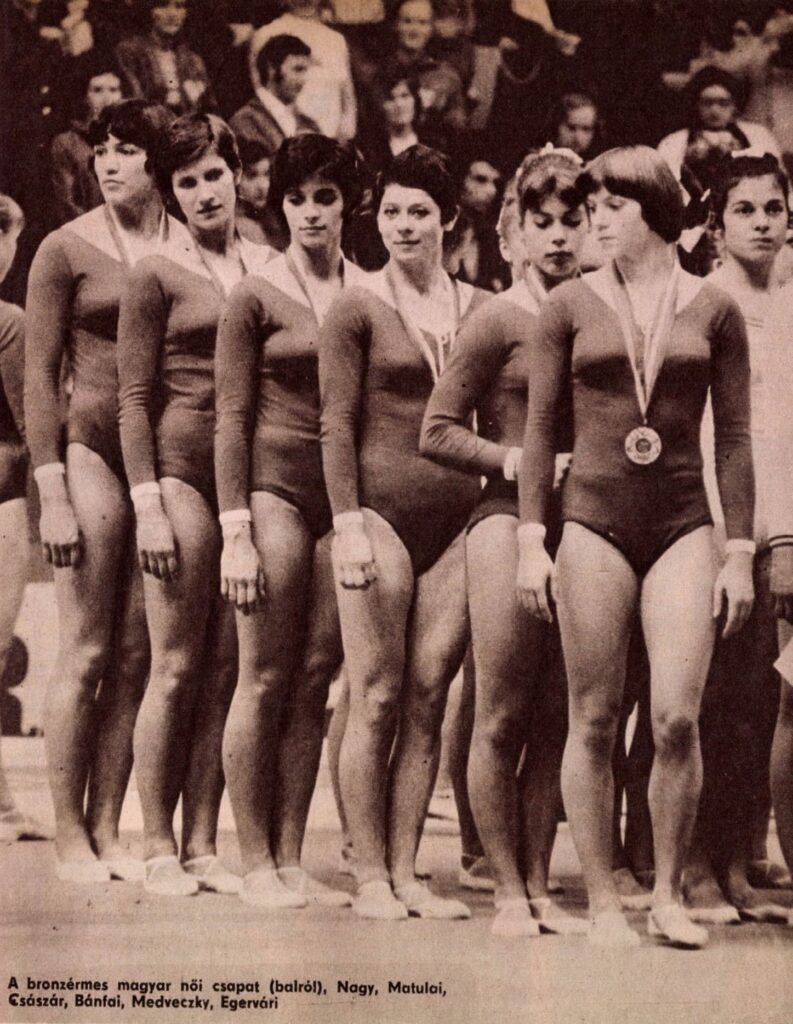
Hungary’s team, Source: Képes Sport, October 29, 1974
Note: Quality photos are hard to find for these World Championships
Varna, Bulgaria was set to hold the 1974 World Championships. However, the Gymnastics Federation of Bulgaria could not guarantee that the government would issue visas to participants from all affiliated federations, most notably South Africa. (Bulgaria and South Africa did not have official diplomatic relations until 1992.) As a result, the competition was briefly moved to Munich, but then, it was moved back to Varna again.
This was a big deal. Moving the World Championships is not an easy task. Here’s how Valerie Nagy, president of the Women’s Technical Committee, described it:
A year full of agitation and problems is now over. An extraordinary meeting of the assembly general had to be convened and, for a long time, we did not know [w]here the 1974 World Championships would be held. This uncertainty naturally caused a great deal of anxiety, and the Championships themselves were almost called in question.
FIG Bulletin of Information, no. 1, 1975
What follows are the official FIG communications about the decision, as well as contemporaneous commentary. The West German Gymnastics Yearbook went as far as to say that the World Championships in Varna were “illegitimate,” while the Deputy Chairman of the Bulgarian Union for Physical Education and Sports accused the FIG of trying to “drag those South African racists into the World Championship thus depriving Bulgaria of the right to organize it.”
Reminder: This was not the first time that the FIG ran into problems with visas for South Africans. In 1969, the FIG tried to hold a qualifying competition for the 1970 World Championships, but due to issues with South Africa’s visas, the meet no longer counted as a qualifying competition.
Bulgaria, Black Sea Coast, Varna, elevated city and port view, morning
In 1973, at the General Assembly in Rotterdam, Netherlands, it became clear that the executive committee was growing frustrated with Bulgaria’s organization. Answers were not quick to come by, especially when it came to the question of visas. Here’s an excerpt from the minutes of the 52nd Meeting of the General Assembly:
The question of knowing how many teams will be able to take part in the 1974 World Championships in Varna gives rise to very lively debate and numerous speakers express their dissatisfaction at having not yet received a decision from the organizers.
[…]
The president, Mr. Gander, replies that a definitive answer must reach the FIG by 15th December 1973, also covering the question of visas. He goes on to point out that the World Championships must be worthy of their name. It is absolutely essential that a certain standard must be maintained.
52nd Meeting of the Assembly General
13th November 1973, Rotterdam
FIG’s Bulletin of Information, no. 4, 1973
Note: As indicated above, the FIG had to briefly consider using a qualification system for the 1974 World Championships because the event organizers wanted to “reduce the contingent to 24 groups of gymnasts for the men and to the same number for the women” (FIG Bulletin, no. 3, 1974). In the end, a qualification system was not used, but visas remained an issue.
1974: Moving the World Championshipsto Munich
The Executive Committee held a meeting in Bienne, Switzerland, in April 1974. During that meeting, they chose to move the World Championships to Munich in part because the competition was meant to be open to all affiliated federations — something that the Gymnastics Federation of Bulgaria could not guarantee due to visa issues.
Here are the reasons recorded in the FIG’s Bulletin of Information:
6. 1974 World Championships
Taking into account:
— the decisions taken by the 1973 assembly general in Rotterdam
— the result of the enquiry carried out among the affiliated federations
— the fact that the Bulgarian Gymnastics Federation is unable to give the required guarantees ensuring that the Championships may take place in accordance with the statutory prescriptions (Art. 34)
— the numerous personal interventions made by the president of the FIG who has pointed out the dangerous consequences of failing to observe the statues both to the president of the Bulgarian Federation and to the Bulgarian Minister for Sports, the Executive Committee has been obliged to seek another organizer, this decision having been taken by a vast majority. Two federations have spontaneously made themselves available for this office, Spain and the German Federal Republic. Priority having been accorded the German Federal Republic because of already existing installations, the 1974 World Championships will now be taking place in Munich from 20th-20th October 1974.
Extract from the minutes of the Executive Committee meetings held in Bienne, April 10-14, 1974
Printed in FIG’s Bulletin of Information, no. 2, 1974
Note: Article 34 of the FIG statutes stated, “The entry visas must be granted to the gymnasts and officials of all member associations.”
1974: Moving the World Championships back to Bulgaria
After awarding the World Championships to Munich, they moved the competition back to Varna even though doing so violated the federation’s statutes. As the FIG’s president stated, this decision should not become a precedent: “In spite of all this, in [the] future, the decision of Montreux must not be invoked as a precedent.”
Here’s the full English translation found in the Bulletin of Information:
After the Meeting of the Extraordinary F.I.G. Congress Held in Montreux, July 18-19, 1974.
The record participation of 51 of the 67 federations affiliated to the FIG leaves no room for doubt concerning the intensity of the combat being fought to obtain the return of the World Championships for artistic gymnastics to the Bulgarian town of Varna. These Championships were transferred by the Executive committee to Munich subsequent to a violation of the statutes.
The decision was taken by 26 votes against 24, with one abstention, in favour of the Bulgarian town on the Black Sea and the 18th World Championships will no definitively be held in Varna from 20th to 27th October 1974.
This decision, together with the violation of the statutes which it involves, must not either influence the preparatory work nor disturb the smooth running of this international event. By the same token, good understanding between members of differing opinions should not in any way be disturbed or negatively influenced. It is regrettable that one of our federations affiliated in a perfectly regular manner should be excluded by this decision from participation in Varna.
In [the] future, we shall have to solve the problem of our general legislation and its regulation appreciation, by dealing with this matter at the next ordinary congress. In spite of all this, in [the] future, the decision of Montreux must not be invoked as a precedent.
Today, it is a question for all of us who are anxious to maintain a truly democratic spirit to try to adapt ourselves to a situation just as this which has just arisen in Montreux as, irrespective of the factors leading to the situation, efforts must be made to keep in line with the majority.
The federations have already been informed regarding the formalities of application. It will also be noted that a meeting of the special commission of the Technical FIG Committees for the drawing of lots and the establishment of work plans will already take place on 27th and 28th August in Varna. The work plans must be in the hands of the federations and other interested parties by 20th September. The definitive nominative applications must reach the FIG General Secretariat at the latest by 28th September 1974.
May all this courageous zeal on the part of our athletes lead to a common ideal as well as to the establishment, by sport, of genuine relations and closer understanding among the peoples, irrespective of their politics, religion, or race. May these 18th World Championships for artistic gymnastics take place with dignity and prove a tremendous success!
Arthur Gander, president of the FIG
FIG’s Bulletin of Information, no. 3, 1974
Before the World Championships: Bulgaria’s Response
Hristo Meranzov, the Deputy Chairman of the Bulgarian Union for Physical Education and Sports, was not pleased with the FIG. Here’s what he said on the eve of the World Championships — as printed in Sovetsky Sport:
Hristo Meranzov. The World Gymnastics Championship is regarded in Bulgaria as the most important sport event. The leaders of the Communist Party of Bulgaria watch closely the preparations for the championship. Comrade Zhivko Zhivkov, the organization committee chairman and deputy chairman of the Ministers Council of Bulgaria, also gives it his every day attention.
No matter how hard some characters of the International Gymnastics Federation tried to drag those South African racists into the World Championship thus depriving Bulgaria of the right to organize it, we were confident that the world’s strongest gymnasts would come to Varna and did not pause our preparations to meet them. We felt the support of the sports community of the Soviet Union and other socialist countries. We strive to ensure that the World Cup becomes a real feast for its numerous participants, spectators and for all sports fans of Bulgaria.
Nikola Hadzhiev. 314 athletes from 35 countries will take part in the competition. 21 countries will present their complete men’s teams; 23 countries will present their women’s teams. Those who were expecting the failure of the championship made fools of themselves.
Meranzov. I will add that numerous tourists from a dozen countries, including Japan and the USA, will come to Varna. The largest gymnastics fans group will come from the Soviet Union.
Hadzhiev. The gymnasts will be accommodated in the best Varna hotels on Golden Sands, such as Intercontinental, Ambassador, Shipka, Kamchie, Sportpalace, etc. The championship participants will also enjoy the vast cultural program we prepared for them. They will attend performances by the famous Bulgarian singer Yordanka Hristova, the world-famous children’s choir of the Bulgarian Radio and Television, and attend a Varna Symphony Orchestra concert. Athletes will be able to discover the wonderful resorts of Varna and Albena, and visit the giant of Bulgarian chemical industry — the Devnya plant.
The championship opening will be a big theatrical celebration at the Palace under the motto “Gymnastics is the sport of the people.”
The choice of the motto was not made by chance. Gymnastics is very popular in Bulgaria. Although our leading athletes have not yet achieved major success on the international stage, they train for the championship in Varna with a particular diligence. Soviet experts, such as Candidate of Pedagogical Sciences Evgeny Zemskov and Honored Trainer of the RSFSR Vyacheslav Rudakov, were of big help. We hope to see both men’s and women’s teams in the top ten, we also hope that our athletes, under the guidance of Bulgarian champions Maya Blagoeva and Stefan Zoev, will perform well in the individual competitions too.
Meranzov. I would like to acknowledge the great role our Varna comrades played in the exemplary preparation for the championship. I encourage you to talk about it with the BUPCF district council chairman, Dino Dimitrov.
Sovetsky Sport, no. 246, Oct. 19, 1974
Христо Меранзов. Чемпионат мира по гимнастике расценивается в Болгарии, как важнейшее спортивное событие. За подготовкой к нему внимательно следят руководители Компартии Болгарии, нашего государства. Повседневное внимание ему уделяет председатель организационного комитета, заместитель председателя Совета Министров Болгарии тов. Живко Живков.
И как ни старались некоторые деятели Международной федерации гимнастики протащить на чемпионат мира расистов из ЮАР, лишив Болгарию права на организацию первенства, мы верили, что сильнейшие гимнасты мира приедут в Варну и не переставали готовиться к встрече с ними, Мы чувствовали поддержку спортивной общественности Советского Союза, других стран социализма. Мы стремимся к тому, чтобы чемпионат мира стал настоящим праздником для его многочисленных участников и зрителей, для всех любителей спорта Болгарии.
Никола Хаджиев. В соревнованиях примут участие 314 спортсменов из 35 стран. Полные команды гимнастов выставит 21 страна, гимнасток — 23 страны. Те, кто предрекал неуспех первенства сели в лужу.
Меранзов. Добавлю, что в Варну прибудут многочисленные туристы из доброго десятка стран, в том числе из Японии и США. Самая большая группа туристов — любителей гимнастики приедет из Советского Союза.
Хаджиев. Гимнасты будут жить в лучших варненских отелях на Золотых Песках — в «Интерконтинентале», «Амбасадоре», «Шипке», «Камчие», «Спортпаласе» и других. Для участников чемпионата подготовлена обширная культурная программа, Они смогут послушать выступления знаменитой болгарской: певицы Иорданки Христовой, известного во всем мире детского хора Болгарского радио и телевидения, побывать на концерте Варненского симфонического оркестра. Смогут спортсмены познакомиться и с замечательными курортами Варны и Албены, посетить гигант химической индустрии Болгарии — Девненский комбинат.
Открытием чемпионата станет во Дворце большой театрализованный праздник, который пройдет под девизом «Гимнастика — спорт народе».
Девиз этот избран не случайно. Гимнастика в Болгарии очень популярна. И хотя наши ведущие мастера пока не добивались крупных успехов на международной арене, к чемпионату в Варне они готовились с особым старанием. Нам очень помогают советские специалисты — кандидат педагогических наук Евгений Земсков и заслуженный тренер РСФСР Вячеслав Рудаков. Мы планируем и мужской, и женской командам места в первой десятке, и надеемся, что наши спортсмены во главе с чемпионами Болгарии Майей Благоевой и Стефаном Зоевым смогут неплохо выступить и в личном зачете,
Меранзов. Хотел бы отметить большую роль в образцовой подготовке к чемпионату варненских товарищей. Советую поговорить на эту тему с председателем окружного совета БСФС Дино Димитровым.
West Germany after the Competition: “Illegitimate”
Dr. Josef Göhler, Vice President of the West German Gymnastics Federation at the time, wrote a long screed after the 1974 World Championships. He was not pleased that the FIG had broken its statutes. Here’s what he had to say:
Reminder: West Germany was briefly awarded the 1974 World Championships.
1974 World Gymnastics Championships Illegitimate
This is a novelty in the 70-year history of the World Gymnastics Championships: the 1974 title fights are against the statute and therefore illegitimate. This was the case: in 1972, an FIG congress had awarded the “1974 World Gymnastics Championships” to Varna (Bulgaria) under the assumption guaranteed by the statutes that all member associations could participate there. Ljubljana was still remembered where South Africa’s gymnasts had not been allowed to enter; but for the sake of peace, the South Africans had waived their right to participate.
The Bulgarians may have hoped that, at the 1973 congress in Rotterdam, their comrades from the USSR and GDR or from any socialist country would finally box South Africa out of the FIG after so many futile attempts, which would have solved the problem that Article 34g of the statute of the FIG posed: “The entry visas must be granted to the gymnasts and officials of all member associations.” But it didn’t work out that way! In Rotterdam, out of 39 delegates, only 14 voted in favor of the USSR’s request to exclude South Africa from the FIG, and only 15 voted in favor of the GDR’s meeker request to suspend South Africa as long as it pursued an apartheid policy. The required two-thirds majority was far, far away.
For months, the FIG waited for a clear answer from Sofia and President Arthur Gander as well as his Secretary General Max Bangerter were put to the ultimate test with their patience. A written vote was taken after it became clear that the Bulgarian government would not issue visas to the representatives of South Africa. 44 of the 68 member associations of the FIG took part in this written vote; they cast a clear vote for the articles of association, 27:15 with two abstentions! This prompted the FIG presidium to strip away the World Championships from Varna and transfer it to Munich. With 8:2, the Comité Directeur had decided so. Things seemed to be going well, but now the politically trained South Africa opponents came on the scene, brought together the necessary votes according to the statute, who stood for a special congress, and so they met on July 20th in Montreux to find a solution here in a heated debate with a record participation of 51 countries. The debate led to an embarrassment such as is unprecedented in the history of the International Gymnastics Federation: although the statutes no longer allowed voting on Varna at all, since this vote completely hit the statutes in three important paragraphs and in other paragraphs on the sidelines, the Presidium was overruled with 26:24 that Varna was still being discussed! This was also the result of the vote on the completely unconstitutional alternative “World Championships ’74 in Munich or in Varna?” It did not help that President Arthur Gander, in his weariest hour as a proven FIG president (since 1966!), summoned the assembly not to act against the statutes. 26 delegates thought purely politically and, following the bad examples of power politicians of all centuries and all nuances, disregarded law and statutes. At 26:24, the International Gymnastics Federation lost a battle. The gymnastics spirit fell by the wayside; the FIG as such fell by the wayside. 24 of 68 members can still look into each other’s eyes after this black day in Montreux, all others can no longer have a clear conscience as gymnasts. They may feel like pioneers of human dignity, which they believe is being trampled underfoot by the South African Union government for not treating blacks as equals. But the apartheid policy of the South African Union was not on the agenda in Montreux, was not allowed to appear on the agenda, as this should only have been done by a two-thirds majority vote and this only if the congress had first been dissolved and a new special congress convened. But what more could there be here, antiquated rules from unworldly dreamers!
So far, the International Gymnastics Federation has disregarded its own laws when it comes to political questions, but only those political questions that fit into the ideological concept of socialist countries. Where would the International Gymnastics Federation be if, tomorrow, the representatives of countries of freely elected democracies were to propose that all member federations have to leave the FIG if their governments violate the human right to freedom of movement or, to put it even more brutally, shoot at people who choose the path to freedom? The § 2 FIG statute condemns political machinations within the large gymnastics family: “The FIG follows a strict political, religious and racial neutrality. The member associations must also adhere to this principle in their relations with each other.” These sentences state that political, religious, and racial or racial-political differences must not play a role in the relations between the member associations. It would therefore also be against Article 2 to exclude the GDR gymnasts, because their government built the wall and has shot at all those who dare to make their way to freedom since 1961. We would also refer to Article 2 in such a case and if a country wanted to deny entry to the GDR gymnasts, this would also be an intolerable violation of the spirit of the gymnastics laws. At the 1963 European Gymnastics Championships [for women’s artistic gymnastics] in Paris, the GDR gymnasts were denied entry by the French government, after which all Eastern Bloc countries boycotted the event. Even if Article 34g had not yet existed at that time, it would have been better to immediately award the Euro ’63 to another country. However, this Euro ’63 was by no means a precedent for the World Cup ’74. An injustice remains an injustice, a breach of the statutes remains a breach of the statutes. But what if the non-socialist countries and all those who want to tolerate South Africa’s gymnasts in the FIG because they want to see politics outside their sphere, what if the 24 defeated of Montreux boycotted the World Championships ’74 in Varna, as the socialist countries had done in 1963 at the European Championships? After all, who would it serve? The tear would only get bigger, so it is barely curable. Gymnastics became illegitimate in Varna. Hopefully at least the scores were right!
The German Gymnastics Federation has shown great restraint in Montreux. Nobody was interested in giving the impression that we wanted to host the World Championship ’74 at all costs, which would have caused us major problems due to the short time available, not least in terms of financing. In two letters, the Federal Foreign Office also indicated the possibility that South Africa’s gymnasts would be denied visas. Of course, it had been limited: If the teams were only made up of whites or, as was stated more clearly in the other letter, if the teams of South Africa were to be selected according to the principles of apartheid. But they were not, as the South African Gymnastics Federation officially declared and as Federal President Erich Götze had also informed the Federal Foreign Office. The fact that the threat of visa refusal was mentioned again in the second letter, which was only available in Montreux, must be cause for concern. Is sport still free in the Federal Republic of Germany? We do think the letters from the AA [Federal Foreign Office] are the end of world, since they did not come from the Minister, nor from the Secretary of State, but from a department head. His letter can also be read positively: against South African gymnasts, who are selected according to the principle of tolerance and not according to the principle of apartheid, we have no objection from the AA [Federal Foreign Office]. So we can expect that South Africa’s 400 Gymnaestrada participants will have no problems getting to Berlin in 1975, especially because there will be 100 Black people in the impressive contingent.
DR. JOSEF GÖHLER
Jahrbuch der Turnkunst, 1974/75
Turnweltmeisterschaften 1974 illegitim
Dies ist ein Novum in der 70jährigen Geschichte der Turnweltmeisterschaften: Die Titelkämpfe des Jahres 1974 sind gegen die Satzung und also illegitim. Das kam so: 1972 hatte ein ITB-Kongreß die „Turnweltmeisterschaften 1974“ an Varna (Bulgarien) vergeben unter der durch die Satzung gesicherten Annahme, daß dort alle Mitgliedsverbände teilnehmen könnten. Noch hatte man Ljubljana in Erinnerung, wo Südafrikas Turnerinnen und Turner nicht hatten einreisen dürfen; doch um des lieben Friedens willen hatten die Südafrikaner darauf verzichtet, ihr Teilnahmerecht geltend zu machen.
Die Bulgaren mögen darauf gehofft haben, daß beim Kongreß 1973 in Rotterdam ihre Genossen von der UdSSR und DDR oder von welchem sozialistischen Land auch immer Südafrika nach so vielen vergeblichen Anläufen endgültig aus dem ITB hinausboxen würde, womit das Problem gelöst gewesen wäre, das der Artikel 349 der Satzung des ITB aufgibt: „Die Einreisevisa müssen den Turnern und Offiziellen aller Mitgliedsverbände bewilligt werden.“ Aber es lief nicht so! In Rotterdam stimmten von 39 Delegierten nur 14 für den Antrag der UdSSR, Südafrika aus dem ITB auszuschließen, und auch nur 15 für den milderen Antrag der DDR, Südafrika zu suspendieren, solange dort Apartheidpolitik betrieben werde. Von der geforderten Zweidrittelmehrheit war man weit, weit entfernt.
Monatelang wartete der ITB auf eine klare Antwort aus Sofia, und Präsident Arthur Gander wie auch sein Generalsekretär Max Bangerter wurden mit ihrer Geduld auf die äußerste Probe gestellt. Es kam zu einer schriftlichen Abstimmung, nachdem deutlich geworden war, daß die bulgarische Regierung den Vertretern Südafrikas keine Visa erteilen würde. An dieser schriftlichen Abstimmung beteiligten sich 44 der 68 Mitgliedsverbände des ITB; sie gaben ein klares Votum ab für die Satzung, 27:15 bei zwei Enthaltungen! Das veranlaßte das Präsidium des ITB, Varna die WM zu entziehen und sie München zu übertragen. Mit 8:2 hatte das Comité Directeur sich so entschieden. Die Sache schien gelaufen, doch jetzt traten die politisch geschulten Südafrika-Gegner auf den Plan, brachten die laut Satzung nötigen Stimmen zusammen, die für einen Sonderkongreß eintraten, und so traf man sich am 20. Juli in Montreux, um hier bei einer Rekordbeteiligung von 51 Ländern in hitziger Debatte eine Lösung zu finden. Die Debatte führte zu einer Blamage, wie sie in der Geschichte des Internationalen Turnerbundes ohne Beispiel ist: Obwohl über Varna der Satzung nach überhaupt nicht mehr hätte abgestimmt werden dürfen, da diese Abstimmung die Satzung in drei wichtigen Paragraphen voll und in anderen Paragraphen am Rande traf, überstimmte man das Präsidium mit 26:24, daß doch über Varna diskutiert werde! Das war dann auch das Stimmergebnis bei der völlig satzungswidrigen Alternative „WM 74 in München oder in Varna?“. Es half nichts, daß Präsident Arthur Gander in seiner schwersten Stunde als bewährter ITB-Präsident (seit 1966!) die Versammlung beschwor, doch ja nicht gegen die Satzung zu handeln. 26 Delegierte dachten rein politisch und setzten sich, den üblen Beispielen von Machtpolitikern aller Jahrhunderte und aller Schattierungen folgend, über Recht und Satzung hinweg. Mit 26:24 verlor der Internationale Turnerbund eine Schlacht. Auf der Strecke blieb der Turnergeist; auf der Strecke blieb der ITB als solcher. 24 von 68 Mitgliedern können sich nach diesem schwarzen Tag von Montreux noch in die Augen sehen, alle andern können als Turner kein reines Gewissen mehr haben. Sie mögen sich als Pioniere der Menschenwürde fühlen, die nach ihrer Überzeugung von der Regierung der Südafrikanischen Union mit Füßen getreten wird, weil sie die Schwarzen nicht als gleichberechtigt behandelt. Aber die Apartheidpolitik der Südafrikanischen Union stand in Montreux nicht auf dem Programm, durfte gar nicht auf dem Programm erscheinen, da dies nur durch eine Zweidrittel-Mehrheitsentscheidung hätte geschehen dürfen, und dies auch nur, wenn man den Kongreß zunächst aufgelöst und einen neuen Sonderkongreß einberufen hätte. Doch was sollten hier noch Paragraphen, verstaubte Regeln von weltfremden Träumern!
Soweit also ist der Internationale Turnerbund, daß er seine eigenen Gesetze mißachtet, wenn es um politische Fragen geht, aber nur um solche politischen Fragen, die ins ideologische Konzept der sozialistischen Länder passen. Wo käme der Internationale Turnerbund auch hin, wollten morgen die Vertreter von Ländern freigewählter Demokratien den Antrag stellen, alle Mitgliedsverbände müßten aus dem ITB ausscheiden, deren Regierungen das Menschenrecht auf Freizügigkeit verletzten oder, noch brutaler formuliert: deren Regierungen auf Menschen schießen lassen, die den Weg in die Freiheit wählen. Der § 2 der ITB-Satzung verurteilt politische Machenschaften innerhalb der großen Turnerfamilie: „Die FIG befolgt eine strikte politische, religiöse und rassische Neutralität. Die Mitgliedsverbände müssen sich in ihren Beziehungen zueinander gleichfalls nach diesem Prinzip richten.“ Diese Sätze besagen, daß politische, religiöse und rassische oder rassenpolitische Verschiedenheiten keine Rolle spielen dürfen in den Beziehungen der Mitgliedsverbände untereinander. Es wäre deshalb auch gegen den Artikel 2, wollte man die DDR-Turner ausschließen, weil ihre Regierung die Mauer baute und seit 1961 dort auf alle schießen läßt, die den Weg in die Freiheit wagen. Wir würden auch in einem solchen Falle auf den Artikel 2 verweisen, und wollte ein Land den DDR-Turnern die Einreise versagen, so wäre dies ebenfalls ein unerträglicher Verstoß gegen den Geist der Turngesetze. Bei den Europameisterschaften der Turnerinnen 1963 in Paris war den DDR-Turnerinnen von der französischen Regierung die Einreise verweigert worden, woraufhin alle Ostblockstaaten die Veranstaltung boykottierten. Auch wenn es den Artikel 34g damals noch nicht gegeben haben sollte, hätte man die EM 63 besser sofort an ein anderes Land vergeben. Ein Präzedenzfall waren diese EM 63 für die WM 74 aber keineswegs. Unrecht bleibt Unrecht, Satzungsbruch bleibt Satzungsbruch. Wie aber, wenn jetzt die nicht-sozialistischen Länder und alle, die Südafrikas Turnerinnen und Turner im ITB tolerieren wollen, weil sie die Politik außerhalb ihres Bereiches sehen möchten, wie, wenn die 24 Unterlegenen von Montreux die WM 74 von Varna boykottierten, wie es die sozialistischen Länder 1963 bei den EM getan haben? Wem ware damit gedient? Der Riß würde nur noch größer, er ist so schon kaum noch heilbar. Geturnt wurde in Varna illegitim. Hoffentlich stimmten wenigstens die Noten!
Der Deutsche Turner-Bund hat sich in Montreux einer betonten Zurückhaltung befleißigt. Niemand hatte ein Interesse daran, den Eindruck zu erwecken, als wollten wir um jeden Preis die WM 74 ausrichten, die uns der Kürze der Zeit wegen überdies große Probleme gebracht hätte, nicht zuletzt bei der Finanzierung. Auch hatte das Auswärtige Amt in zwei Briefen die Möglichkeit angedeutet, daß man Südafrikas Turnerinnen und Turnern die Visa verweigern werde. Freilich hatte man eingeschränkt: Falls die Mannschaften nur aus Weißen bestünden oder wie es im anderen Brief klarer formuliert war: Wenn die Mannschaften Südafrikas nach den Grundsätzen der Apartheid ausgewählt sein sollten. Aber das waren sie nicht, wie der Südafrikanische Turnverband offiziell erklärt und wie Bundesvorsitzender Erich Götze dem Auswärtigen Amt auch mitgeteilt hatte. Daß im zweiten Brief, der erst in Montreux vorlag, die Androhung der Visa-Verweigerung trotzdem noch einmal erwähnt worden war, muß bedenklich stimmen. Ist der Sport in der Bundesrepublik Deutschland noch frei? Wir möchten die Briefe aus dem AA nicht allzu tragisch nehmen, kamen sie doch nicht vom Herrn Minister, noch vom Herrn Staatssekretär, sondern von einem Abteilungsleiter. Sein Brief kann auch positiv gelesen werden: Gegen südafrikanische Turnerinnen und Turner, die nach dem Prinzip der Toleranz und nicht nach dem Grundsatz der Apartheid ausgewählt sind, haben wir vom AA nichts einzuwenden. Also dürfen wir damit rechnen, daß Südafrikas 400 Gymnaestrada-Teilnehmer 1975 keine Schwierigkeiten haben werden, nach Berlin zu kommen, vor allem deshalb nicht, weil 100 Schwarze im stattlichen Aufgebot vertreten sein werden.
If you’re reading this website, you probably have an affinity for compulsory routines. Heck, if you’re like me, you might even want to learn these old routines.
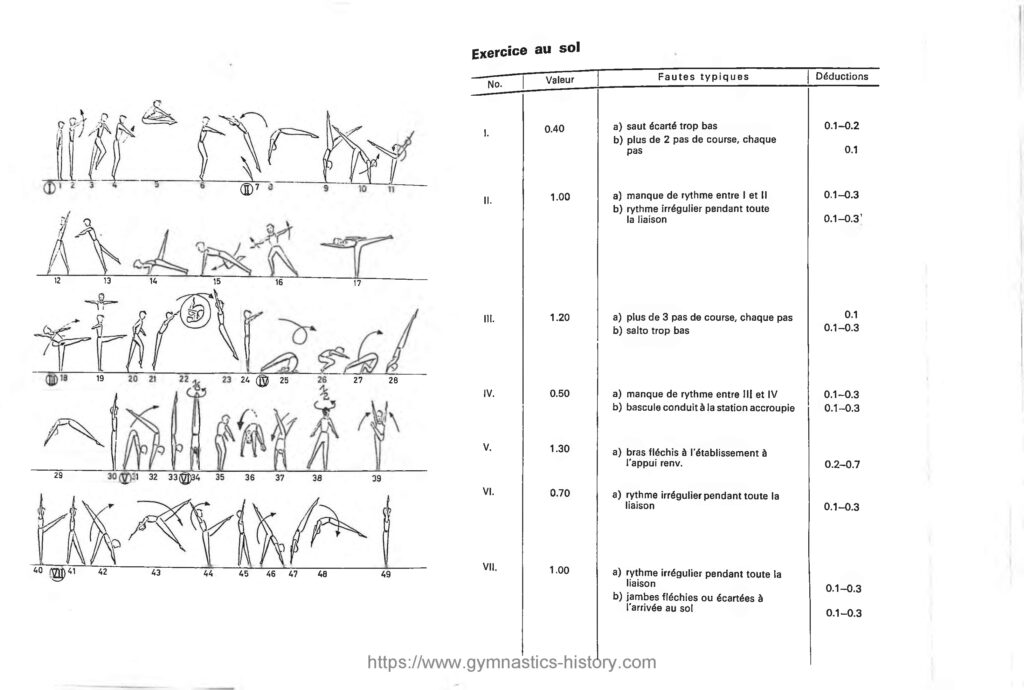
Well, I have good news for you: I have the official text, stick figures, and deductions for the men’s compulsories at the 1966 World Championships in Dortmund.
And there’s an added bonus: You can find an excerpt from the technical regulations in the PDF below. (They are in French and German.)
An interesting tidbit: Both the men’s and women’s compulsories had similar vaults with sideways landings. That had to feel great on the knees. (You can find the women’s compulsories here.)
I think it’s important to document the floor music used at major gymnastics competitions. It tells us a lot about the general cultural zeitgeist in the world, as well as what gymnasts and their coaches think the judges will or will not like.
What does it feel like to be in the lead after the first day of competition? And what does it feel like to hang onto that lead to win the all-around title?
In his book, Number One (1976), Mikhail Voronin recounts what he was thinking and feeling during the World Championships in Dortmund, where he won the all-around title.
In addition to insights into his inner state, Voronin’s autobiography provides a few details that were not reported widely at the time. For example, the Soviet team had a new coach on the floor during the optional competition in Dortmund because the other coach was too nervous during the compulsory competition. And there are gossipy tidbits like this one: Sergei Diomidov had a fight with his coach before the 1966 World Championships, which made him want to quit the sport.
Below is a translation of the first chapter of Voronin’s book.
Note: The first chapter of Voronin’s book was translated into Estonian for the newspaper Spordileht (published January 4 and 6, 1978), and I have translated the chapter from Estonian into English.
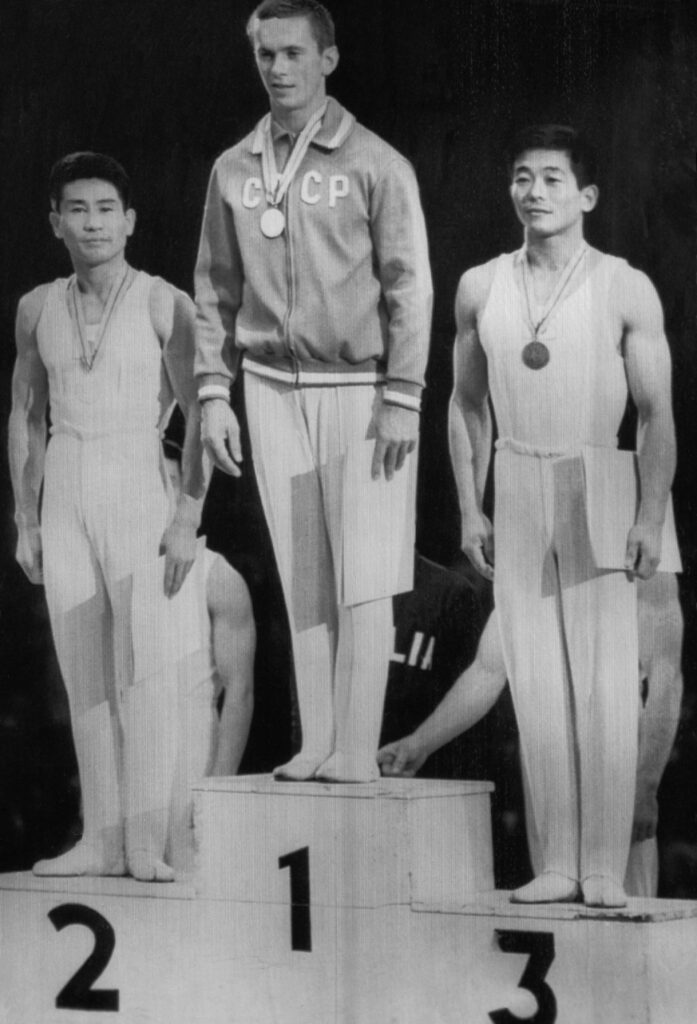
Datum: 20.09.1966 Copyright: imago/ITAR-TASS Dortmund. The world competitions in gymnastics. Mikhail Voronin (first place, UDSSR, C), Tsurumi (second place, Japan) and Nakayama (third place, Japan).
At the 1966 World Championships, the Czechoslovak women’s team finally defeated the Soviet team, and Čáslavská won the all-around title, defeating Kuchinskaya, who reportedly stated before the competition, “I will share the medals with Čáslavská!”
Stadión, a Czechoslovak sports magazine, dedicated several pages to the competition. The article’s tone was blunt in places. It criticized the complacency of the Czechoslovak men’s team, as well as the judges during the women’s event finals and Villancher’s interventions in the judging.
Note: Berthe Villancher, the President of the Women’s Technical Committee, was known for her interventions. For example, she intervened during Čáslavská’s beam routine at the 1968 Olympics and during Tourischeva’s beam routine at the 1969 European Championships.
It also provided interesting tidbits of information. For example, there were spies at the competitions in Czechoslovakia before the World Championships; the Czechoslovak pianist may have been the key to victory; and the Czechoslovak gymnasts’ shoes were believed to have magical powers.
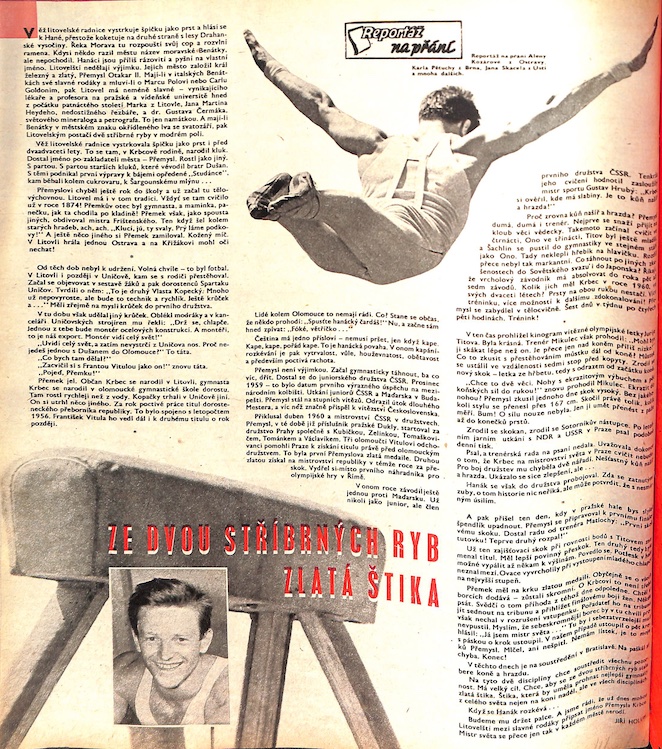
At the 1962 World Championships, Přemysl Krbec of Czechoslovakia won the gold medal on vault. This was the last time that a Czechoslovak gymnast was a world champion in men’s artistic gymnastics. Since there hasn’t been much written about Krbec, I translated a profile that was published after the 1962 World Championships in Prague.
Like many gymnasts, gymnastics was not his first love. Even though both his parents were gymnasts, he loved soccer.
Heads-up: Holub, the author of this profile, tended to be a bit fanciful in his profiles of gymnasts.
In 1962, Prague hosted the World Championships, and, all in all, it was a successful competition for Czechoslovak gymnasts. On the women’s side, the team finished second, and Čáslavská defeated all the Soviet gymnasts except for Latynina in the all-around. She also was the gold medalist on vault and the bronze medalist on floor, while Bosáková was the gold medalist on beam and the silver medalist on bars. On the men’s side, the team took home bronze, and Krbec won gold on vault.
Here’s what the Czechoslovak weekly sports newspaper Stadión reported. As we’ll see, there were 10s being thrown out by individual judges. (No gymnast received enough 10s to receive a final score of 10.) At the same time, the newspaper noted that there were some “thoughtful mistakes” by the judges, but it did not dive into what those mistakes were.
Even if you don’t read the text below, enjoy the photos. Stadión was a highly visual periodical.
Even though Čáslavská won the all-around and vault titles, and even though the Czechoslovak team defeated the Soviet team, the 1966 World Championships were still a low point for her — one that she hardly remembers. When she returned home from the competition, she received many letters, some of which were hate mail.
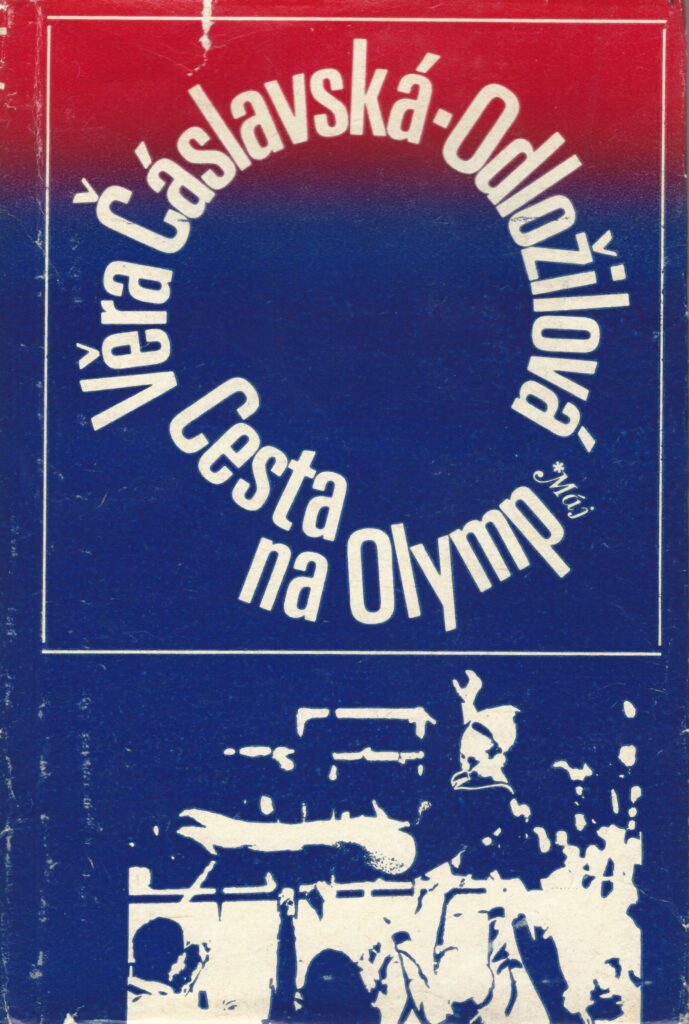
What follows is a translation of The Road to Olympus (Cesta na Olymp), Čáslavská’s 1972 autobiography. Here’s how she remembers Dortmund…
Note: You can read the main article on the 1966 World Championships here.
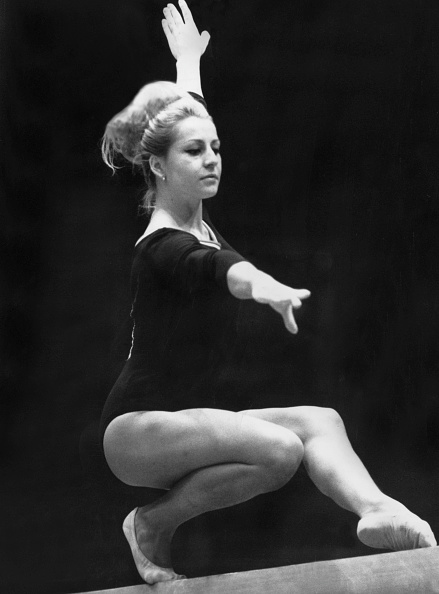
(GERMANY OUT) Die tschechische Kunstturnerin Vera Caslavska auf dem Schwebebalken, aufgenommen bei den Kunstturn-Weltmeisterschaften in Dortmund am 24.09.66. . (Photo by Schirner/ullstein bild via Getty Images)
In 1972, Věra Čáslavská published her autobiography, The Road to Olympus (Cesta na Olymp). It provides a detailed recounting of her early days through the 1968 Olympics in Mexico City.
As a child, Čáslavská was a mischievous and funny child. Though a performer at heart, she struggled with stage fright until her mother helped her work through it, and as an adult, she came to see it as an asset.
Čáslavská started with ballet, then added ice skating, and finally found gymnastics. Initially, she trained under Czechoslovak gymnastics legend Eva Bosáková, and when Bosáková was away with the national team, Čáslavská used to sneak into the gym to train. Given her relationship with Bosáková, Čáslavská found it difficult to beat her mentor.
From the start, the international crowd loved Čáslavská. At the age of 16, during her first World Championships in 1958, Čáslavská wowed the audience in Moscow — so much so that the public demanded a performance by Čáslavská, even though she didn’t make the floor finals.
Below, I’ve translated sections of Čáslavská’s autobiography, tracing her early years in sports through to her first World Championships in Moscow in 1958.